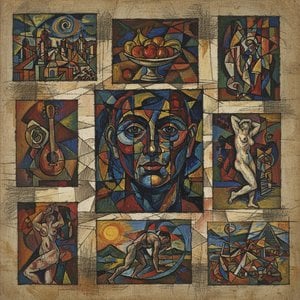
Albert Müller (1863-1943): A Visionary of Swiss Expressionism
Albert Müller, born in 1863 in Switzerland, was a prolific artist who carved out a distinctive niche within the burgeoning Expressionist movement. Though overshadowed by contemporaries like Edvard Munch and Ernst Ludwig Kirchner, Müller’s landscapes and portraits—particularly those depicting women—retain an undeniable power and emotional resonance that continues to captivate art historians today. His artistic journey began with meticulous observation of the natural world, honed through years spent studying the Tessin region – a landscape he would repeatedly revisit in his prints and paintings. This dedication to capturing authentic emotion rather than idealized beauty cemented his place as one of Switzerland’s foremost artists of his time.- Early Life & Artistic Training: Müller received formal artistic training at the Kunstgewerbeschule Zürich, where he mastered techniques in etching and woodcut printing. These skills would prove instrumental in shaping his distinctive visual language.
- Influences: Like many artists of his era, Müller was deeply affected by Impressionism and Symbolism. However, it was the burgeoning Expressionist movement—fueled by anxieties surrounding societal change and psychological introspection—that truly ignited his creative spirit.
A Landscape Painter’s Soul: Tessin Revisited
Müller's artistic output is overwhelmingly dominated by landscapes of the Tessin region, a mountainous area in Switzerland known for its dramatic vistas. He approached these scenes with an uncompromising commitment to conveying mood and atmosphere—rather than merely reproducing visual details. His prints and paintings are characterized by bold lines, textured surfaces, and a masterful use of tonal gradation, creating images that pulsate with energy and emotion. Consider ‘Grosse tessinerlandschaft’ – a woodcut print showcasing the rugged grandeur of the Alps; it exemplifies Müller's ability to distill complex feelings into simple visual forms. The artist’s meticulous attention to detail—particularly in capturing the interplay of light and shadow—elevates his landscapes beyond mere depictions of scenery, transforming them into expressions of inner experience.- Notable Tessin Paintings:
- - “Alpenpanorama” – Demonstrates Müller’s skill in conveying vastness and sublime beauty.
- - “Tessiner Hügel” - Captures the quiet contemplation of rural life.
Portraiture & Female Figures: Exploring Inner Landscapes
Beyond his landscapes, Müller produced a significant body of portraiture work, focusing particularly on depictions of women. Unlike many artists of his time who idealized their subjects, Müller sought to portray female figures with unflinching honesty—revealing vulnerability and psychological depth. His etching ‘Drei badende’ exemplifies this approach; the three nude figures are rendered with subtle shading and expressive lines, conveying a palpable sense of intimacy and emotion. Similarly, ‘Anna und Susanna’ – a woodcut print depicting two women engaged in reading—captures a moment of quiet contemplation and intellectual curiosity. Müller's portraits aren’t merely representations of physical appearance; they are explorations of inner landscapes—revealing the complexities of human emotion and experience.- Recurring Themes:
- - Domestic scenes depicting women.
- - Portraits conveying psychological nuance.
Technique & Legacy
Müller’s artistic technique—primarily etching and woodcut printing—was rigorously honed over decades of practice. He embraced the expressive potential of these mediums, utilizing bold lines, textured surfaces, and tonal gradation to convey emotion and atmosphere with remarkable precision. His prints are considered masterpieces of Expressionist art, demonstrating a profound understanding of visual language and psychological insight. Although Müller’s work received relatively little critical acclaim during his lifetime, it has gained considerable recognition in recent years—particularly for its evocative depictions of the human condition and its unwavering commitment to capturing authentic emotion. He remains an important figure in Swiss art history, representing a pivotal moment in the development of Expressionism.Q&A
Albert Müller은(는) 어느 시대의 작품을 남겼나요?
Albert Müller은(는) 19th Century 시대에 활동했습니다. 이 시기는 역사적 맥락 속에서 작가의 예술적 위치를 보여줍니다.
Albert Müller의 작품을 연도순으로 어디에서 볼 수 있나요?
Albert Müller의 작품 연표를 확인해 보세요: 작품 연대기 페이지에서 작품들을 제작 날짜순으로 보실 수 있습니다.
Albert Müller의 모든 작품을 어디에서 볼 수 있나요?
이 사이트에 등록된 Albert Müller의 모든 작품은 작가의 전체 작품 보기 페이지에서 만나보실 수 있습니다.
특정 매체로 분류된 Albert Müller의 모든 작품을 어떻게 찾을 수 있나요?
특정 매체로 제작된 Albert Müller의 모든 작품을 확인하시려면, 작가의 모든 매체별 페이지를 이용해 주세요.