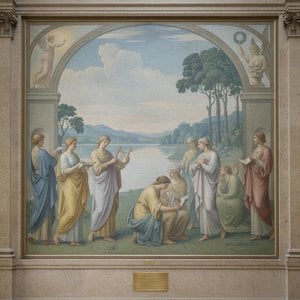
The Life of Adolphe Brune
Born in the first arrondissement of Paris, Adolphe Brune entered a world of shifting artistic currents. His early years in the city shaped a career defined by a steady hand and a commitment to the formal demands of his era. He sought guidance under the tutelage of Antoine-Jean Gros, a connection that likely helped ground his technical development. By the time he made his debut at the Salon in 1833 with his work Adoration of the Magi, he had already begun to establish himself as a painter capable of handling complex, large-scale compositions.
His professional life was marked by a series of significant public commissions that took him into the heart of French institutional life. He was not merely a painter of private canvases but a decorator of the spaces that defined the state. His brush touched the ceilings and walls of important landmarks, leaving a physical mark on the architecture of Paris.
Public Commissions and Artistic Focus
Brune’s work spanned a variety of genres, from the quietude of still life to the drama of religious subjects and the dignity of portraiture. His ability to adapt to different scales allowed him to move between intimate studies and grand mural works. His career included several notable engagements:
- The decoration of the Salle des Séances of the Senate in the Luxembourg.
- The painting of the ceiling in the Bibliothèque of the Louvre.
- The creation of three tables for the hall of the palace of the Senate.
- The depiction of various historical figures, including portraits of Louis XII and Charles IX.
In his portraiture, he sought to capture the likeness and presence of notable individuals such as Ney and Claude Annebaut. These works required a precise understanding of character and a disciplined approach to form. He also turned his attention to the religious, contributing to the chapel of St. Catherine in the Saint-Roch church in Paris.
Later Years and Legacy
As his career progressed, Brune remained a fixture in the Parisian art scene, moving from the first arrondissement where he was born to the ninth arrondissement later in life. His work, such as Joseph the Negro, reflects the diverse subjects that occupied his mind, including the human figures that moved through the studios of Paris during his time. He died in 1880, leaving behind a body of work that remains tied to the history of French public and religious art.
Q&A
Adolphe Brune 작가의 다른 활동명이나 알려진 이름이 있나요?
Adolphe Brune은(는) أدولف برون(으)로도 알려져 있습니다.
Adolphe Brune의 작품들은 어떤 분위기를 담고 있나요?
Adolphe Brune의 작품은 각 작품이 지닌 분위기에 따라 분류된 무드 룸 페이지에서 무드별로 감상하실 수 있습니다.
Adolphe Brune은(는) 어느 시대의 작품을 남겼나요?
Adolphe Brune은(는) 19th Century 시대에 활동했습니다. 이 시기는 역사적 맥락 속에서 작가의 예술적 위치를 보여줍니다.
Adolphe Brune 작가의 작품을 연도별로 어떻게 확인할 수 있나요?
Adolphe Brune의 작품은 작품 연대기 페이지에서 연도순으로 확인하실 수 있습니다.