Historical Overview
Adolf Hitler was an Austrian-born German politician who served as the dictator of Germany during the Nazi era from 1933 until his death in 1945. He rose to power as the leader of the Nazi Party, becoming the chancellor of Germany in 1933 and later taking the title of Führer und Reichskanzler in 1934. His leadership was central to the outbreak of the Second World War following the invasion of Poland in 1939.
During his time in power, he was involved in the direction of German military operations and the genocide of approximately six million Jews in the Holocaust, as well as the murder of millions of other victims. He implemented numerous racist policies and sought to deport or kill German Jews. His expansionist foreign policy, aimed at acquiring Lebensraum, is considered a primary cause of World War II in Europe.
Early Life and Political Rise
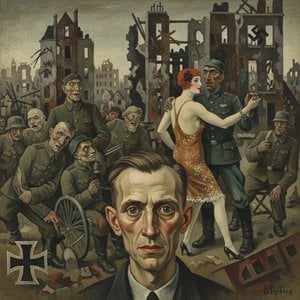
Born in Braunau am Inn, Austria-Hungary, Hitler moved to Germany in 1913. During the First World War, he served in the German Army, where he was decorated with the Iron Cross. In 1919, he joined the German Workers' Party, which later became the Nazi Party, and became its leader in 1921. Following a failed coup in Munich in 1923, he was imprisoned, during which time he dictated his autobiography, Mein Kampf.
After his release, he gained support through propaganda and oratory. In 1933, he was appointed chancellor. Through the Enabling Act, he transformed Germany into a totalitarian dictatorship. He oversaw significant infrastructure projects, such as the construction of autobahns, and led the country through the Second World War until his suicide in 1945.
Q&A
Adolf Hitler은(는) 어느 시대의 작품을 남겼나요?
Adolf Hitler은(는) Modern 시대에 활동했습니다. 이 시기는 역사적 맥락 속에서 작가의 예술적 위치를 보여줍니다.
Adolf Hitler의 연도별 활동 기록이 있나요?
Adolf Hitler의 작품 세계를 시간순으로 정리한 기록은 아티스트 연대기 페이지에서 확인하실 수 있으며, 이곳에서는 각 시기별로 분류된 챕터를 따라 작품들을 제작 순서대로 만나보실 수 있습니다.
Adolf Hitler 작가의 작품 관련 통계 정보는 어디에서 확인할 수 있나요?
Adolf Hitler의 방문 통계 페이지에서는 이 사이트에 등록된 작가의 작품들을 바탕으로 산출된 통계 정보를 제공합니다.