


 실제 크기로 보기
 보내기
보내기 공유하기
공유하기
 상세 보기
상세 보기 가이드 보기

 이미지 다운로드
 유사 작품 더 보기
 X-레이
X-레이 슬라이드 쇼 보기
 통계 정보
통계 정보Arrangement
 Lithograph
- WallArt
- Socialist Realism
 1922
1922 20.0 x 20.0 cm
 상세 보기
상세 보기
핸드메이드 유화 복제화
작가가 직접 캔버스에 손으로 그린 유화 작품으로, 원하는 크기와 액자로 맞춤 제작해 드립니다. ( 프린트 판매로 전환 디지털 이미지 판매 채널로 전환)




P118B $10

P118H $10

P118W $10

P438Z $10

P508JH $12

P508YH $12

P805H $10

P805Z $10

P919BZ $10

P919G $10

P919XJ $10

P959ZH $10

P968JZ $12

W106C $8

W218G $10

W218JH $8

W218Y $10

W307PJ $10

W316G $10

W316PJ $8

W316Y $10

W398PJ $8

W4111J $10

W500HY $15

W500JH $15

W692G $12

W849H $8

W940BG $15

W953PJ $8




작품의 원본 비율을 그대로 유지하는 프리셋 사이즈 중에서 선택해 보세요.

특정 프레임이나 공간에 맞춰 원하는 크기를 직접 입력하실 수 있습니다. 선택하신 크기가 원본 이미지의 비율과 일치하지 않을 경우, 작품을 자르거나 추가적인 수작업 요소를 더해 그림을 확장하여 제작합니다. 제작 시작 전, 최종 확인을 위해 디지털 목업을 보내드립니다.
화면상의 미리 보기는 실제 크롭(자르기)이나 확장된 상태를 완벽히 반영하지 않을 수 있습니다. 최종 구도는 오직 목업을 통해서만 정확하게 확인하실 수 있습니다.
맞춤 크기 제작도 가능하지만, 원본의 비율을 그대로 유지하기 위해서는 미리 정의된 목록에서 크기를 선택하시는 것을 권장합니다.
주문 완료 후 ArtsDot.com 팀에서 상세 안내를 위해 고객님께 이메일을 보내드리며, 미리보기 시안을 함께 제공해 드립니다.


 유리 옵션은 110cm 미만 크기에서만 선택 가능합니다.

Arrangement
재현 매체
복제본 규격
-


총 결제 금액
$ 313
Aleksandr Deyneka's "Arrangement": A Snapshot of Soviet Modernity
Aleksandr Deyneka’s “Arrangement,” painted in 1922, isn't merely a depiction of figures within an interior space; it is a carefully constructed tableau reflecting the burgeoning spirit of post-revolutionary Russia. The lithograph pulsates with a dynamic energy, capturing a moment of seemingly casual interaction that belies a deeper commentary on social shifts and artistic experimentation. It’s a work steeped in the Constructivist movement's ideals – a celebration of industrial progress, urban life, and the new Soviet citizen. The monochromatic palette, dominated by shades of black, white, and grey, immediately draws the eye, forcing a focus on form and composition rather than coloristic nuance. This deliberate choice underscores the stark realities of the era, while simultaneously lending an air of dramatic intensity to the scene. The absence of color doesn't diminish the vibrancy; instead, it amplifies the textures created through bold lines, hatching, and cross-hatching – techniques that lend a raw, almost graphic quality to the image.Constructivism and Urban Life: A Visual Manifesto
The artwork’s style is firmly rooted in Constructivism, an avant-garde movement that sought to synthesize art with industrial production and social reform. Deyneka, like many of his contemporaries, aimed to create a visual language that reflected the new Soviet reality – one characterized by rapid modernization, technological advancement, and a collective spirit. The scene itself—a crowded interior space populated by figures engaged in various activities—is quintessential urban. A skateboard lies casually on the floor, an unexpected element hinting at youthful energy and perhaps even a touch of Western influence amidst the socialist fervor. The composition is deliberately asymmetrical, eschewing traditional notions of balance in favor of a more dynamic and unsettling arrangement. The diagonal lines created by limbs and objects contribute to this sense of movement, pulling the viewer’s eye across the canvas and creating a feeling of restless energy. This deliberate disruption of visual harmony mirrors the societal upheaval that defined the post-revolutionary period.Symbolism and Social Commentary
While seemingly straightforward in its depiction, "Arrangement" is rich with symbolic undertones. The reclining woman and standing man are central figures, their poses suggesting a complex interplay of power dynamics and social relationships. The other figures populating the background add to the sense of crowded urban life, hinting at the anonymity and interconnectedness of modern society. The skateboard itself can be interpreted as a symbol of youth culture and leisure, but also perhaps as a subtle critique of Western consumerism creeping into Soviet society. Deyneka’s use of stark contrasts between light and shadow further enhances the symbolic weight of the image. The deep shadows that engulf portions of the scene create an atmosphere of mystery and intrigue, suggesting hidden tensions beneath the surface of apparent social harmony. The rough, almost crude lines used to depict the figures contribute to a sense of immediacy and authenticity, as if we are witnessing a candid snapshot of everyday life rather than a carefully staged portrait.Technical Mastery: Lithography's Expressive Power
Deyneka’s choice of lithography as his medium is crucial to understanding the artwork’s impact. Lithography, a printmaking technique that involves drawing on a stone or metal plate with greasy materials and then using chemicals to fix the image before printing, allowed for a remarkable level of detail and tonal variation. The artist skillfully exploited the capabilities of this process, creating a range of textures and shades through meticulous hatching and cross-hatching. The resulting print possesses a unique tactile quality – one that invites close inspection and rewards careful observation. It’s not merely a reproduction; it's an original work of art in its own right, showcasing Deyneka’s technical prowess and his ability to harness the expressive potential of lithography to convey complex emotions and ideas. The slightly imperfect lines and textures further contribute to the artwork’s raw energy and authenticity, reinforcing its status as a powerful document of a pivotal moment in Russian history.


작가 소개
Aleksandr Deyneka (1899-1969): A Life Forged in Revolution – The Artistic Journey of Aleksandr Deyneka
Aleksandr Aleksandrovich Deyneka, born in 1899 in the provincial Russian city of Kursk, was an artist inextricably linked to the tumultuous currents of the twentieth century. His life and work mirrored the dramatic shifts of his nation – from the waning days of Tsarist Russia through the fervor of revolution, the industrialization of the Soviet era, and the shadow of war. Deyneka wasn’t merely a recorder of these events; he was an active participant, shaping and being shaped by the ideological forces that swept across his homeland. His early life offered little hint of the artistic prominence to come. He initially pursued studies at a railway college, simultaneously attending art workshops – a practical grounding that would later inform the dynamic energy and structural clarity present in his compositions. This period was cut short by the upheaval of 1917, propelling him towards Moscow and enrollment at Vkhutemas, the Higher State Artistic and Technical Workshops, a crucible of avant-garde thought and experimentation. It was here, under the tutelage of Vladimir Favorsky, that Deyneka honed his skills in graphic arts and printmaking, absorbing the principles of constructivism and developing a keen understanding of form and space.The Dawn of Modernism: Early Influences and Artistic Formation
Deyneka’s artistic journey began amidst the intellectual ferment of the Russian avant-garde. He absorbed the ideas of artists like Kazimir Malevich and Vladimir Tatlin, embracing the radical experimentation that characterized these movements—a rejection of traditional aesthetics in favor of geometric abstraction and monumental sculpture. This formative period instilled in him a conviction that art could serve as a vehicle for social transformation, shaping his subsequent artistic endeavors. His initial explorations focused on graphic design and printmaking, mastering techniques like etching and linocut – skills he would later utilize to produce striking visual statements reflecting the spirit of his time. The influence of Constructivism is palpable in his early works—a deliberate simplification of form and a prioritization of structural elements that foreshadowed his later stylistic developments. He sought to express ideas directly through visual means, rejecting decorative embellishments in favor of clarity and precision.The Embrace of Socialist Realism: Adapting to the Soviet Aesthetic
As Stalin consolidated power and Socialist Realism became the officially sanctioned style, Deyneka skillfully navigated the complexities of the Soviet artistic landscape. Initially aligned with groups like OST (Society of Easel Artists), he embraced modernist principles while simultaneously responding to the demands of the regime—a delicate balance that allowed him to continue creating impactful work without compromising his artistic integrity. This wasn’t simply acquiescence; rather, it was a strategic maneuver that recognized the importance of maintaining institutional support for his art. His paintings of the 1930s – particularly Collective Farmer on a Bicycle (1935) – exemplify this adaptation—celebrating labor, athleticism, and the promise of a new socialist society. The painting is not merely a depiction of rural life; it’s an embodiment of forward momentum, a visual manifesto of progress and optimism. He skillfully utilized color palettes and compositional techniques to convey emotion and reinforce ideological messages—a testament to his ability to communicate complex ideas through accessible imagery.Monumental Visions: Public Art Commissions and Artistic Expression
Deyneka’s ambition extended beyond easel paintings into monumental works and public art commissions—demonstrating his versatility and mastery of different artistic mediums. He created large-scale canvases depicting historical events – The Defense of Petrograd (1928) being a prime example – imbued with dramatic intensity and a sense of epic scale. These weren’t simply illustrations of battles; they were attempts to capture the spirit of revolutionary struggle, transforming historical moments into mythic narratives. His involvement with the *Windows of ROSTA* project—producing propaganda posters for the Soviet state—further solidified his reputation as an artist capable of engaging directly with social and political themes. He skillfully employed visual language to disseminate ideological messages while maintaining a distinctive artistic voice—a remarkable feat considering the constraints imposed by the regime.Legacy and Enduring Influence: A Pioneer of Constructivism and Beyond
Aleksandr Deyneka passed away in 1969, leaving behind a vast body of work that continues to resonate today. His paintings, mosaics, and graphic designs offer a compelling window into the Soviet experience – its aspirations, contradictions, and artistic achievements. He is categorized as a “1A - world famous artist” in the United Artists Rating—a testament to his enduring international recognition. Exhibitions dedicated to his work, such as those held at the Gallery for Russian Arts and Design in London, continue to introduce new audiences to his art. Deyneka’s influence can be seen in subsequent generations of artists who sought to engage with social and political themes through powerful visual imagery—a legacy that transcends stylistic boundaries and celebrates the transformative potential of artistic expression. His ability to blend modernist techniques with socially conscious subject matter makes him a uniquely important figure in the history of twentieth-century art, a golden boy whose work continues to provoke thought and inspire awe.
알렉산드르 데이네카
1899 - 1969 , 러시아
작가 정보 요약
- Artistic Movement Or Style: 사회주의 현실주의
- Date Of Birth: 5월 20일 1899년
- Date Of Death: 6월 12일 1969년
- Full Name: Aleksandr Aleksandrovich Deyneka
- Nationality: 러시아인
- Notable Artworks:
- 콜렉티브 농부와 자전거
- 페트로그라드 방어전
- 농구 경기장
- 세브라스토폴 전투
- Place Of Birth: 크루스크 러시아
관련 기사

Echoes of Society: Exploring Social Realism's Enduring Legacy in Art
Explore the powerful world of Social Realism art! Discover key artists, masterpieces & its profound social commentary. Expert insights into this influential movement's history and enduring legacy.

Romantic Realism's Finest: 10 Masterpieces for Your Home | ArtsDot
Explore 10 defining masterpieces of Romantic Realism! Discover Courbet, Millet & Daumier's powerful paintings—capturing emotion and social realities. Find museum-quality reproductions for your home at ArtsDot.com.

Dark Masterpieces: 10 Iconic Paintings Dominated by Black Tones |
Explore 10 iconic paintings dominated by black tones, from Rembrandt’s chiaroscuro to Goya's dark expressions. Discover the stories behind these masterpieces & find museum-quality art reproductions for your home at .
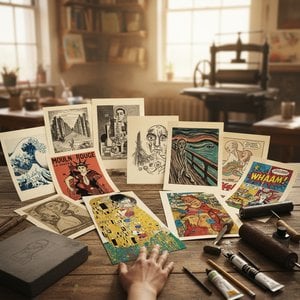
Top 10 Lithographs That Revolutionized Art | ArtsDot
Explore 10 legendary lithographs by Toulouse-Lautrec, Munch & Picasso that redefined art! Discover the stories behind these iconic prints and find museum-quality reproductions for your home decor at ArtsDot.com. Explore the full collection online.

Socialist Realism: Ideology, Aesthetics & Enduring Legacy of Soviet Art
Explore the fascinating world of Socialist Realism! Discover its historical context, key artists like Deyneka & Brodsky, defining aesthetics, and lasting impact on Soviet culture. A comprehensive guide for art lovers.
