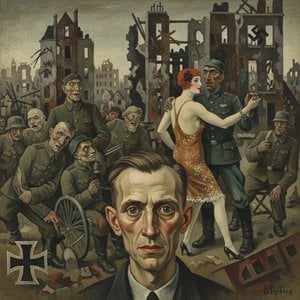
The Weight of Expressionism
To look at the work of Waldemar Flaig is to witness a life compressed into four decades. He was not a painter of idle scenery, but one who translated the psychological tension of the interwar period onto canvas and paper. His output, though truncated by an early death in 1932, carries the unmistakable grit of German Expressionism. This was an art form defined by angularity and emotional weight, and Flaig utilized these tools to process a reality shaped by the scars of the First World War.
His technical foundation was rigorous, built through training at the art academies in Karlsruhe and Munich. This academic discipline provided the structure for his more radical impulses. In works like his 1922 winter landscape, likely depicting Meersburg, one sees a rejection of romanticism. Instead of soft edges, he employed thick brushwork and a cold, blue-dominated color scale. The buildings are broken into volumes that feel almost cubic, suggesting a graphic sensibility that informed his work as a printmaker.
A Fragmented Legacy
The tragedy of Flaig’s career is twofold: the physical toll of war and the political erasure of his art. Having recovered from severe injuries sustained in the First World War, he brought an inherent tension to his subjects. This intensity is visible in his portraits and landscapes alike, where even a still scene can feel heavy with movement and internal conflict. His connection to figures like Otto Dix and Karl Hofer placed him within a specific, high-stakes artistic dialogue of the era.
However, much of what he achieved was nearly lost to history. The Nazi campaign against Entartete Kunst (Degenerate Art) resulted in the destruction of several of his works. What remains allows us to judge his contribution to southern German art. His ability to merge everyday observations—such as a schoolyard scene or a Black Forest landscape—with a deep, humanistic fervor makes him more than a mere chronicler of his surroundings. He was an artist who used the sharp lines of expressionism to map a fractured inner life.
- Movement: German Expressionism
- Training: Art academies in Karlsruhe and Munich
- Key Subjects: Black Forest landscapes, winter motifs, and portraits
アーティストへのQ&A
カタログ内で閲覧可能なWaldemar Flaigの作品数はいくつですか?
全作品一覧ページでは、Waldemar Flaigによる作品数 2点点のアートワークをご覧いただけます。
Waldemar Flaigの出身地はどこですか?
Waldemar Flaigの出身国はGermanyです。
Waldemar Flaigの作品を時系列で確認できるタイムラインはありますか?
Waldemar Flaigの作品は、アーティストの作品の年表ページにて、制作年代順にご覧いただけます。
Waldemar Flaigによるすべての作品を見るには、どうすればよいですか?
本サイトにおけるWaldemar Flaigのすべての作品は、アーティストの全作品一覧ページからご覧いただけます。