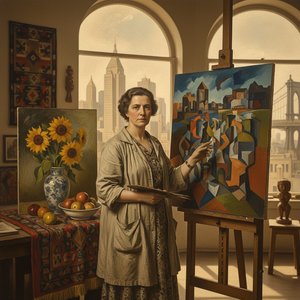
Marguerite Zorach: A Pioneer of American Modernism
Early Life and Education
- Born in Santa Rosa, California in 1887, Marguerite Zorach came from a family with roots in New England seafaring and Pennsylvania Quaker traditions.
- Her early education included music lessons and four years of Latin at Fresno High School, reflecting her parents’ commitment to a liberal arts upbringing.
- She was among the first women admitted to Stanford University in 1908 but left before graduating to pursue art studies in France.
Paris and Fauvist Influences
- In Paris, Zorach immediately encountered the groundbreaking works of Henri Matisse and André Derain at the Salon d'Automne, profoundly impacting her artistic direction.
- Despite being initially rejected from the École des Beaux-Arts, she studied at the Académie de la Palette under John Duncan Fergusson and Jacques-Emile Blanche, fostering her unique style.
- She actively participated in modernist exhibitions like the Société des Artistes Indépendants and the Salon d'Automne, connecting with prominent figures such as Pablo Picasso, Gertrude Stein, and Henri Rousseau.
- It was in Paris that she met her future husband and artistic collaborator, William Zorach.
Global Travels and Artistic Development
- A lengthy world tour with her aunt from 1911-1912 took her to Jerusalem, Egypt, India, Burma, China, Hong Kong, Japan, and Hawaii.
- These travels broadened her artistic horizons, leading to more abstract compositions and the use of bold colors with thick black outlines in her landscapes.
- Upon returning to California, she painted the Sierra Nevada mountains but faced disapproval from her parents, resulting in the destruction of much of her early work.
New York and Collaborative Work
- After marrying William Zorach in 1912, she moved to New York City, where they began a lifelong artistic partnership.
- Both participated in the influential 1913 Armory Show, marking a turning point for modern art in America.
- They experimented with various art forms, including poetry, alongside their painting and sculpture.
- Their Greenwich Village home became a vibrant salon for artists and intellectuals.
Major Achievements and Artistic Style
- Zorach won the 1920 Logan Medal of the Arts, recognizing her significant contributions to American art.
- Her artistic style is characterized by bold Fauvist colors, simplified forms, and a focus on capturing the essence of landscapes and figures.
- She worked across multiple mediums, including painting, textiles (bedspreads), and graphic design.
- Notable works include “Memories of my California Childhood” (1921) and “Nevada Falls, Yosemite Valley, California” (1920).
Historical Significance
- Marguerite Zorach was a key figure in the introduction of modernism to America.
- Her work challenged traditional artistic conventions and paved the way for future generations of American artists.
- As a female artist during a period of significant social change, she broke barriers and contributed to the growing recognition of women in the art world.
- She remains an important example of an early 20th-century artist who embraced experimentation and pushed the boundaries of artistic expression.
Q&A
Marguerite Zorach氏の作品のカラープロファイルはどこで確認できますか?
Marguerite Zorachのパレット・ゲノムは、そのアーティストの作品群におけるカラープロファイルを紹介するページです。
Marguerite Zorachの作品を、カラースペクトラム(色相)ごとに探すことはできますか?
Marguerite Zorachの作品は、アーティストの色彩インデックスページにて、色別に探すことができます。
Marguerite Zorachによるすべての作品はどこで閲覧できますか?
当サイトにおけるMarguerite Zorachのすべての作品は、アーティストのすべての作品一覧ページからご覧いただけます。
Marguerite Zorachのキャリアは、どのように時代ごとに分けられていますか?
Marguerite Zorachのキャリアは、クロニクルページにて、活動時期ごとに章立てされた作品群を横型のタイムライン形式で辿ることができます。
Marguerite Zorachの作品を技法別に閲覧することはできますか?
Marguerite Zorachの作品は、アーティストの全技法ページにて、技法別に閲覧いただけます。
特定のテーマに基づいたMarguerite Zorachの作品を探すには、どうすればよいですか?
Marguerite Zorachの作品は、アーティストのキーワード別ページからキーワード別に探すことができます。各キーワードには関連する作品がまとめられています。
カタログ内で閲覧可能なMarguerite Zorachの作品数はいくつですか?
すべての作品一覧ページでは、Marguerite Zorachによる作品数 123点点のアートワークをご覧いただけます。
Marguerite Zorachの作品を、ムード別に探すにはどこへ行けばよいですか?
Marguerite Zorachのムード別ルームは、アーティストの作品をムード別にまとめたページです。