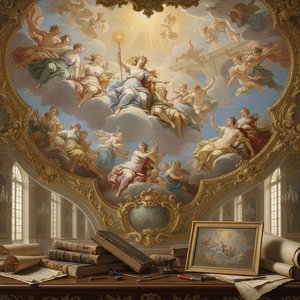
The Architect of Shadows and Scenery
Born in Prague in 1751, Josef Platzer moved through the artistic circles of Central Europe with a versatility that defined his career. He was a man of many disciplines, operating as a painter, scenographer, and draftsman. His early training began in Prague under the painter Franz Wolf, but his ambitions eventually drew him to Vienna. There, he refined his skills in architectural drawing and the specialized art of painting theater decorations, a craft that required both technical precision and a sense of dramatic scale.
His professional ascent was marked by significant institutional recognition. In 1789, he became a full member of the Academy of Fine Arts in Vienna, and by 1795, he had attained the prestigious title of imperial court chamber painter. This position placed him in the service of the era's most influential figures, including Prince Moritz von Liechtenstein, Prince Ferdinand von Kinsky, and Count Moritz von Fries. His work was not confined to the canvas; he was as much a builder of illusions as he was a recorder of reality.
A Vision of Ruin and Drama
Platzer’s aesthetic was deeply rooted in the Rococo movement, often finding beauty in the decaying and the dramatic. He possessed a particular talent for capturing the melancholy of ruins and the tension of nocturnal settings. His compositions frequently explored the interplay between light and shadow, whether in a quiet landscape or a claustrophobic dungeon. His ability to construct space made him a sought-after designer for the stage, where he translated historical and mythological narratives into visual spectacles.
His body of work includes several notable subjects:
- Landscape with Ruins
- The Murder of Semiramis
- Caesar Octavianus finds Cleopatra by the body of Antonius
- Julius Sabinus says goodbye to his family in the dungeon
- Decorations for the ballet Die Geschöpfe des Prometheus
The scale of his output was immense. He left behind 222 stage designs and drawings, many of which provided the visual foundation for the theatrical productions of his time. His scenography for Beethoven's ballet, Die Geschöpfe des Prometheus, remains a significant point in his professional history. While much of his work was designed to be ephemeral—existing only for the duration of a performance—some of his designs, such as those in the theater of Schloss Litomyšl, have survived to offer a glimpse into his creative process.
The Final Act in Vienna
The later years of his life were spent in Vienna, the city where he had established his reputation and secured his place within the imperial court. His technical skill as a draftsman allowed him to navigate the complex requirements of both architectural design and dramatic scenery. He died in Vienna in 1806, leaving behind a legacy of works that reside in significant collections, including the Hamburger Kunsthalle in Hamburg and the Cleveland Museum of Art.
アーティストへのQ&A
Josef Platzerの作品一覧はすべて確認できますか?
本サイトにおけるJosef Platzerのすべての作品は、アーティストの全作品一覧ページからご覧いただけます。
Josef Platzerの作品を色別に探すには、どこへ行けばよいですか?
カラーインデックスでは、Josef Platzerの作品を色別に分類してご紹介しています。
Josef Platzerの出身地はどこですか?
Josef Platzerの出身国はCzech Republicです。
Josef Platzerの作品をカラーパレットごとにまとめて見られる場所はどこですか?
Josef Platzerの作品は、アーティストページのカラーパレットから探すからカラーパレット別に閲覧いただけます。