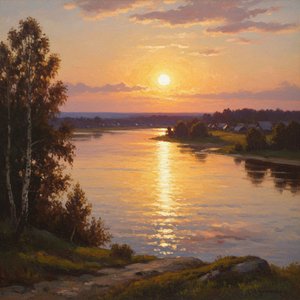
A Life Shaped by Change
Isaak Izrailevich Brodsky entered the world in late 1883 in the village of Sofiyivka, located near Berdiansk in what is now Ukraine. His early years were rooted in a family of tradesmen, with his father working as a merchant and landowner. This upbringing provided him with a foundation that eventually led him toward the study of fine arts. He began his formal training at the Odessa Art School, where he learned under the guidance of instructors such as G. A. Ladyzhensky, K. K. Kostandi, and L. D. Iorini. These early years in Odessa were followed by a significant move to St. Petersburg in 1902.
In the imperial capital, Brodsky entered the Higher Art Institute of painting, sculpture, and architecture under the Imperial Academy of Arts. His time there was marked by intense study and competition. He spent five years working in the studio of Ilya Repin, a mentor who left a lasting impression on his approach to the canvas. Between 1909 and 1911, Brodsky traveled through Germany, France, Spain, and Italy, using academy funding to expand his view of the European landscape. During these travels, he spent time on the island of Capri, an experience that brought him into contact with other figures of the era.
The Development of a Style
Brodsky’s work underwent various shifts as the political and social landscape of Russia transformed. His early pieces often reflected the influences of the Silver Age and Art Nouveau. As he moved through the years following the 1917 revolution, his focus shifted toward the realities of the new Soviet era. He became a central figure in the formation of Socialist Realism, a style that demanded a clear and recognizable depiction of life. His paintings often captured the gravity of historical moments, such as the events of the Russian Civil War.
His technical skill was applied to a wide range of subjects, from landscapes to portraits of political leaders. Some of his notable works include:
- Fallen Leaves (1915), an oil on canvas piece that captures the atmosphere of autumn.
- The Execution of 26 Baku Commisaries, a painting noted for its stark realism and emotional weight.
- Portraits of prominent figures such as Vladimir Lenin and Joseph Stalin.
- Early Spring (1906), which shows an earlier, more impressionistic side of his landscape work.
By the 1930s, Brodsky was working frequently under government orders. His ability to document the era through precise portraiture and historical scenes made him a significant figure in the Soviet art establishment. In 1932, he earned the title of professor, and by 1934, he was appointed Director of the All-Russian Academy of Arts.
Legacy and Memory
Brodsky’s life ended in Leningrad in 1939. He left behind a substantial body of work and a collection of paintings that included pieces by masters like Repin, Surikov, and Levitan. His commitment to the arts was evident in his many contributions to museums; he donated hundreds of works to the Berdyansk Art Museum and helped establish various artistic societies.
Today, much of his personal history is preserved in the Brodsky House Museum in Saint Petersburg. This space maintains his former apartment, allowing visitors to see the environment where he lived and worked. His paintings remain part of major collections, including the State Tretyakov Gallery and the State Russian Museum, serving as historical records of a period defined by profound upheaval.
アーティストへのQ&A
Isaak Brodskyが最も頻繁に使用した色は何ですか?
Isaak Brodskyのパレット・ゲノムでは、そのアーティストの作品群を構成するカラープロファイルをご覧いただけます。
Isaak Brodskyの作品はどのくらい人気がありますか?
Isaak Brodskyの閲覧統計ページでは、本サイトに掲載されているアーティストの作品から算出された統計データをご覧いただけます。
カタログ内で閲覧可能なIsaak Brodskyの作品数はいくつですか?
全作品一覧ページでは、Isaak Brodskyによる作品数 23点点のアートワークをご覧いただけます。