Early Life, Family and Training
Georg Seligmann enters the world in Copenhagen on 22 April 1866. He is born into a family headed by Rudolf Seligmann, a grocer, and Sophie Seligmann, née Weil. His early years are shaped by this domestic stability before his interests shift toward the intellectual and the visual.
In 1883, he turns toward philosophy, studying the subject for a time. This academic pursuit, however, does not define his path. The pull of the visual arts takes hold. He begins formal training under the portrait painter Frans Schwartz. This mentorship provides the technical foundation for a career that will eventually span landscapes and urban views.
His education continues through a painting school directed by Peder Severin Krøyer and Laurits Tuxen. Under their guidance, Georg Seligmann refines his ability to observe the world. He moves from the abstract inquiries of philosophy toward the concrete discipline of the brush, preparing for his debut in the Danish art scene.
Artistic Career and Travels
The professional trajectory of Georg Seligmann begins in earnest at the age of 21. He makes his debut at the Charlottenborg Spring Exhibition, presenting two landscapes to the public. This early success precedes a significant international recognition in 1889, when he is awarded a bronze medal at the Exposition Universelle in Paris.
Movement defines his middle years. In 1892, he travels through Holland, Belgium, Italy, Germany, and Paris. This period of transit coincides with a shift in his exhibition history, as he begins showing his work at Den Frie Usstilling, also known as The Free Exhibition. His connection to Italy remains a recurring theme, marked by another significant trip to the country in 1899.
Beyond the canvas, Seligmann moves through different sensory realms. He is an accomplished cellist and an operatic baritone, possessing a musicality that exists alongside his visual practice. His life is characterized by this dual engagement with both sound and sight.
Technique, Style and Subject Matter
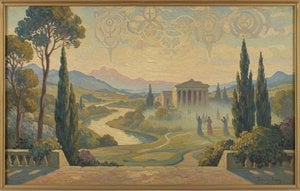
Seligmann moves between the structured precision of architecture and the fluid spontaneity of genre scenes. His brushwork carries an intangible sense of feeling, an emotional weight that connects the viewer to the subject. This sensitivity is particularly evident in his figurative works, where he seeks to capture the underlying spirit of a model rather than a mere likeness. He does not simply record a scene; he injects it with a specific mood, reflecting the temperament of the artist during the creative process.
His travels through Holland, Belgium, Italy, Germany, and Paris allow him to absorb the techniques of the old masters. He studies the works of Frans Hals, a pursuit that informs his approach to portraiture and light. This study translates into a strong reputation among the bourgeois clientele, who seek his ability to render both status and soul. His repertoire is diverse, spanning urban views, landscapes, and portraits, yet a consistent thread of human presence remains central to his output.
Where to See the Works Today
The physical legacy of Georg Seligmann remains anchored in the major public institutions of Denmark. His paintings occupy permanent spaces within the Statens Museum for Kunst, where his presence is established alongside the nation's primary art collections. The Hirschsprung Collection, known as Den Hirschsprungske Samling, also holds his works, preserving his contribution to the Danish artistic landscape. These collections ensure his visual output remains accessible to those studying the development of genre and landscape painting in the late nineteenth and early twentieth centuries.
Beyond these central repositories, his imagery is held in specialized collections that reflect the breadth of his subject matter. The Thorvaldsens Museum and the Danish Jewish Museum both maintain works by the artist. His reach extends to the Museum Sønderjylland, where his pieces are part of the regional record. These various holdings provide a fragmented but comprehensive view of a career that moved from the urban views of Copenhagen to the broader landscapes of Europe.
アーティストへのQ&A
Georg Seligmannの作品を技法別にまとめて閲覧できる場所はどこですか?
Georg Seligmannの作品は、技法別一覧にて技法別に閲覧いただけます。
Georg Seligmannの出身地はどこですか?
Georg Seligmannの出身国はDenmarkです。
Georg Seligmannの作品一覧はすべて確認できますか?
本サイトにおけるGeorg Seligmannのすべての作品は、アーティストの全作品一覧ページからご覧いただけます。
Georg Seligmannの全作品を通じた色彩の使い方を詳しく知ることはできますか?
本サイトに掲載されている作品群におけるGeorg Seligmannの色彩表現は、アーティストのパレット・ゲノムページで詳しくご覧いただけます。