Early Life, Family and Training
Frederick Hagan was born on May 21, 1918, in the Cabbagetown neighborhood of Toronto, Canada. His early years were defined by a sudden shift from domestic stability to economic necessity. When he was 13, the death of his father left his mother to support eight children alone. This hardship forced Hagan into the workforce early, as he took a job in a paper-box factory to contribute to the family income. Even then, his creative impulse remained active; he began sketching his surroundings from a makeshift studio he constructed in the family garage.
His formal education was a matter of persistence rather than ease. Hagan attended night school at Central Technical School while balancing his responsibilities. This period of study led him to the Ontario College of Art, where he trained between 1936 and 1941. During these years, he studied under John Martin Alfsen, Franklin Carmichael, and Fred Haines. This rigorous training provided the technical foundation that would support his later career as a lithographer and painter.
Artistic Training and Early Career
Hagan’s early professional recognition arrived with significant momentum. In 1939, four of his drawings were selected for exhibition at the New York World's Fair, a concrete validation of his technical skill during a formative period. That same year, he began exhibiting his work at the Royal Canadian Academy. These early successes established a trajectory that moved quickly from local sketches to institutional visibility.
His technical development was defined by a rigorous pursuit of printmaking and formal composition. In 1946, he traveled to New York to study at the Art Students League under Martin Lewis. He further refined his command of the medium at George C. Miller's Lithography Workshop. This period of study provided the technical foundation for a career that would eventually balance fine art production with significant pedagogical influence.
Before his long tenure in academia, Hagan held several practical positions that integrated his practice with the community. He served as the resident artist at Pickering College in Newmarket in 1941. Between 1945 and 1946, he expanded his instructional reach by teaching evening classes at the Northern Vocational School in Toronto. These roles demonstrate a professional life built on both active creation and the dissemination of technical knowledge.
Teaching and Professional Life
Hagan’s influence on Canadian art education was defined by a long-term commitment to the Ontario College of Art. After being hired in 1946 to teach drawing, painting, and printmaking, he moved into significant leadership roles. By 1955, he had become the head of printmaking at OCAD, a position he maintained until his retirement in 1983. His tenure ensured that technical precision in printmaking remained a central component of the institution's curriculum for nearly three decades.
His professional standing was validated by several institutional honors. In 1965, he was named an Honorary Member of the Canadian Society of Graphic Art. This recognition was followed by the Canadian Centennial Medal in 1967. Even late in his life, the industry continued to acknowledge his contributions, evidenced by the Royal Canadian Academy of Arts Medal awarded to him in 1998.
Beyond the classroom, his professional reach extended to national iconography. Between 1986 and 1989, he produced a series of 16 stamps for Canada Post titled "Exploration of Canada." This work brought his specific visual language into the daily lives of citizens across the country.
Technique and Artistic Style
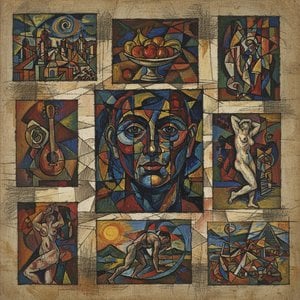
Hagan’s practice was defined by a refusal to follow the mid-century drift toward total abstraction. While his contemporaries moved toward the non-objective, he remained anchored in a figurative style that prioritized the human subject and the lived environment. His approach was not merely observational; it was a deliberate synthesis of conflicting formal languages. He integrated Cubist fragmentation, Mannerist tension, and Expressionist energy, all while maintaining a foundation in Classical principles of composition. This hybridity allowed him to move beyond simple representation into a more structured, psychological space.
His technical versatility was centered on his mastery of lithography and painting. As a lithographer, he utilized the chemical properties of limestone to create precise, layered imagery, a skill that extended to his ability to capture the social realities of Ontario. His figurative works from the 1940s functioned as a form of social commentary, documenting the textures of provincial life through a lens that was both intimate and structurally rigorous. He did not rely on self-promotion to sustain his career, focusing instead on the technical demands of his medium and the integrity of the image.
- Samuel (about 1944)
Later Years and Death
Hagan eventually settled in Newmarket, where he married Isabelle Heald. His presence in the region left a physical mark on the local landscape; Fred Hagen Court in Newmarket, Ontario, is named in his honor. This recognition, alongside a plaque located at 262 Ontario Street in Toronto, anchors his legacy to the specific urban and suburban environments that informed his figurative work. His life ended in Newmarket, Ontario, on September 6, 2003, at the age of 85.
The permanence of his contribution is found in the institutional collections that hold his prints and paintings. His papers remain preserved in the Art Gallery of Ontario E. P. Taylor Research Library and Archives, ensuring his technical processes and personal records are available for study. He was a figure of significant institutional weight, evidenced by the Royal Canadian Academy of Arts Medal he received in 1998. His career was defined by a commitment to the craft of printmaking and a refusal to abandon figurative subjects even as abstraction became the dominant trend in Canadian art.
アーティストへのQ&A
Frederick Haganの作品を年代順に辿るには、どうすればよいですか?
Frederick Haganの作品は、アーティストの作品の年表ページにて、制作年代順にご覧いただけます。
Frederick Haganの作品を色別に探すには、どこへ行けばよいですか?
Frederick Haganのカラーインデックスでは、作品を色別に探すことができます。
Frederick Hagan氏の作品のカラープロファイルはどこで確認できますか?
Frederick Haganのパレット・ゲノムでは、そのアーティストの作品群を構成するカラープロファイルをご覧いただけます。
Frederick Haganの作品一覧はすべて確認できますか?
本サイトにおけるFrederick Haganのすべての作品は、アーティストの全作品一覧ページからご覧いただけます。