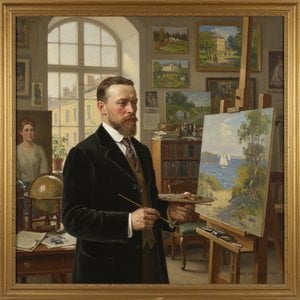
The Life and Academic Career of Ferdinand Pauwels
Ferdinand Pauwels was a Belgian history painter who lived and worked in Germany. His formal training began between 1842 and 1850 at the Royal Academy of Fine Arts in Antwerp, where he studied under Gustave Wappers and Nicaise De Keyser, developing his skills as an outstanding colorist. In 1852, he was awarded the Prix de Rome for Belgium for his painting Coriolanus at Rome, which allowed him to spend four years studying in Italy.
His career included significant academic roles, serving as the Professor of History Painting at the Weimar Saxon-Grand Ducal Art School from 1862 to 1872. During this productive period, he completed seven large wall panels at the Wartburg depicting the life of Martin Luther. Later, he became a professor at the Dresden Academy of Fine Arts, where he taught students such as Ludwig von Hofmann, Osmar Schindler, Paul Thumann, and Oskar Zwintscher.
Major Works and Historical Commissions
Pauwels is noted for several large-scale historical commissions. In addition to his work at the Wartburg, he executed six large historical wall panels at the Fürstenschule in Meissen. Between 1870 and 1881, he produced what was considered his greatest work: twelve frescoes in the upper part of the Ypres Cloth Hall. These frescoes, which depicted scenes from the history of Ypres from 1187 to 1383, were left incomplete by Charles de Groux. While most of the Cloth Hall and these frescoes were destroyed during World War I, the city of Ypres eventually acquired six of his paintings for its Municipal Art Museum.
アーティストへのQ&A
Ferdinand Pauwelsが最も頻繁に使用した色は何ですか?
Ferdinand Pauwelsの作品のカラープロファイルは、アーティストのパレット・ゲノムページでご確認いただけます。
Ferdinand Pauwelsの作品を主題別に探すことはできますか?
Ferdinand Pauwelsの主題別アーカイブでは、作品を主題ごとに分類してご覧いただけます。
Ferdinand Pauwelsの出身地はどこですか?
Ferdinand Pauwelsの出身国はBelgiumです。