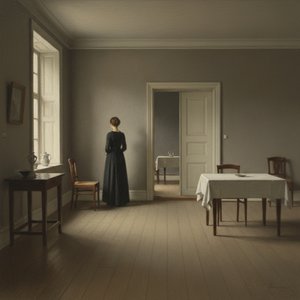
The Life of a Narva Painter
Born in the town of Narva, Eduard Verber lived a life shaped by the shifting tides of the late nineteenth and early twentieth centuries. His path was not a straight line toward the canvas, but rather a winding route through various disciplines and locations. After completing his studies at a local city school and passing his exams at a gymnasium, he sought a different kind of discipline. He attended the Kiev Officers' School, a path that led him far from the quietude of a studio, but a period of illness during his time there sent him to Crimea for recovery. This movement through different landscapes and roles, including time spent in Saint Petersburg, helped define the man behind the brush.
His ambitions were often met with the complexities of his era. He once sought entry into the Academy of Arts in Saint Petersburg, yet the social and technical requirements of the time presented significant hurdles. Rather than yielding to these obstacles, he turned his focus toward technical studies, successfully passing entrance exams for a polytechnic. This blend of formal education and personal struggle created a man who was as much a teacher as he was a painter, a figure deeply rooted in the educational and cultural life of his home.
Artistic Pursuits and Technique
Verber’s work often reflected the specific geography of his life, capturing the essence of the places he inhabited. His hand was particularly adept at the delicate medium of watercolor, a choice that allowed for a certain fluidity and lightness in his depictions. His technical skill was not merely a matter of instinct but was forged through years of rigorous study and a desire to master the nuances of light and form.
His creative output included several notable elements of his professional life:
- The use of watercolor to capture the movement of water and light.
- A focus on the landscapes of his native Estonia.
- A dual identity as both a practitioner of fine art and a dedicated teacher.
A Legacy in Narva
In his later years, Verber remained tied to Narva, the place of his birth and his eventual passing. His work, such as the 1925 watercolor titled "NARVA JÕGI," serves as a quiet record of the river that defined his surroundings. He participated in various exhibitions, contributing to the growing artistic dialogue of his region. Though his life was cut short, his presence in the Estonian art scene remains through the works he left behind, documenting a specific moment in the history of his homeland.
アーティストへのQ&A
Eduard Verberの作品を展示したバーチャルミュージアムを訪れることはできますか?
バーチャルでの鑑賞も可能です:Eduard Verberの3Dギャラリーページでは、アーティストの作品を3Dギャラリーでご覧いただけます。
Eduard Verberは、どの芸術運動に属していましたか?
Eduard Verberの作品は、アーティストの全ムーブメントページにて、各ムーブメント(芸術運動)別に閲覧いただけます。
Eduard Verberの全作品を通じた色彩の使い方を詳しく知ることはできますか?
Eduard Verberのパレット・ゲノムでは、そのアーティストの作品群を構成するカラープロファイルをご覧いただけます。
Eduard Verberの作品を時系列で確認できるタイムラインはありますか?
Eduard Verberの作品年表はこちら:作品の年表ページでは、制作日順に作品が並んでいます。