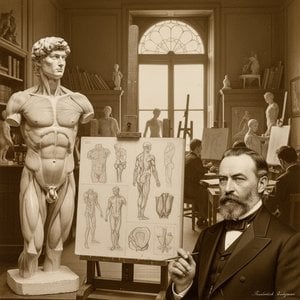
The Classroom and the Canvas
Costa Miranda lived a life defined by the steady rhythm of the classroom and the precision of the drawing pen. Born in Brazil in 1818, he moved through the halls of the Imperial Academy of Fine Arts, first as a student and later as a teacher. He learned under the guidance of Debret and Grandjean de Montigny, absorbing the technical foundations that would later define his own career. His path was one of gradual ascent within the academy, moving from a substitute teacher of drawing to a professor of historical painting, and eventually to the chair of landscape painting. By 1848, he held a prestigious position as a professor of drawing, a role he maintained until his retirement.
His hands were as comfortable with a brush as they were with a pen. There is a specific, delicate quality to the way he approached portraiture, particularly in his pen-and-ink drawings. One such work, a portrait of Princess Isabel, suggests a level of detail and technical control that likely found a place within the Imperial Family's private collections or the Imperial Museum. His presence in the art world was marked by participation in the General Exhibitions of Fine Arts in 1841 and 1850, where he presented his portraits to the public.
A Legacy of Instruction
In the later years of his career, Miranda moved away from the academy to teach at the Liceu de Artes e Ofícios. For eight years, he focused on the discipline of figure drawing, working alongside a circle of respected contemporaries. He was a man who understood the mechanics of form, and his influence extended through the students he mentored. His teaching was not merely about the finished image, but about the fundamental understanding of the human figure.
His professional life was characterized by several key transitions:
- His early training and subsequent teaching roles at the Imperial Academy of Fine Arts.
- His appointment to the chair of Drawing in 1848.
- His eight-year tenure teaching Figure Drawing at the Liceu de Artes e Ofícios.
- His recognition by the Liceu's board in 1878 for his dedicated service.
The Quiet End of a Career
The historical record of his life becomes thin toward the end. After leaving his teaching position at the Liceu, he moved toward Rio de Janeiro. While his official recognition from the Liceu in 1878 acknowledged his merits, the details of his final years remain obscured. He likely passed away in Rio de Janeiro shortly after his retirement, leaving behind a body of work that remains relatively rare. He left no trace of his final residence or his burial place, leaving only the quiet evidence of his skill and his commitment to the art of drawing.
アーティストへのQ&A
Costa Mirandaの作品を、雰囲気別に探すにはどこへ行けばよいですか?
Costa Mirandaの作品は、それぞれの作品が持つムード(情緒)ごとに分類されたアーティスト専用ページムードで探すから、気分に合わせてお探しいただけます。
美術様式別に分類されたCosta Mirandaの作品は、どこで閲覧できますか?
Costa Mirandaが属する各ムーブメント(芸術運動)は、作品をムーブメント別に分類したアーティストの全ムーブメントページでご覧いただけます。
Costa Mirandaの作品を色別に並べ替えることはできますか?
カラーインデックスでは、Costa Mirandaの作品を色別に分類してご紹介しています。
Costa Mirandaは、どの時代に活動していましたか?
Costa Mirandaは19th Centuryに活動していました。この時代背景は、その画家の足跡を歴史の中に位置づけるものです。