The Soul of the Swedish Coast: The Life and Art of Carl Wilhelmson
In the quiet, salt-sprayed fishing village of Fiskebäckskil, where the rugged coastline of Västergötland meets the sea, the foundations of a profound artistic vision were laid. Born in 1866, Carl Wilhelm Wilhelmson did not merely observe the landscape; he became its chronicler. His early life was marked by both the industrious spirit of his coastal home and the sudden tragedy of losing his father to a shipwreck, an event that perhaps deepened his connection to the powerful, unpredictable nature of the Swedish waters. Before he ever held a painter's brush with the intent of high art, Wilhelmson’s hands were trained in the precise, disciplined world of lithography. This early apprenticeship in the printing trade provided him with a unique graphic sensibility, a mastery of line and tonal depth that would later distinguish his paintings from those of his contemporaries.
The trajectory of Wilhelmson's career was shaped by a series of transformative encounters with some of the most significant figures in Scandinavian art. His time at the Valand Academy in Gothenburg brought him under the mentorship of the legendary Carl Larsson, whose humanist approach to depicting domestic life and natural beauty left an indelible mark on the young artist. This connection anchored Wilhelmson in a tradition of celebrating the dignity of everyday existence. However, his thirst for broader horizons eventually led him to the vibrant, pulsating heart of Paris in 1890. Immersed in the atmosphere of the Académie Julian, he studied under masters such as Paul Sérusier and Maurice Denis, absorbing the revolutionary light and color theories of Impressionism. This period of international exposure allowed him to marry the structural precision of his graphic training with a newfound ability to capture the fleeting, atmospheric nuances of plein air painting.
A Tapestry of Rural Devotion and Natural Light
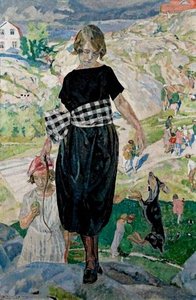
Wilhelmson’s body of work serves as a poignant window into a vanishing era of Swedish rural life. He possessed a rare ability to elevate the mundane—the gathering of churchgoers, the quiet labor of fishermen, and the stillness of coastal landscapes—into something deeply spiritual and timeless. His subject matter often revolved around themes of community and religious devotion, yet he avoided the overtly dramatic in favor of a subtle, meditative realism. In works such as “Four Women” or his various depictions of fishermen, there is a palpable sense of reverence for the subjects' connection to the earth and sea. He did not merely paint people; he painted the weight of their history and the quiet strength of their endurance.
Technically, Wilhelmson’s style is a masterclass in atmospheric subtlety. His palette was famously restrained, favoring a sophisticated range of muted blues, deep greens, and earthy browns that mirrored the overcast skies and granite shores of his homeland. He utilized light not as a spotlight, but as a pervasive element that softened edges and unified his compositions. Through meticulous attention to detail, he could render the texture of a weathered net or the dampness of a coastal mist with breathtaking accuracy. His compositions often embraced an asymmetrical elegance, creating a sense of natural movement and visual dynamism that drew the viewer into the very heart of the Swedish countryside.
Legacy and Artistic Significance
Beyond his personal canvases, Wilhelmson’s influence extended through his role as a dedicated educator and mentor. By teaching at the Valand Academy, he helped shape the next generation of Swedish artists, passing on a legacy of technical rigor and emotional sincerity. His work remains a cornerstone of late nineteenth and early twentieth-century Scandinavian art, representing a bridge between traditional realism and the modern fascination with light and atmosphere.
Today, the significance of Carl Wilhelmson lies in his ability to have captured the very essence of a culture's soul. He remains a celebrated figure for those seeking to understand the quiet majesty of the Swedish landscape and the enduring dignity of its people. His paintings are more than mere visual records; they are emotional landscapes that continue to resonate with a sense of peace, nostalgia, and profound respect for the natural world.
Q&A
Carl Wilhelm Wilhelmsonは、どの時代に活動していましたか?
Carl Wilhelm Wilhelmsonは19th Centuryに活動していました。この時代背景は、その画家の活動を歴史の中に位置づけるものです。
Carl Wilhelm Wilhelmsonは、どの芸術運動に属していましたか?
Carl Wilhelm Wilhelmsonが活動した各ムーブメント(芸術運動)は、作品をムーブメント別に分類しているアーティストのすべてのムーブメントページでご覧いただけます。
Carl Wilhelm Wilhelmsonの作品を主題別に探すことはできますか?
Carl Wilhelm Wilhelmsonの主題別アトラスは、そのアーティストの作品を主題ごとに分類してご紹介するページです。