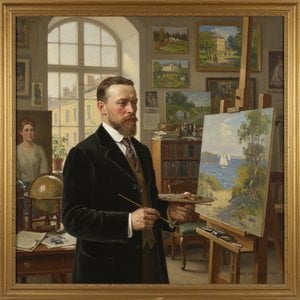
A Life Shaped by Struggle and Ink
Born in Groningen, Netherlands, in 1877, Albert Hahn grew up in what he later described as respectable poverty. His father was a man of many trades, painting signs, making frames, and working with glass. This humble beginning meant that the boy's path was never easy. At the age of nine, a battle with tuberculosis in his vertebrae forced him to leave school, a setback that would shadow much of his early life. While recovering in hospitals, he found solace in his drawing, sketching the doctors and nurses who cared for him. This early connection to the pen and paper was more than a pastime; it was a lifeline.
His formal training began at the Academie Minerva in Groningen, though his health often dictated the pace of his education. After a period of recovery, he moved to Amsterdam to study at the Teekenschool voor Kunstambachten. It was here that his artistic vision began to sharpen, influenced deeply by seeing the works of Van Gogh at an exhibition in Groningen. By the time he graduated, he was working as a drawing teacher at a technical school, but his heart was pulling him toward the social realities of the streets.
The Voice of the Working Class
Hahn’s art became inseparable from his politics. As a member of the Social Democratic Workers' Party, he used his talent to document the lives of those often ignored by society. In 1901, he contributed drawings to a booklet titled "Krotten en Sloppen" (Shacks and Slums), which provided a stark, almost photographic look at the damp, cramped living conditions of Amsterdam's workers. His ability to capture the weight of poverty through line and shadow led him to a permanent position at the socialist newspaper Het Volk.
His work was characterized by several key focuses:
- The harsh realities of urban housing and the lives of the impoverished.
- The struggle of the labor movement against capitalist exploitation.
- The devastating impact of war and the senselessness of military destruction.
- The critique of religious institutions that he felt kept the people in a state of ignorance.
He was a prolific creator, producing more than 4,000 drawings throughout his career. His illustrations were not merely decorations; they were journalistic weapons used to advocate for social change. During the First World War, his focus shifted toward denouncing the destruction caused by global conflict, using his imagery to speak for those caught in the crossfire of history.
Legacy of the Graphic Artist
Albert Hahn’s influence extended beyond the pages of newspapers and into the very fabric of Dutch political history. His depictions of the railroad strikes of 1903 remain so significant that they are frequently used in history textbooks to illustrate the era. He was a master of many forms, working as a caricaturist, etcher, lithographer, and poster artist, leaving a mark on everything from book covers to editorial cartoons.
He passed away in 1918, just as the Great War was drawing to a close, having spent his final years documenting the chaos of a changing world. His son, Albert Hahn jr., followed in his footsteps as an artist, ensuring the family name remained tied to the visual arts. Today, his life's work is remembered through major retrospectives, honoring a man who used his pen to fight for justice and to give a face to the struggle of the common person.
アーティストへのQ&A
Albert Hahnは、どの時代に活動していましたか?
Albert HahnはModernに活動していました。この時代背景は、その画家の足跡を歴史の中に位置づけるものです。
Albert Hahnの作品をカラーパレット別に閲覧することはできますか?
Albert Hahnの作品は、アーティストページのカラーパレットから探すからカラーパレット別に閲覧いただけます。
Albert Hahnの作品はどのくらい人気がありますか?
Albert Hahnの閲覧統計ページでは、本サイトに掲載されているアーティストの作品から算出された統計データをご覧いただけます。
キーワードでAlbert Hahnの作品を探すことはできますか?
Albert Hahnの作品は、アーティストのキーワードから探すページからキーワード別に探すことができます。各キーワードには関連する作品がまとめられています。