


The picture follows your choices: , .
コレクション詳細
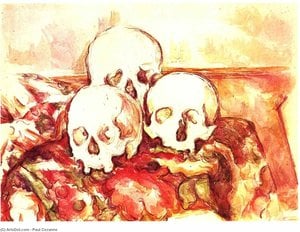
Three vibrant skulls in yellow, orange, and green create a striking Post-Impressionist meditation on mortality by Paul Cézanne that invites you to explore the profound beauty of decay through this timeless masterpiece.
 続きを読む
続きを読む
アーティストプロフィール
セザンヌは印象派とキュビスムを繋ぐ革新的画家。リンゴや風景、バスティユなどを独自の視点で捉え、後の芸術に多大な影響を与えました。幾何学的な形態と色彩の探求が特徴です。
手描き油彩複製画
当社のアーティストが、お客様のご希望のサイズと額縁に合わせて、キャンバスに手描きで制作する油彩画です。 ( プリント版に切り替え デジタル画像販売へ切り替え)
More about this painting
 設置イメージを確認
 送る
送る シェア
シェア
 詳細情報
詳細情報 ガイドを表示

 画像をダウンロード
 似ている作品
 X線調査
X線調査 スライドショー
 Q&A
Q&A 統計情報
統計情報Order your painting in four simple steps
Take your time. You can change any answer; the price in your order card follows each choice.
1 Step one of four
Which size would you like?
These sizes keep the proportions of the original painting. The drawing shows your choice on a wall, above a two-metre sofa.
Or give your own measurements
作品のオリジナル比率に合わせた、当店の規定サイズからお選びください。

フレームや壁のスペースに合わせて、ご希望の幅と高さを入力してください。本作品は手描きのため、異なる比率のサイズをご希望の場合、絵画の周囲を少し広げて描くか、あるいは端を少しカットして調整することが可能です。お客様のご要望に合わせます。制作を開始する前に、仕上がりを確認するためのデジタルモックアップをお送りいたします。このページに表示されている画像は完成品の実物ではなく、あくまでモックアップによるイメージです。
2 Step two of four
How should it be prepared: rolled, stretched or framed?
The prices below are for the size you chose in step one.
Choose the edges of the stretched canvas
Choose your frame

White ¥1

Blurside ¥1

Extended ¥1

P118B ¥10

P118H ¥10

P118W ¥10

P438Z ¥10

P508JH ¥12

P508YH ¥12

P805H ¥10

P805Z ¥10

P919BZ ¥10

P919G ¥10

P919XJ ¥10

P959ZH ¥10

P968JZ ¥12

W106C ¥8

W218G ¥10

W218JH ¥8

W218Y ¥10

W307PJ ¥10

W316G ¥10

W316PJ ¥8

W316Y ¥10

W398PJ ¥8

W4111J ¥10

W500HY ¥15

W500JH ¥15

W692G ¥12

W849H ¥8

W940BG ¥15

W953PJ ¥8

H24-GOLD ¥30

H24-SILVER ¥30

H36-GOLD ¥45

H36-SILVER ¥45
額装済み
Moulding: . Overall size with the frame: .
3 Step three of four
Would you like anything changed in the painting?
Most people answer no. Because each painting is made by hand, our artist can also adapt it for you.
After order, ArtsDot.com team will email client for instructions and provide a mockup preview
4 Step four of four
A few finishing options
All of them are optional. The answers already selected cost nothing extra.
Who paints it?
A nameplate, as in a museum?
刻印入りブロンズプレートの詳細
This elegant plaque features the artist's name and the title of the artwork, finely engraved for a timeless presentation.
It is made from bronze with a refined, elegant finish. The text is precisely laser-engraved for a sharp and permanent result. Measuring 9x2 cm, the plaque is compact yet easy to read. It's built to be durable and scratch-resistant, offering a professional, museum-quality look. Mounting is simple thanks to the included adhesive backing.
透明アクリル銘板の詳細
The plaque includes essential engraved details such as the artist's name, the title of the artwork, the date it was created, the type of media used-like oil on canvas or watercolor-a brief description of the piece, and a QR code that links to the complete artwork information.
It is crafted from clear acrylic, offering a sleek, modern appearance. The text is UV-engraved in black to ensure strong visual contrast. With a size of 10x15 cm, it ensures optimal readability. It comes equipped with two metal hooks for secure wall mounting. The plaque is designed to be weather-resistant, making it suitable for various environments, and it includes interactive features that work seamlessly with smartphone scanning.
黒アクリル製銘板の詳細
This elegant plaque includes engraved information such as the artist's name, the title of the artwork, the date it was created, the type of media used (like oil on canvas or watercolor), a short description of the artwork, and a QR code for quick access to more information.
The plaque itself is made from refined black acrylic with a premium finish. The text is laser-engraved in white for high contrast and readability. Its size is 10x15 cm, designed to be easy to read. It comes with two metal hooks for professional mounting. The design is sleek and fits any interior style. It is also weather-resistant and durable, with built-in digital integration for mobile compatibility.
A protective varnish?
When do you need it?
✓ Check and order
Your painting, as you ordered it

The Three Skulls
再現技法
複製画サイズ一覧
-

厳選された熟練アーティスト
より細部までこだわった表現、洗練された技術、そして十分な制作時間
-

複製画用額装
-
-
いずれかの辺が105 cm(約41インチ)を超えるアートワークまたは複製画の場合、フレームは分解されたキットの状態でお届けいたします。この方法は、輸送中の破損を防ぎ、安全に配送するために採用しております。
組み立てには専門知識が必要です(DIY用製品ではありません)。
本キットは、経験豊富なプロの額装師が、木工用ボンド(別売)、キャンバス用プライヤー、およびボンドの乾燥時に桟を直角に保持するためのクランプを使用して、組み立ておよびキャンバスの張り作業を行う必要があります。不適切な組み立てやキャンバスの張りの不均一は、作品に永久的な損傷を与える恐れがあり、弊社の保証対象外となります。
 いずれかの辺が105 cm(約41インチ)を超えるアートワークまたは複製画の場合、フレームは分解されたキットの状態でお届けいたします。この方法は、輸送中の破損を防ぎ、安全に配送するために採用しております。
すべての無垢材のパーツが含まれており、組み立てに最適なサイズに正確にカットされています。
付属のネジを使用し、角の接合部には別途木工用ボンドをご用意ください(ボンドは付属しておりません)。ボンドは額装業者様にてご手配をお願いいたします。
プロ仕様の道具が必要ですが、キットには含まれていません:キャンバス用ストレッチングプライヤー(テンショナー)、および接着剤が乾燥するまで木枠を直角に固定するためのクランプ。
重要:
コーナーの接合部には木工用ボンドが必要です。また、ボンドが完全に乾くまでクランプでバーを固定しておく必要があり、組み立てたフレームにキャンバスを張るにはキャンバス用ストレッチングプライヤーが必要となります。これらの道具はキットに含まれておりません。このサイズをご注文される前に、経験豊富なプロの額装師(フライマー)の手配をお願いいたします。

銘板
-
-

保護用ワニス
光沢ワニス(色彩を鮮やかに引き立て、光や湿気から保護します)
-

作品をカスタマイズ
カスタマイズの例:顔をお客様の写真に差し替える、ペットを追加する(例:猫を犬に変更)、背景に隠しメッセージを入れる、背景の風景や要素を変更する。
-

お急ぎ便
世界中への配送()は、通常の5週間ではなく、3〜4週間でお届けいたします。(1 11月)。品質には一切の妥協を許しません。
-
お急ぎ便
世界中への配送()は、5週間ほどでお届けします。(8 11月)。
送料込
合計金額
¥ 41502
ガラスオプションは、110cm未満のサイズでのみご利用いただけます。
Included with every order
- 世界中へ無料エクスプレス配送
- 高品質なリネンキャンバス
- 配送時完全保険付
- 関税・輸入税の払い戻し保証
- 忠実な色彩再現の保証
- 100日間返品保証(製造上の欠陥がある場合のみ)
- 100% 全額返金保証
- まとめ買い割引のご案内


A Silent Symphony of Decay
In the quiet corners of art history, few works command the room with such haunting, understated power as Paul Cézanne’s "The Three Skulls." Completed around 1898, this masterpiece is far more than a mere study of mortality; it is a profound meditation on transformation and the enduring strength of artistic vision. As one gazes upon this composition, there is an immediate sense of being pulled into a world where the boundaries between life and death, light and shadow, begin to dissolve. Hanging prominently within the Detroit Institute of Arts, the painting serves as a cornerstone of Post-Impressionism, offering a glimpse into the mind of a creator who sought to capture not just the visual surface of reality, but its very essence.
The brilliance of Cézanne’s technique lies in his ability to eschew traditional perspective in favor of a revolutionary structural harmony. He presents three skulls stacked vertically against a muted, dark background, creating a stark contrast that vibrates with life despite the macabre subject matter. Each skull is rendered in a distinct, luminous hue—yellow, orange, and green. These are not merely colors chosen for aesthetic balance; they evoke a visceral cycle of existence. The warmth of the yellow and orange suggests the fading embers of vitality and passion, while the subtle infusion of green hints at the quiet promise of rebirth and the organic process of decomposition. Through this masterful manipulation of color, Cérand transforms a memento mori into a vibrant, breathing landscape of form.
The Architecture of Modernity
For the discerning collector or interior designer, "The Three Skulls" offers an unparalleled opportunity to introduce a piece of profound intellectual depth into a curated space. Cézanne’s approach to form—simplifying complex biological structures into fundamental geometric shapes like cylinders and spheres—foreshadowed the seismic shifts of Cubism. This deliberate flatness and structural integrity make the work exceptionally versatile for modern decor. Whether placed in a minimalist gallery setting or as a focal point in a sophisticated study, the painting’s rhythmic arrangement and balanced weight provide a sense of stability and timelessness.
The emotional impact of the piece is found in its stillness. There is no frantic movement here, only a heavy, contemplative silence that invites the viewer to linger. It is a work that rewards slow looking, revealing new layers of texture and tonal nuance with every encounter. To possess a high-quality reproduction of this work is to bring a piece of the revolutionary spirit of the late 19th century into the contemporary home—a constant reminder of the beauty found in the cycle of change and the eternal power of the artist's hand to find light within the darkness.
よくあるご質問
Living Roomに「The Three Skulls」を飾る場合、どのサイズがおすすめですか?
セザンヌ作「The Three Skulls」 におすすめの組み合わせ:Living Room に飾る Small サイズのプリント。
「The Three Skulls」の色彩は、どの程度鮮やかですか?
セザンヌ作「The Three Skulls」は、彩度Clear Color Presenceで記録されています。
「The Three Skulls」にはどのような感情が込められていますか?
「The Three Skulls」は、Melancholicな感情を呼び起こします。この情緒的なトーンは、作品が与える印象を表しています。
関連作品



セザンヌ
1839 - 1906, フランス
アーティストについて
ポール・セザンヌ:近代美術の礎を築いた画家
ポール・セザンヌは、1839年に南フランスのエクス=アン=プロヴァンスで生まれ、印象派の儚い光の描写と、キュビスムの断片化された形態を結びつける架け橋となった、まさに革命的な芸術家でした。彼の人生は、一躍成功を収めるのではなく、自己探求の長い道のりであり、自己疑念や批判に直面しながらも、近代美術の流れを根底から変える遺産を残しました。裕福な家庭に生まれ、父親は帽子職人から銀行家へと転身し、セザンヌは経済的な安定を得て、商業的な成功のプレッシャーなしに芸術に専念することができました。当初は父親の意向により法学を志しましたが、芸術への情熱がそれを上回り、最終的には法律を捨て、絵画の世界に飛び込みました。ロマン主義の影響やバルビゾン派の風景描写への傾倒など、初期には様々な影響を受けましたが、ポール・ゴーギャンやジョルジュ・スーラといった画家たちとの出会いを通じて、革新的な色彩と形態に対する彼らのアプローチに触発され、独自の道を切り開いていきます。印象を超えて:構造へと至る芸術的進化
セザンヌの初期作品には、ロマン主義特有の劇的で感情的なテーマが反映されており、暗いパレットと表現力豊かな筆致が特徴でした。しかし、この初期段階は、より分析的で画期的なアプローチへの移行のための単なるステップに過ぎませんでした。印象派が好んだ光の儚い瞬間を捉えるだけでは不満を感じたセザンヌは、対象物の背後にある構造を理解し、表現することを追求しました。彼は、自分が何を見ているかだけでなく、現実を構成する根本的な形態がいかに認識されているのかを知りたいと考えました。この探求が、自然の形を幾何学的な等価物へと分解するという手法を生み出しました。彼の技法は、複雑な色彩とテクスチャのフィールドを作り上げるために注意深く重ねられた小さな反復筆致によって特徴づけられ、前例のない安定感と奥行きを生み出します。彼は単なる写実性ではなく、対象を複数の視点から同時に提示することで、伝統的な遠近法の概念に挑戦し、鑑賞者に彼の構成の構築された性質と積極的に関わることを強いるのです。この意図的な歪みは恣意的なものではなく、時間の一瞬だけでなく、知覚の統合を表す、より完全な形の理解を伝えるための試みでした。風景、静物、そして人体:主要作品と繰り返されるモチーフ
セザンヌの作品群は非常に多様で、風景画、静物画、肖像画、そして沐浴者の描写などを含みますが、そのすべてが彼の独特な形態と色彩のアプローチによって統一されています。1880年に描かれたジャス・ド・ブーファンの池は、形を注意深く配置し、色調を調整することで自然の本質を捉える能力を示す代表的な風景画です。1866年のエミール・ゾラの肖像は、彼の発展途上のスタイルを示し、親友であり作家であるゾラへの魅力的な洞察を提供します。リンゴなどの果物を取り上げた静物画は、単なる対象の描写ではなく、ボリューム、光、空間関係を探求する試みです。モン・サン=ヴィクトールシリーズはセザンヌにとって強迫観念とも言えるモチーフであり、何十年にもわたって形態と遠近法を徹底的に調査することを可能にしました。これらの絵画は単なる山の描写ではなく、私たちが奥行き、ボリューム、光と影の相互作用をどのように認識するかを探求する研究なのです。最後に、牧歌的な風景の中に裸婦を描いた沐浴者シリーズは、人体と自然とのつながりを深く探求し、しばしば時の流れを超越した静けさと瞑想に満ちた雰囲気で表現されています。革新によって築かれた遺産:近代美術への影響
ポール・セザンヌの芸術が後世の世代に与えた影響は計り知れません。彼は、画期的な絵画言語への貢献により、「近代美術の父」として広く認められており、20世紀の主要な芸術運動の多くへの道を開きました。パブロ・ピカソやジョルジュ・ブラックは、セザンヌの幾何学的形態と複数の視点への強調に深く負い目を抱いており、それがキュビスムの中核となる原則となりました。彼の大胆な色彩の使用はまた、アンリ・マティスが率いるフォーヴィズム運動にも影響を与え、彼らは非現実的で鮮やかな色調を受け入れました。シュルレアリスムの芸術家でさえ、セザンヌの主観的な知覚と心理的な深さの探求に共鳴を見出しました。特定の運動を超えて、セザンヌは芸術家の個人的なビジョンを重視し、伝統的な学術的制約を拒絶することで、世代を超えた画家たちに新たな表現形態を探求する自由を与えました。彼は表象の定義そのものを覆し、現実を模倣することから、構造と主観的な知覚に基づいた視覚体験を構築することへの焦点をシフトさせました。1906年の彼の死は終わりではなく、始まりを告げるものでした。それは、彼の革命的なビジョンによって深く形作られた、芸術史における新たな時代の幕開けでした。


関連記事

Sage Green Masterpieces: 10 Famous Paintings & Timeless Decor Inspiration
Explore 10 famous paintings dominated by serene sage green tones! Discover Monet, Renoir & Manet masterpieces. Learn art history & find museum-quality reproductions for your home decor on .

没後印象派を彩る至宝:時代を定義した10大名作
時代を彩る没後印象派の名作10選。ゴッホ、セザンヌら巨匠の傑作を深く掘り下げ、その物語と技法に迫ります。色彩豊かなアートで空間を演出。ArtsDot.comで至高のアートプリントを見つけませんか?

Verdant Visions: Exploring the Symbolism & Aesthetic Impact of Green in Art History
Explore the rich history & symbolism of green in art! Discover iconic paintings, techniques, and how to bring verdant harmony into your home with ArtsDot's expert guide.