


選択した条件に基づいた画像: , .
作品解説
 詳細を表示
詳細を表示
アーティストの略歴
Explore the abstract art of Osvaldo Licini (1894-1958), an Italian painter blending abstraction, surrealism & symbolic figures. Discover his unique style & legacy.
手描き油彩複製画
当社のアーティストが、ご希望のサイズと額縁に合わせてキャンバスに手描きで制作する、オーダーメイドの油彩画です。 ( プリント版に切り替え デジタル画像販売へ切り替え)
本作品の著作権について
このページに掲載されている作品は著作権法によって保護されており、当社の許可なく同一の複製物を制作または販売することは法律で禁じられています。この保護は、以下のような国際条約に基づき執行されます。 ベルヌ条約 および、以下の条項に定められたものを含む各国の法律により、 米国著作権法 第17編。
敬意を払った法的な代替手段として、私たちはオリジナルにインスピレーションを与えられた、カスタムの手描きアートワークを提供しています。私たちの熟練したプロのアーティストは、元の作品が持つスタイル、情緒、そして芸術的なエッセンスを注意深く研究し、独自の創作物でありながら、同じ感性を呼び起こすような、新しくユニークな作品を作り上げます。
この手法は、著作権で保護された作品の複製や複写を伴わないため、著作権法に完全に準拠しています。これは単なる模倣ではなく、創造的な再解釈です。元の作品からインスピレーションを受けつつも、それとは異なる、全く新しい絵画を生み出すものです。
この絵画の詳細を見る
 設置イメージを表示
 シェアする
シェアする シェアする
シェアする
 詳細を見る
詳細を見る ガイドを表示

 ダウンロード
 似ている作品
 X線調査
X線調査 スライドショーを表示
 Q&A
Q&A 統計情報
統計情報絵画のご注文は、わずか4つの簡単なステップで完了します
ゆっくりとお選びください。回答はいつでも変更可能です。選択内容に応じて、注文カート内の価格が随時更新されます。
1 全4ステップ中のステップ1
サイズをご選択ください。
これらのサイズは、原画の比率を維持しています。図は、高さ2メートルのソファの上の壁に、選択したサイズを配置した際のイメージです。
または、ご希望のサイズを指定する
作品のオリジナル比率に合わせた、当店の規定サイズからお選びください。

フレームや壁のスペースに合わせて、ご希望の幅と高さを入力してください。本作品は手描きのため、異なる比率のサイズをご希望の場合、絵画の周囲を少し広げて描くか、あるいは端を少しカットして調整することが可能です。お客様のご要望に合わせます。制作を開始する前に、仕上がりを確認するためのデジタルモックアップをお送りいたします。このページに表示されている画像は完成品の実物ではなく、あくまでモックアップによるイメージです。
2 4ステップ中の2番目
どのような状態での配送をご希望ですか:ロール状、キャンバス張り、または額装済み?
以下の価格は、ステップ1で選択されたサイズに基づいています。
キャンバスの側面仕上げを選択
フレームを選択

白の側面仕上げ ¥1

エッジぼかし仕上げ ¥1

回り込み仕上げ ¥1

P118B ¥10

P118H ¥10

P118W ¥10

P438Z ¥10

P508JH ¥12

P508YH ¥12

P805H ¥10

P805Z ¥10

P919BZ ¥10

P919G ¥10

P919XJ ¥10

P959ZH ¥10

P968JZ ¥12

W106C ¥8

W218G ¥10

W218JH ¥8

W218Y ¥10

W307PJ ¥10

W316G ¥10

W316PJ ¥8

W316Y ¥10

W398PJ ¥8

W4111J ¥10

W500HY ¥15

W500JH ¥15

W692G ¥12

W849H ¥8

W940BG ¥15

W953PJ ¥8

H24-GOLD ¥30

H24-SILVER ¥30

H36-GOLD ¥45

H36-SILVER ¥45
額装済み
額縁の形状: . 額縁を含む全体サイズ: .
3 4ステップ中の3ステップ目
絵画の内容に変更をご希望されますか?
ほとんどの方は「いいえ」と答えます。一枚一枚が手描きであるため、アーティストがお客様のご要望に合わせて調整することも可能です。
ご注文後、ArtsDot.com のチームより詳細な手順についてメールをお送りし、仕上がりイメージ(モックアップ)をご提示いたします。
4 4ステップ中、第4ステップ
仕上げのオプション(数種類)
すべて任意です。すでに選択されている回答に追加料金はかかりません。
作者は誰?
美術館にあるような、銘板(ネームプレート)を。
刻印入りブロンズプレートの詳細
This elegant plaque features the artist's name and the title of the artwork, finely engraved for a timeless presentation.
It is made from bronze with a refined, elegant finish. The text is precisely laser-engraved for a sharp and permanent result. Measuring 9x2 cm, the plaque is compact yet easy to read. It's built to be durable and scratch-resistant, offering a professional, museum-quality look. Mounting is simple thanks to the included adhesive backing.
透明アクリル銘板の詳細
The plaque includes essential engraved details such as the artist's name, the title of the artwork, the date it was created, the type of media used-like oil on canvas or watercolor-a brief description of the piece, and a QR code that links to the complete artwork information.
It is crafted from clear acrylic, offering a sleek, modern appearance. The text is UV-engraved in black to ensure strong visual contrast. With a size of 10x15 cm, it ensures optimal readability. It comes equipped with two metal hooks for secure wall mounting. The plaque is designed to be weather-resistant, making it suitable for various environments, and it includes interactive features that work seamlessly with smartphone scanning.
黒アクリル製銘板の詳細
This elegant plaque includes engraved information such as the artist's name, the title of the artwork, the date it was created, the type of media used (like oil on canvas or watercolor), a short description of the artwork, and a QR code for quick access to more information.
The plaque itself is made from refined black acrylic with a premium finish. The text is laser-engraved in white for high contrast and readability. Its size is 10x15 cm, designed to be easy to read. It comes with two metal hooks for professional mounting. The design is sleek and fits any interior style. It is also weather-resistant and durable, with built-in digital integration for mobile compatibility.
保護用ニスをご希望ですか?
お届け希望日をお選びください
✓ 内容を確認して注文する
ご注文通りの絵画内容

Marine
再現技法
複製画サイズ一覧
-

至高の熟練アーティスト
より細部までこだわった表現、洗練された技術、そして十分な制作時間
-

複製画用フレーム
-
-
いずれかの辺が105 cm(約41インチ)を超えるアートワークまたは複製画の場合、フレームは分解されたキットの状態でお届けいたします。この方法は、輸送中の破損を防ぎ、安全に配送するために採用しております。
組み立てには専門知識が必要です(DIY用製品ではありません)。
本キットは、経験豊富なプロの額装師が、木工用ボンド(別売)、キャンバス用プライヤー、およびボンドの乾燥時に桟を直角に保持するためのクランプを使用して、組み立ておよびキャンバスの張り作業を行う必要があります。不適切な組み立てやキャンバスの張りの不均一は、作品に永久的な損傷を与える恐れがあり、弊社の保証対象外となります。
 いずれかの辺が105 cm(約41インチ)を超えるアートワークまたは複製画の場合、フレームは分解されたキットの状態でお届けいたします。この方法は、輸送中の破損を防ぎ、安全に配送するために採用しております。
すべての無垢材のパーツが含まれており、組み立てに最適なサイズに正確にカットされています。
付属のネジを使用し、角の接合部には別途木工用ボンドをご用意ください(ボンドは付属しておりません)。ボンドは額装業者様にてご手配をお願いいたします。
プロ仕様の道具が必要ですが、キットには含まれていません:キャンバス用ストレッチングプライヤー(テンショナー)、および接着剤が乾燥するまで木枠を直角に固定するためのクランプ。
重要:
コーナーの接合部には木工用ボンドが必要です。また、ボンドが完全に乾くまでクランプでバーを固定しておく必要があり、組み立てたフレームにキャンバスを張るにはキャンバス用ストレッチングプライヤーが必要となります。これらの道具はキットに含まれておりません。このサイズをご注文される前に、経験豊富なプロの額装師(フライマー)の手配をお願いいたします。

キャプション
-
-

保護用ワニス
光沢ワニス(色彩を鮮やかに引き立て、光や湿気から保護します)
-

作品をカスタマイズ
カスタマイズの例:顔をお客様の写真に差し替える、ペットを追加する(例:猫を犬に変更)、背景に隠しメッセージを入れる、背景の風景や要素を変更する。
-

お急ぎ便
世界中への配送()は、通常の5週間ではなく、3〜4週間でお届けいたします。(9 11月)。品質には一切の妥協を許しません。
-
お急ぎ便
世界中への配送()は、5週間ほどでお届けします。(16 11月)。
込み
合計金額
¥ 41614
ガラスオプションは、110cm未満のサイズでのみご利用いただけます。
すべての注文に同梱
- 世界中へ無料エクスプレス配送
- 高品質なリネンキャンバス
- 配送時完全保険付
- 関税・輸入税の払い戻し保証
- 真の色彩再現に関する保証
- 100日間返品保証(製造上の欠陥がある場合のみ)
- 100% 全額返金保証
- まとめ買い割引のご案内


Q&A
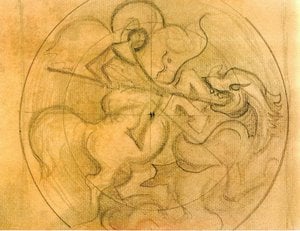
「Marine」の色味は、どの程度鮮やかですか?
「Marine」の彩度はClear Color Presence、色の強度はVividです。
Galleria Civica di Arte Moderna e Contemporanea Torino所蔵の「Marine」の複製権について教えてください。
「Marine」の原画はGalleria Civica di Arte Moderna e Contemporanea Torinoに所蔵されており、本作品は著作権の保護対象ですです。
Osvaldo Licini作「Marine」の構図を主導している色は何ですか?
「Marine」の中で最も際立っている色はBronze (#b8811f)です。作品の主色(メインカラー)を知ることは、インテリアとのコーディネートを考える際に役立ちます。
関連作品




Osvaldo Licini
1894 - 1958, Italy
作家プロフィール
Early Life and Artistic Foundations
Osvaldo Licini, born on March 22nd, 1894, in the small Italian town of Monte Vidon Corrado in the Marche region, embarked on an artistic journey that would see him become a pivotal figure in the development of abstract art. His early life was somewhat unconventional; his parents relocated to Paris shortly after his birth to pursue work opportunities, leaving young Osvaldo in the care of his paternal grandfather, Filippo, back in Monte Vidon Corrado. This separation instilled in him a sense of independence and perhaps contributed to an introspective nature that would later inform his artistic vision. While his parents established themselves in Paris—his father as a commercial poster designer and his mother running a fashion house—Osvaldo received a traditional art education, beginning studies at the Accademia di Belle Arti di Bologna in 1908. It was here he forged a significant friendship with Giorgio Morandi, a fellow student who would become a lifelong companion and influence.
Licini’s initial artistic explorations were rooted in figurative representation, but even during his academic years, a subtle questioning of form and space began to emerge. He continued his studies at the Academy of Fine Arts in Florence, where he encountered the burgeoning Futurist movement. While intrigued by their dynamism and rejection of traditional aesthetics, Licini never fully embraced Futurism’s tenets, maintaining a critical distance that allowed him to forge his own unique path.
The Path to Abstraction
The 1920s marked a period of transition for Licini. He became increasingly interested in the “Return to Order” movement and the *Novecento Italiano*, participating in exhibitions organized by Margherita Sarfatti, a prominent figure in promoting Italian art during the Fascist era. However, his participation was always tempered by a desire to simplify volumes and explore two-dimensionality without fully adhering to the rigid classicism favored by the group. This period saw him exhibiting still lifes and landscapes that hinted at an underlying abstraction, a move away from strict representation towards a more conceptual approach.
A pivotal moment arrived in 1935 with Licini’s relocation back to Paris. It was here he encountered the Circle et Carré and Abstraction-Création groups—collectives of artists dedicated to pure abstraction. Exposure to figures like Vasily Kandinsky, Alberto Magnelli, and František Kupka profoundly impacted his artistic development. He immersed himself in abstract research, fueled by a growing intellectual curiosity and a desire to express inner realities through non-representational forms. This year also saw him participate in the first Italian Abstract Art Exhibition in Turin, solidifying his position within the burgeoning abstract art scene.
Mature Style and Symbolic Language
By the late 1930s, Licini had fully embraced abstraction, developing a distinctive style characterized by biomorphic shapes, floating forms, and a subtle yet powerful use of color. His paintings are not entirely devoid of reference; they often evoke organic structures, symbolic figures, and dreamlike landscapes. He sought to create a visual language that transcended the literal, tapping into universal emotions and subconscious realms.
His compositions frequently feature balanced arrangements of shapes—often described as ‘equilibristic’—suggesting a delicate interplay between opposing forces. While abstract, his works are imbued with a sense of poetic resonance, hinting at narratives and emotional states without explicitly depicting them. The influence of Surrealism is also discernible in his art, particularly in the juxtaposition of unexpected forms and the exploration of psychological themes.
Later Life and Legacy
Following World War II, Licini returned to Monte Vidon Corrado where he unexpectedly entered public life, being elected Mayor in 1946. He continued to paint prolifically throughout his later years, refining his abstract language and exploring new compositional possibilities. His work gained increasing recognition both nationally and internationally.
Osvaldo Licini passed away on October 11th, 1958, leaving behind a significant body of work that continues to captivate and inspire. In 1986, the town of Monte Vidon Corrado established the Centro Studi Osvaldo Licini—a testament to his enduring legacy and commitment to his artistic vision. Licini’s contribution lies in his ability to blend abstraction with a subtle symbolic depth, creating paintings that are both visually compelling and emotionally resonant. He stands as a key figure in Italian abstract art, bridging the gap between figurative tradition and the radical experimentation of the avant-garde.
- Key Influences: Giorgio Morandi, Futurist movement, Circle et Carré, Abstraction-Création group, Surrealism
- Major Themes: Abstraction, symbolic figures, organic forms, emotional resonance, balance and equilibrium.
- Notable Achievements: Participation in key Italian art exhibitions (Novecento Italiano, Quadriennale), development of a distinctive abstract style, election as Mayor of Monte Vidon Corrado, establishment of the Centro Studi Osvaldo Licini.