

 設置イメージを表示
 シェアする
シェアする シェアする
シェアする
 詳細を見る
詳細を見る ガイドを表示

 ダウンロード
 似ている作品
 X線調査
X線調査 スライドショーを表示
 Q&A
Q&A 統計情報
統計情報Landscape with orpheus and eurydice


 詳細を表示
詳細を表示
ジークレー/アートプリント
スピーディーな制作と多彩な仕上げオプションが魅力の、ミュージアムクオリティなジークレー・キャンバスプリント。 ( 手描き複製画を注文する デジタル画像販売へ切り替え)




P118B ¥10

P118H ¥10

P118W ¥10

P438Z ¥10

P508JH ¥12

P508YH ¥12

P805H ¥10

P805Z ¥10

P919BZ ¥10

P919G ¥10

P919XJ ¥10

P959ZH ¥10

P968JZ ¥12

W106C ¥8

W218G ¥10

W218JH ¥8

W218Y ¥10

W307PJ ¥10

W316G ¥10

W316PJ ¥8

W316Y ¥10

W398PJ ¥8

W4111J ¥10

W500HY ¥15

W500JH ¥15

W692G ¥12

W849H ¥8

W940BG ¥15

W953PJ ¥8




作品のオリジナル比率に合わせた、当店の規定サイズからお選びください。

額縁や壁のスペースに合わせて、ご希望の幅と高さを入力してください。プリントはカットすることは可能ですが、元の画像より大きくすることはできないため、異なる比率のサイズを選択された場合は、画像の一部が欠けることになります。印刷を開始する前に、内容を確認していただくためのデジタルモックアップをお送りいたします。このページに表示されている画像は、実際のカット後の状態を示すものではありません。実際の仕上がりはモックアップにてご確認ください。


 ガラスオプションは、110cm未満のサイズでのみご利用いただけます。

Landscape with orpheus and eurydice
ジークレー/アートプリント
複製画サイズ一覧
-


合計金額
¥ 9988
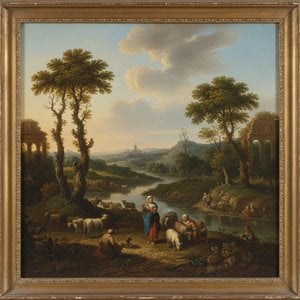
A Pastoral Elegy: Nicolas Poussin’s *Landscape with Orpheus and Eurydice*
This captivating landscape by Nicolas Poussin (1594-1665) is more than just a beautiful scene; it's a poignant visual interpretation of the classical myth of Orpheus and Eurydice, rendered with the refined elegance characteristic of French Baroque painting. Painted around 1650, the artwork resides in the Louvre Museum and exemplifies Poussin’s mastery of composition, color, and narrative storytelling.Decoding the Myth & Historical Context
The story of Orpheus, the legendary musician who descends into the underworld to retrieve his beloved Eurydice, is a timeless tale of love, loss, and the power of art. Poussin doesn’t depict the dramatic moment of their journey *from* the Underworld, but rather a serene, almost melancholic pause *during* it. This choice is crucial. He focuses on the fragile hope and inherent uncertainty within the myth – Orpheus leading Eurydice forward, yet unable to look back as per Hades' condition. Poussin’s career unfolded during a period where classical themes were experiencing a significant revival, particularly among French artists seeking to establish a distinctly national style rooted in intellectual rigor and order. He spent most of his working life in Rome, but remained deeply connected to the artistic ideals of France.Visual Analysis: Style & Technique
Poussin’s style is immediately recognizable for its clarity, balance, and emphasis on linear perspective. The composition is carefully structured around a pyramidal form – drawing the eye from the distant castle, across the gently rolling hills, down to the figures of Orpheus and Eurydice in the foreground. This compositional device creates depth and guides the viewer’s gaze through the landscape.- Color Palette: The painting is dominated by a muted palette of earthy tones – browns, greens, and blues – creating a sense of tranquility and timelessness. Warmer hues are subtly introduced in the figures' clothing and within the sky, adding visual interest without disrupting the overall harmony.
- Brushwork & Texture: Poussin’s technique is characterized by meticulous brushwork and glazing, building up layers of paint to achieve luminous effects and subtle color transitions. The textures are layered, suggesting foliage, water, and architectural elements with remarkable detail.
- Light & Shadow: Dramatic lighting illuminates the figures, casting shadows that enhance the scene’s three-dimensionality and contribute to its emotional depth. The light isn't harsh but rather diffused, lending a soft glow to the pastoral setting.
Symbolism Woven into the Landscape
Poussin imbues his landscape with symbolic meaning:- The River: Represents the journey of life and, in this context, the passage between worlds – a liminal space for Orpheus and Eurydice.
- The Castle & Bridge: Symbolize civilization, power, and perhaps the unattainable ideal. They stand as distant markers of the world Orpheus is attempting to rejoin with Eurydice.
- Musical Instruments: Represent harmony, art, and the power of music itself – Orpheus’s defining attribute and his means of navigating both worlds.
Emotional Resonance & Lasting Influence
*Landscape with Orpheus and Eurydice* evokes a sense of quiet contemplation and melancholic beauty. It's not a scene of triumphant joy, but rather one of fragile hope tinged with the awareness of potential loss. Poussin’s ability to convey such complex emotions through landscape is remarkable. His work profoundly influenced generations of artists, including Jacques-Louis David and Paul Cézanne, who admired his compositional rigor and intellectual approach to painting. This artwork remains a powerful testament to the enduring appeal of classical mythology and Poussin’s exceptional artistic vision – a piece that invites viewers to reflect on themes of love, loss, and the ephemeral nature of existence.Q&A
その色彩を考慮すると、"Landscape with orpheus and eurydice" はどの場所に飾るのがおすすめですか?
Earthyの色彩を纏ったニコラ・プーサン作「Landscape with orpheus and eurydice」は、Living Roomに飾るのがおすすめです。その色使いこそが、この提案の理由のひとつです。
「Landscape with orpheus and eurydice」の作者は誰ですか?
「Landscape with orpheus and eurydice」の作者はニコラ・プーサンとされています。
Living Roomに「Landscape with orpheus and eurydice」を飾る場合、どのサイズがおすすめですか?
ニコラ・プーサン作「Landscape with orpheus and eurydice」 におすすめの組み合わせ:Living Room に飾るのに最適な Large サイズのプリント。
関連作品


作家プロフィール
生い立ち、家族、そして修練
ニコラ・プーサンの芸術を貫く厳格な規律を理解するためには、ノルマンディー地方のレ・アンデリーに遡る彼の出自に目を向けなければなりません。1594年6月に生を受けた彼の初期の成長は、突発的なインスピレーションの産物ではなく、構造化された、極めて体系的な修練の賜物でした。彼はルーアンで技術的な教育を開始しましたが、この出発点が、後のより複雑な構図を構築するために不可欠な基礎的メカニズムを彼に授けることとなりました。この初期の研鑽の時期が、彼の生涯を定義づけることになる、徹底した準備という名の様式を確立したのです。
1612年、ニコラ・プーサンはパリへと移り、1623年までその地に留まりました。フランスの首都で過ごしたこの10年間は、幼少期の初歩的な教えを超え、彼が飛躍的な成長を遂げる重要な時期となりました。彼の学びは、単なる視覚的な技術に留まるものではありませんでした。彼はラテン語の教養も身につけており、その言語的素養こそが、後に彼が絵画へと翻訳することになる古典文学のテキストと、直接的に対話するための不可欠な道具となったのです。古代の言語と構造に対するこうした深い造詣があったからこそ、彼の作品は単なる視覚的な感覚に流されることなく、論理という強固な土台の上に築き上げられることになったのです。
ローマでの歳月と芸術的深化
1624年、ヴェネツィアを経由してローマに降り立ったニコラ・プーサンは、まだ自身の芸術的アイデンティティを確立しきっていない、未完の画家であった。後に彼のキャリアを決定づけることになる明確な方向性は、この時点ではまだ見出されていなかったのである。彼は自身の「声」を探すためにフランスに留まる道を選ばず、むしろ創作活動の大部分をローマで過ごすこととなった。永遠の都と呼ばれるこの地は、彼の芸術的な進化に不可欠な、知的かつ物理的な風景を彼に提供したのである。それは単なる滞在の記録ではなく、彼の芸術的軌道における根本的な転換点であった。若き日のヴェネツィア派の影響を受けた官能的なスタイルから脱却し、より規律に基づいた、構造的なアプローチへと彼は歩みを進めていく。この変容を突き動かしたのは、古代の遺跡との深い対話であり、ローマの学術的な社交界との濃密な関わりであった。
ローマにおけるプーサンの発展は、当時主流であった華美で演劇的なバロック的嗜好に対する、静かなる拒絶によって特徴づけられる。彼は、瞬時的な感覚への刺激や劇的な身振りよりも、秩序と論理の在り方を追い求めたのである。古代の遺構やラファエロの傑作を丹念に研究することで、彼は明晰さと均衡に根ざした独自の視覚言語を築き上げていった。この時期、彼は到着当初の実験的で未熟な作風から、極めて高度に制御された構成手法へと昇華を遂げる。色彩による情緒的な訴えよりも、線描による構造を重んじ、表面的なスペクタクルではなく、主題が持つ知的な重みに焦点を当てるスタイルを確立したのである。1665年に世を去るまでローマに留まり続けた彼は、一人の無名の移住者から、古典的伝統の中心的守護者へと、その姿を劇的に変貌させていたのである。
パトロン、工房、そして画題
ニコラ・プーサンのキャリアを形作ったのは、対抗宗教改革が求めた広範で演劇的な要求ではなく、むしろ選りすぐられた知的なパトロンたちの円環であった。ローマにおいて、彼の最も重要な繋がりとなったのは、学者であり考古学者でもあったカシアノ・ダル・ポッツォである。彼との出会いが、ニコラ・プーサンを極めて高潔な社会的層へと繋ぎ止めることとなった。この関係性は、1628年に彼が手にする唯一の教皇庁からの依頼を確かなものにする。当時のローマで流行していた華美で感情的なスタイルとは一線を画し、パトロンたちが求めたのは、秩序ある明晰さであった。こうした審美眼を持つコレクターたちの期待に応え続けたことが、ニコラ・プサンを「精神的な深みを持つ画家」として確立させたのである。
彼の芸術的地位は、やがてフランス国家の最高位にまで達することになる。パリへの短い帰還の際、彼はルイ13世とリシュリュー枢機卿のもとで国王筆頭画家という重職に任命された。この地位は極めて重要なものであったが、宮廷特有の行政的な重圧や社交の儀礼は、彼の独自の制作スタイルとは相容れないものであった。国王筆頭画家という称号を持ちながらも、宮廷の喧騒は彼を突き動かし、結果として彼はその地位を捨ててローマへと帰還することを選ぶ。宮廷の陰謀よりも学識者たちとの対話を好んだその姿勢は、彼の職業人生が極めて規律正しく、ある種、隠遁的な性質を帯びていたことを物語っている。
- 聖エラスムスの殉教 (1628年)
技法とスタイル
ニコラ・プーサンの構図へのアプローチは、幾何学と論理に基づいた、極めて規律ある探求であった。彼は、バロック様式が持つ混沌とした感情的な即興性を拒絶し、代わりに明晰さと秩序を重んじたのである。この理想を実現するために、彼は単なる画家という枠を超え、あたかも建築家のように振る舞った。ニコラ・プーサンは、壁に開けられた隙間から光を取り入れる特殊な箱を用い、キャンバスに最初の一筆を加える前に、光と影の相互作用を徹底的に研究した。このような緻密な準備プロセスによって、描かれる人物や風景のあらゆる要素が、正確かつ合理的な空間の中に配置されることが保証されたのである。
彼の制作過程は、対象を物理的に、あるいは演劇的に演出するプロセスでもあった。彼は小さな舞台に蝋人形を置き、布を配置することで、複雑な場面構成を練り上げた。この触覚的な手法こそが、光と形態の絶妙な絡み合いを彼に習得させたのである。また、彼はキアロスクーロ(明暗法)を駆使して人物を彫刻のように形作り、同時代の画家たちが陥りがちだった表面的なドラマに頼ることなく、光と影によって奥行きと感情的な重みを与えた。色彩よりも線描を優先する姿勢は、彼の美学を決定づけるものとなった。ニコラ・プーサンは、場面の構造的な整合性を最優先事項とし、構図の根底にある論理が、鑑賞者の意識を捉えて離さないよう徹底的に追求したのである。
主要作品と主題
ニコラ・プーサンの芸術的成果を定義づけているのは、構造に対する厳格なまでの献身であり、歴史や神話の物語を借りて人間の道徳性を深く探求した点にあります。彼は古代史の場面を頻繁に描き出し、キャンバスをまるでストイックな尊厳を演じるための舞台のように扱いました。こうした知的なアプローチは、聖ペテロ大聖堂のために描かれた聖エラスムスの殉教のような宗教画にも顕著に表れています。さらに、初期のより官能的な時期の作品であるバッカスへの授乳(The Nurture of Bacchus)を見ても、ヴェネツィア派に触発された色彩豊かな表現から、後の成熟したスタイルを決定づけることになる、規律ある線描表現へと移行していく過程を読み取ることができます。
彼の主題は、より深い哲学的な領域へとまで広がっており、とりわけエト・イン・アルカディア・エゴ(我もまたアルカディアに)においてその真髄が示されています。この作品は、風景画という枠組みを用いながら、死という避けられない運命への沈思を促します。また、1630年代後半には、七つの秘跡シリーズを通じて神聖な領域へと関心を広げました。これらの連作は、重厚な神学的主題を扱いながらも、古典的な抑制を保ち続ける彼の卓越した手腕を証明しています。彼は感情的な過剰さに頼るのではなく、明晰で論理的な構成を用いることで、精神的な意味を雄弁に語りかけたのです。
- 聖エラスムスの殉教
- バッカスへの授乳
- エト・イン・アルカディア・エゴ
- 七つの秘跡
遺産と影響
ニコラ・プーサンのフランス美術における功績は、単なる様式の変遷にとどまらず、その構造そのものに深く根ざしたものでした。秩序と明瞭さの基準を確立したことで、彼はフランス古典主義の礎石となったのです。アカデミー・ロワイヤル・ド・ペinture エ スкульпチュールにおける彼の存在は、その時代を定義づけることになる厳格な構成へのアプローチを確固たるものにしました。彼は単に絵画を描いたのではありません。歴史や神話がいかにしてキャンバスの上で組織化されるべきかという、一つの規範を提示したのです。この規律こそが、ローマでその生涯を閉じた後も、彼の精神が長く生き続けることを確かなものにしました。
彼の探求した手法は次なる世紀へと波及し、主要な芸術運動の方向性を形作っていきました。ジャック=ルイ・ダヴィッドやポール・セザンヌといった巨匠たちは、プーサンの知的な深遠さと、色彩よりも線描を重んじる姿勢に、自らの芸術の源流を見出しています。ダヴィッドがこれらの原理を新古典主義へと昇華させた一方で、セザンヌはプーサンの構築的な風景画の中に、また異なる共鳴を見出しました。情景に論理を宿らせる彼の卓越した能力は、西洋美術における構成の進化を学ぶ者にとって、今なお極めて重要な指標であり続けています。
- エト・イン・アルカディア・エゴ(我もまたアルカディアに)
- 七つの秘跡
- ネルガリクスの死
- オリオンの盲目

ニコラ・プーサン
1594 - 1665 , フランス
プロフィール概要
- Artistic Movement Or Style: フランス・バロック、フランス古典主義
- Artists Or Movements Influenced By This Artist:
- ジャック=ルイ・ダヴィッド
- ポール・セザンヌ
- Artists Who Influenced This Artist:
- ティツィアーノ
- ラファエロ
- Date Of Birth: 1594年
- Date Of Death: 1665年
- Full Name: ニコラ・プーサン
- Nationality: フランス
- Notable Artworks:
- ネルガリクスの死
- 七つの秘跡
- ローマ街道
- オリオンの盲目
- 四季
- Place Of Birth: フランス、ル・アーブル
関連記事

ロマン派ランドスケープ:時代を彩る巨匠の10選|アートとインテリアの世界
ロマン派絵画の時代を彩る10選。巨匠たちの風景が織りなす感動の世界へ。ターナー、ルーベンスなど、名作の裏話と高精細複製でアートをお部屋に。ArtsDot.comで至福のアート体験を。

ジョン・コンスタブルの傑作25選:英国風景画の巨匠が描く自然と光の詩 | ArtsDot
ジョン・コンスタブルの傑作25選。英国風景画の巨匠が描く自然と光の詩の世界へ。ロマン主義を代表する絵画、デダム・ヴェールやヘイ・ウェインなど、ArtsDotで高品質なアートプリントをお楽しみください。インテリアに深みと感動を。コレクションはこちら。

Nicolas Poussin: Classicism, Allegory & Order in 17th-Century French Painting
Explore the life & work of Nicolas Poussin, a master of French Classicism. Discover his allegorical paintings, Roman influences, and enduring impact on art history. Expert analysis & insights.

Evocations of Place: A Historical Journey Through Landscape Art
Explore the rich history of landscape art with ArtsDot. Discover renowned artists, movements like Impressionism & Romanticism, and expert guidance for collecting timeless pieces. Find your perfect serene escape today!
Nicolaes Berchem: Dutch Golden Age Pastoralism & the Evolution of Landscape Painting
Explore the captivating world of Nicolaes Berchem, a leading Dutch Golden Age painter. Discover his idyllic landscapes, masterful technique & lasting influence on art history. Learn more at ArtsDot.


