


 プレビュー
プレビュー
 シェアする
シェアする シェアする
シェアする
 詳細を見る
詳細を見る

 ダウンロード
 似ている作品
 X線調査
X線調査 スライドショー
 統計情報
統計情報Double Virginal

 詳細を見る
詳細を見る
ジークレー/アートプリント
迅速な制作と多彩な仕上げオプションを備えた、ミュージアムクオリティのジークレーまたはキャンバスプリント。 ( 手描きの絵画を購入 デジタル画像販売へ切り替え)




P118B $10

P118H $10

P118W $10

P438Z $10

P508JH $12

P508YH $12

P805H $10

P805Z $10

P919BZ $10

P919G $10

P919XJ $10

P959ZH $10

P968JZ $12

W106C $8

W218G $10

W218JH $8

W218Y $10

W307PJ $10

W316G $10

W316PJ $8

W316Y $10

W398PJ $8

W4111J $10

W500HY $15

W500JH $15

W692G $12

W849H $8

W940BG $15

W953PJ $8




作品のオリジナル比率に合わせた、当店の規定サイズからお選びください。

特定のフレームやスペースに合わせて、ご自身でサイズを指定することも可能です。選択されたサイズが元の画像の比率と一致しない場合、作品をトリミングするか、鏡面反射または単色での塗りつぶしによって画像を拡張いたします。制作を開始する前に、ご確認用のデジタルモックアップをお送りいたします。
画面上のプレビューには、実際のトリミングや拡張は反映されませんのでご注意ください。最終的な構図を正確に確認できるのは、モックアップのみとなります。
カスタムサイズも承っておりますが、元の比率を維持するためには、あらかじめ用意されたリストからサイズを選択することをお勧めいたします。


 ガラスオプションは、110cm未満のサイズでのみご利用いただけます。

Double Virginal
ジークレー/アートプリント
複製画のサイズ
-


合計金額
$ 62
関連作品


アーティストの略歴
The Architect of Harmony: The Legacy of Hans the Elder Ruckers
In the vibrant tapestry of the Flemish Renaissance, few names resonate with as much structural and melodic importance as Hans the Elder Ruckers. Born in Mechelen, Belgium, around 1540, Ruckers was far more than a mere craftsman; he was the progenitor of a musical dynasty that would dictate the sonic landscape of Europe for over a century. While his early years remain partially veiled by the mists of history, his emergence as a master artisan in the mid-sixteenth century signaled a transformative era for keyboard instrument construction. His workshop did not merely produce tools for music; it birthed masterpieces where the boundaries between fine art and acoustic engineering dissolved into a singular, breathtaking expression of Renaissance virtuosity.
The essence of Ruckers’s genius lay in his ability to marry technical precision with an opulent visual language. His instruments, primarily virginals and harpsichords, were designed to be as much a feast for the eyes as for the ears. He possessed a profound understanding of the era's aesthetic currents, weaving intricate geometric patterns, delicate floral motifs, and regal gilded medallions into the very fabric of his work. These decorations often featured the profile portraits of Philip II of Spain and his consort Anne of Austria, serving as a sophisticated nod to the political and social hierarchies of the time. Through these embellishments, Ruckers elevated the harpsichord from a functional object to a symbol of prestige and cultural refinement.
A Symphony of Craft and Influence
The artistry found within a Ruckers instrument often mirrored the broader movements of the Italian Renaissance and the burgeoning Flemish school. The decorative programs found inside his virginals—revealed only when the lid is lifted—suggested a world of grandeur and sophistication reminiscent of Florentine palaces. One can observe the subtle influence of contemporary painters such as Lodewijk Toeput and David Vinckboons in the painted scenes that adorn his work. These miniature landscapes, often depicting idyllic garden parties or fête champêtre settings, provided a poetic counterpoint to the mechanical complexity of the instrument's interior.
Perhaps the most striking example of his technical and artistic summit is the celebrated double virginal, a rare treasure that exemplifies his mastery. This particular instrument, featuring a "mother" and a "child" keyboard, showcases the innovative spirit of the Ruckers lineage. Within its structure, one finds:
- Intricate Carvings: Meticulous woodwork that demonstrates a high level of sculptural skill.
- Latin Inscriptions: Poetic phrases such as Mvsica Dvlce Laborvm Levamen (Sweet music is a balm for toil), which imbue the instrument with philosophical depth.
- Acoustic Innovation: The ingenious design allowing the smaller virginal to be played in octaves with the larger one, a precursor to more complex keyboard developments.
The Enduring Resonance of a Dynasty
Hans the Elder Ruckers’s impact extended far beyond his lifetime, as his workshop established a lineage of makers whose influence stretched into the 18th century. His descendants and kin continued to refine the technical development of the harpsichord, pioneering features like the second manual that would become standard in later centuries. The quality of his craftsmanship was so profound that the name "Ruckers" became synonymous with excellence, much as the name Stradivarius is to the violin family. His ability to blend the mechanical requirements of string tension and pitch with the delicate demands of ornamental painting ensured that his work would be preserved in the world's most prestigious collections, from the Metropolitan Museum of Art to the halls of Yale University.
Ultimately, the historical significance of Hans the Elder Ruckers lies in his role as a bridge between the medieval artisan tradition and the high Renaissance. He transformed the act of instrument making into a multidisciplinary art form, integrating musicology, woodworking, painting, and heraldry. As we look upon the surviving remnants of his workshop today, we do not merely see antique keyboards; we witness the enduring heartbeat of a period when craftsmanship was the highest form of devotion to beauty and harmony.

hans the elder ruckers
1540 - 1598 , Belgium
基本情報
- Artistic Movement Or Style: Renaissance
- Artists Or Movements Influenced By This Artist:
- Lodewijk Toeput
- David Vinckboons
- Date Of Birth: ca. 1545
- Full Name: Hans Ruckers the Elder
- Nationality: Flemish
- Notable Artworks: ['Double Virginal']
- Place Of Birth: Mechelen, Belgium
関連記事

Renaissance Visions: Exploring Artistic Innovation & Cultural Shifts in 16th Century Art
Explore the artistic revolution of the 16th-century Renaissance! Discover humanist ideals, groundbreaking techniques & iconic masterpieces by Raphael, Michelangelo & more. A deep dive into art history.

Jan Gossaert (Mabuse): Pioneering Renaissance Style & the Birth of Netherlandish Antiquity
Explore the groundbreaking art of Jan Gossaert (Mabuse), a pioneer of Renaissance painting in the Low Countries. Discover his Romanist style, stunning portraits, and influence on Northern European art history.

Grant Wood & American Regionalism: Identity, Myth & the Rural Landscape
Explore the world of Grant Wood & American Regionalism with ArtsDot. Discover the symbolism behind 'American Gothic', recurring themes, and the movement's lasting impact on art history. High-quality reproductions available.

ArtsDot.com F.A.Q.: アクリルフレームと木製フレーム:美術品コレクターのための時代を超越する優雅さへのガイド
ArtsDot.comが、美術品コレクターの皆様へアクリルフレームと木製フレームの最適な選択肢をご提案。作品保護から展示まで、専門家がお客様のコレクション価値を高めるお手伝いをいたします。オーダーメイドも承ります。
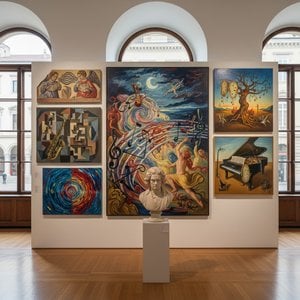
Harmonies on Canvas: Exploring the Visual Representation of Music in Art History
Explore the fascinating history of music's visual representation in art! From ancient symbolism to modern abstraction, discover how artists have captured sound and emotion on canvas. Expert insights & stunning examples.