


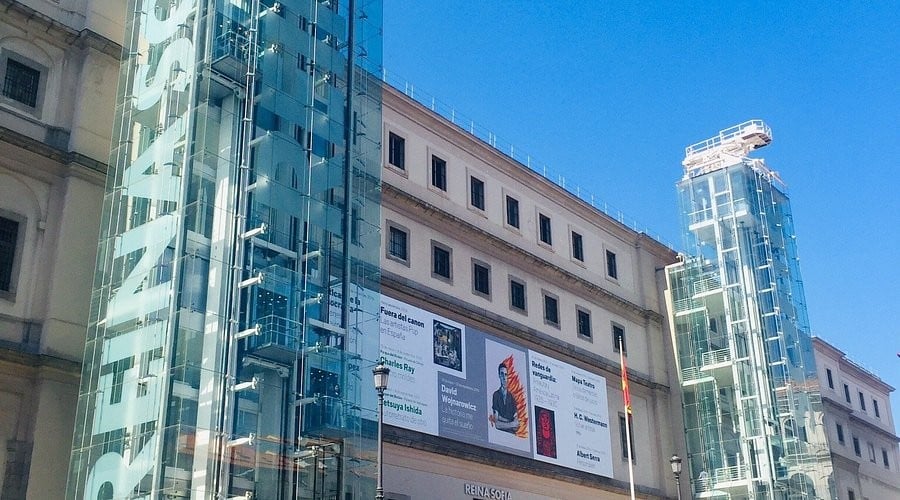
Museo Nacional Centro de Arte Reina Sofía: A Journey Through Spanish Modernity
Nestled in the heart of Madrid, amidst the celebrated “Golden Triangle of Art” alongside the Prado and Thyssen-Bornemisza museums, lies the Museo Nacional Centro de Arte Reina Sofía—a vibrant testament to 20th-century artistic evolution. More than just a repository of masterpieces, it’s an immersive experience that transports visitors through the turbulent and transformative landscape of Spanish art, reflecting both national identity and global influences.
The museum’s story is inextricably linked to its building: originally conceived as a hospital in the late 18th century, it underwent decades of evolution before finally blossoming into the dynamic cultural institution we know today. The very stones seem to whisper tales of healing transformed into inspiration, of suffering giving way to creative expression.
The initial vision of José de Hermosilla and later Francisco Sabatini for a grand neoclassical hospital laid the foundation, but it was the subsequent interventions—most notably those of Ian Ritchie in 1989 with his striking glass circulation towers, and Jean Nouvel’s expansion in 2005—that truly defined its modern character. These additions weren’t merely architectural enhancements; they were dialogues between past and present, creating a space where history doesn’t constrain creativity but rather fuels it.
The Collection: Picasso, Dalí, Miró and Beyond
At the heart of this collection resides Guernica by Pablo Picasso, an icon of artistic anguish born from the horrors of the Spanish Civil War. Its fragmented imagery—a searing indictment of violence—continues to resonate with viewers today, cementing its place as one of the most potent artworks of the 20th century.
Alongside Picasso’s monumental masterpiece, the Reina Sofía boasts an impressive assemblage of works by Salvador Dalí, showcasing his surrealist explorations into dreams and subconsciousness. Pieces like *The Endless Enigma* and *Swans Reflecting Elephants* invite contemplation and offer glimpses into Dalí’s singular artistic universe.
Joan Miró’s vibrant canvases—characterized by playful abstraction and bold color palettes—transport viewers to realms of innocence and wonder. His sculptures, too, contribute to the museum’s distinctive aesthetic.
Architectural Transformation: A Dialogue Between Eras
The Museo Reina Sofía's architectural journey mirrors its artistic evolution. Initially conceived as a hospital in the late 18th century, the building underwent significant transformations throughout the centuries before being repurposed as an art center in 1986.
The original structure—designed by José de Hermosilla and Francesco Sabatini—was a grand neoclassical edifice reflecting Madrid’s imperial ambitions. However, Ian Ritchie's intervention in 1989 dramatically altered its identity with the addition of three towering glass circulation towers, creating a dynamic interplay between history and contemporary design.
Jean Nouvel’s expansion in 2005 further enriched the museum’s architectural landscape, introducing innovative spaces for exhibitions and enhancing visitor experience. The careful consideration given to light, space, and circulation underscores its commitment to preserving heritage while embracing artistic innovation.
## Museo Nacional Centro de Arte Reina Sofía- Established: September 10, 1992
- Location: Madrid
- Coordinates: 40°24′30.85715″N 3°41′38.38596″W
- Website: https://www.museoreinasofia.es/
- The Museo Nacional Centro de Arte Reina Sofía (“Queen Sofía National Museum Art Centre”; MNCARS) is Spain’s national museum of 20th-century art.
- It was officially inaugurated on September 10, 1992, and is named for Queen Sofía.
- It is located in Madrid, near the Atocha train and metro stations, at the southern end of the so-called Golden Triangle of Art (located along the Paseo del Prado and also comprising the Museo del Prado and the Museo Thyssen-Bornemisza).
- The museum’s collection is mainly dedicated to Spanish art. Highlights of the museum include collections of Spain’s two greatest 20th-century masters, Pablo Picasso and Salvador Dalí.
- Certainly, the most famous masterpiece in the museum is Picasso's painting Guernica.
- The Reina Sofía collection has works by artists such as Joan Miró, Eduardo Chillida, Pablo Gargallo, Julio González, Luis Gordillo, Juan Gris, José Gutiérrez Solana, Lucio Muñoz, Jorge Oteiza, Julio Romero de Torres, Pablo Serrano, and Antoni Tàpies.
- International art represented in the collection include works by Francis Bacon, Joseph Beuys, Pierre Bonnard, Georges Braque, Alexander Calder, Robert Delaunay, Max Ernst, Lucio Fontana, Sarah Grilo, Damien Hirst, Donald Judd, Vasily Kandinsky, Paul Klee, Yves Klein, Fernand Léger, Jacques Lipchitz, René Magritte, Henry Moore, Bruce Nauman, Gabriel Orozco, Nam June Paik, Mark Rothko, Richard Serra, Cindy Sherman, Clyfford Still, Yves Tanguy, and Wolf Vostell.
- The Museo Reina Sofía’s architectural journey is as compelling as its art collection. Initially conceived as a hospital in the late 18th century, the building underwent numerous modifications and expansions over the centuries before finally being repurposed as an art center in 1986.
- The original structure, designed by José de Hermosilla and his successor Francisco Sabatini, was a grand neoclassical edifice—a reflection of Madrid’s imperial ambitions. However, it was in 1989 that the building underwent its most dramatic transformation, thanks to the visionary work of Ian Ritchie with the addition of three striking glass circulation towers.
- These towers aren’t merely functional; they are beacons of light and transparency, inviting visitors into the heart of artistic exploration. Further expansion occurred in 2005 with the addition of a new wing designed by French architect Jean Nouvel. This extension not only significantly increased the museum’s floor space but also introduced innovative spaces for temporary exhibitions, auditoriums, and administrative offices.
- The careful consideration given to light, space, and circulation within the museum’s design underscores its commitment to both preserving its heritage and embracing contemporary artistic practices.
- King Philip II centralised all the hospitals that were scattered throughout the court. In the eighteenth century, King Ferdinand VI decided to build a new hospital because the facilities at the time were insufficient for the city. The building was designed by architect José de Hermosilla and his successor Francisco Sabatini who did the majority of the work.
- In 1805, after numerous work stoppages, the building was to assume its function that it had been built for, which was being a hospital, although only one-third of the proposed project by Sabatini was completed. Since then it has undergone various modifications and additions until, in 1969, it was closed down as a hospital.
- Extensive modern renovations and additions to the old building were made starting in 1980. The central building of the museum was once an eighteenth-century hospital.
- The building functioned as the Centro del Arte (Art Centre) from 1986 until established as the Museo Nacional Centro de Arte Reina Sofía in 1988. In 1988, portions of the new museum were opened to the public, mostly in temporary configurations; that same year it was decreed by the Ministry of Culture as a national museum.
- Its architectural identity was radically changed in 1989 by Ian Ritchie with the addition of three glass circulation towers. Museo Nacional Centro de Arte Reina Sofía: A Journey Through Spanish Modernity Nestled in the heart of Madrid, amidst the celebrated “Golden Triangle of Art” alongside the


