- Home

- Stampa su tela
- Pablo Picasso
- Donna seduta 9

 Preview
 Ordina la riproduzione Acquista download
 Invia
Invia
 Condividi
 Dettagli opera
 Aggiungi ai preferiti

 Scarica
 Simili
 Radiografia
 Slideshow
Donna seduta 9


 Scopri di più
Giclée / Stampa d'arte
Stampa giclée o su tela di qualità museale, con produzione rapida e diverse opzioni di finitura.




P118B $10

P118H $10

P118W $10

P438Z $10

P508JH $12

P508YH $12

P805H $10

P805Z $10

P919BZ $10

P919G $10

P919XJ $10

P959ZH $10

P968JZ $12

W106C $8

W218G $10

W218JH $8

W218Y $10

W307PJ $10

W316G $10

W316PJ $8

W316Y $10

W398PJ $8

W4111J $10

W500HY $15

W500JH $15

W692G $12

W849H $8

W940BG $15

W953PJ $8




Scegli tra le nostre dimensioni predefinite, che rispettano le proporzioni originali dell'opera d'arte.

È possibile inserire dimensioni personalizzate per adattare l'opera a una cornice o a uno spazio specifico. Se la dimensione selezionata non corrisponde alle proporzioni dell'immagine originale, procederemo al ritaglio dell'opera o all'estensione dell'immagine con un bordo specchiato o a tinta unita. Un mockup digitale ti verrà inviato per approvazione prima dell'inizio della produzione.
Si prega di notare che l'anteprima a schermo non riflette il ritaglio o l'estensione effettivi. Solo il mockup mostrerà accuratamente la composizione finale.
Sebbene siano disponibili dimensioni personalizzate, si raccomanda di selezionare una dimensione dall'elenco predefinito per preservare le proporzioni originali.
Consegna in tutto il mondo () in 2 settimane invece delle normali 4/5 settimane. (28 Luglio)

Spedizione espressa gratuita in tutto il mondo

Tela in lino di alta qualità

Assicurazione completa sulla spedizione

Garanzia di rimborso dei dazi doganali

Garanzia di fedeltà cromatica

Politica di reso entro 60 giorni (solo per difetti)

Garanzia di rimborso al 100%

Sconto per acquisti multipli
 L'opzione vetro è disponibile solo per dimensioni inferiori a 110 cm

Donna seduta 9
Giclée / Stampa d'arte
Dimensioni riproduzione
-


Prezzo totale finale
-
Descrizione dell'opera
A Revolutionary Vision: Deconstructing Form in Picasso’s “Seated Woman 9”
Pablo Ruiz Picasso, born in Malaga, Spain, in 1881, stands as one of the most influential figures in twentieth-century art. His artistic journey began with rigorous academic training under his father, José Ruiz y Blasco, mastering realistic depiction from a young age—a foundation that would soon be challenged by an unwavering desire to explore new frontiers of expression. This early mastery wasn’t merely technical; it foreshadowed an intellectual curiosity and a rebellious spirit that propelled him toward groundbreaking innovations. The family’s subsequent relocations fostered immersion in vibrant cultural landscapes where Picasso honed his skills and began to formulate the conceptual bedrock of his future artistic endeavors.- Cubism: Picasso's artistic trajectory took its decisive turn around 1907, alongside Georges Braque, initiating a movement that fundamentally altered perceptions of visual representation. Rejecting traditional perspective—the Renaissance ideal of depicting reality from a single viewpoint—Cubism sought to capture the totality of experience through multiple perspectives simultaneously.
- Analytical Cubism: This initial phase focused on dissecting objects into geometric planes and angles, rendering them in muted tones—primarily browns and grays—to emphasize their structural components. Picasso’s aim wasn't to reproduce what he saw but rather how the mind perceives form through simultaneous viewpoints.
- Synthetic Cubism: Embracing a more optimistic outlook, Synthetic Cubism incorporated brighter colors and collage elements—fragments of newspaper or fabric—to enrich the visual tapestry and convey emotional resonance. This approach signaled a shift toward reintegrating form and color into a unified composition.
Decoding the Language of Cubism
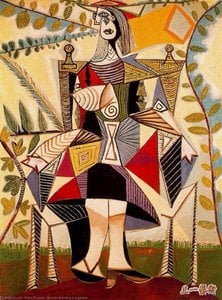
The artwork exemplifies Cubist principles through its bold geometric shapes, fractured planes, and deliberate rejection of single-point perspective. Picasso doesn’t aim to replicate *what* he sees but rather *how* he perceives it—how the mind processes form through multiple viewpoints simultaneously. The figures are broken down into angular forms—triangles, rectangles, and intersecting curves—and reassembled in a way that challenges traditional notions of space and representation. This analytical approach, characteristic of Synthetic Cubism pioneered with Georges Braque, creates a sense of depth despite the overall flatness of the composition.Palette & Technique: A Symphony of Color and Texture
A vibrant color palette dominates “Seated Woman 9,” featuring intense yellows, reds, blacks, and whites—a deliberate departure from naturalistic skin tones designed to amplify emotional impact. The application of paint appears meticulous and layered, building volume within the flattened planes. Though seemingly spontaneous, this technique demanded profound understanding of color theory and careful consideration of compositional balance. Executed likely in oil paints on canvas, the work showcases rich pigmentation and subtle textural variation—a testament to Picasso’s mastery of artistic craft. The background is rendered in muted grays and browns, providing grounding and subtly contrasting with the energetic foreground figures.Picasso & The Birth of Cubism: A Historical Perspective
To fully appreciate this artwork, understanding its historical context is paramount. Picasso’s artistic journey began with rigorous academic training under his father, mastering realistic depiction from a young age—a foundation that would soon be challenged by an unwavering desire to explore new frontiers of expression. Inspired by Post-Impressionists like Cézanne and profoundly influenced by African masks and Iberian sculpture encountered at the Trocadéro Museum in Paris, Picasso embarked on a radical experiment that would become Cubism—not merely an aesthetic shift but a philosophical one. This movement questioned the Renaissance ideal of representing the world from a fixed viewpoint, aiming instead to capture its totality through multiple perspectives simultaneously.Symbolism & Emotional Resonance
The symbolism within “Seated Woman 9” remains open to interpretation—a hallmark of Cubist works. However, the fragmentation of the figures can be seen as reflecting anxieties and uncertainties inherent in modern life. The disjointed forms might symbolize the breakdown of traditional structures—social, artistic, and perhaps even psychological. The intensity of color and angularity contribute to a feeling of unease or tension, hinting at complex inner lives within the subjects. This is not simply a portrait; it’s an exploration of perception, identity, and the human condition in a rapidly changing world.A Statement Piece for Contemporary Spaces
This artwork would serve as a captivating focal point in any modern or contemporary interior. Its bold colors and dynamic composition demand attention, sparking conversation and adding intellectual depth to a space. The abstract nature allows it to complement diverse design styles—from minimalist to eclectic. A high-quality reproduction captures the essence of Picasso’s genius, bringing a piece of art history into your home or office. It's an investment in both aesthetic beauty and artistic legacy, offering a constant source of inspiration and contemplation. Consider pairing it with neutral tones to allow the artwork's vibrancy to truly shine. Photo Description: --Overall Impression-- The artwork is a Cubist portrait of two figures presented in an abstracted and fragmented manner. It’s dominated by bold, geometric shapes and a vibrant color palette. The composition is dynamic and slightly unsettling due to the disjointed representation of the subjects. The figures are broken down into planes and angles, creating a sense of depth through overlapping forms rather than traditional perspective. Lines are angular and sharply defined, contributing to the Cubist style. Shapes include triangles, rectangles, and curved lines, all intersecting and interacting with each other. The color palette is intensely bright and contrasting – primarily featuring yellows, reds, blacks, and whites. Texture appears flat, typical of this style, suggesting a two-dimensional representation despite the illusion of depth. The subject matter is clearly human figures, but their identity is obscured by the abstraction. There's an emotional quality conveyed through the intensity of color and the fragmented form, hinting at tension or perhaps a commentary on modern life. The technique involves layering paint to create the illusion of volume within the flat planes. Materials used are likely oil paints on canvas.Opere simili


Biografia dell'artista
Pablo Picasso: Un Artista Rivoluzionario
Primi Anni di Vita e Formazione (1881-1904)
- Nato il 25 ottobre 1881 a Málaga, in Spagna, Pablo Ruiz y Picasso dimostrò un talento artistico fin da piccolissimo.
- Suo padre, José Ruiz y Blasco, era un insegnante d'arte che gli fornì una formazione precoce. Si dice che le prime parole di Picasso fossero “piz, piz” – cercando di dire ‘matita’.
- Picasso superò rapidamente le capacità del suo padre, mostrando un’abilità notevole nelle rappresentazioni naturalistiche.
- La famiglia si trasferì a A Coruña e successivamente a Barcellona dopo la tragica perdita della sorella di Picasso.
- A Barcellona, frequentò la Scuola d'Arti Visive ma spesso entrò in conflitto con le istruzioni accademiche tradizionali. Studiò brevemente alla Royal Academy of San Fernando a Madrid, trovandola soffocante e preferendo studiare i maestri come Velázquez e Goya in modo indipendente.
Il Periodo Blu e Rosa (1901-1906)
- Il Periodo Blu (circa 1901-1904) è caratterizzato da dipinti malinconici dominati da sfumature di blu e verde acqua.
- Questi lavori raffigurano spesso figure emarginate – mendicanti, ciechi, prostitute – riflettendo malinconia e commento sociale. Esempi chiave includono La Vie (1903) e L'Oldista (1903-1904).
- Successivamente, il Periodo Rosa (1904-1906) emerse con tonalità più calde – rosa, arancione e rosso.
- Questo periodo riflette una prospettiva più ottimista, spesso ritraendo artisti di circo, harlequini e acrobati. Famiglia dei Saltimbanchi (1905) ne è un esempio.
Gli Anni Rivoluzionari: Cubismo e Oltre (1907-1919)
- Il 1907 ha segnato un momento cruciale con Les Demoiselles d'Avignon, influenzato dalla scultura iberica e dalle maschere africane. Questo dipinto infranse la prospettiva tradizionale, aprendo la strada al Cubismo.
- Lavorando a stretto contatto con Georges Braque, Picasso co-fondò il Cubismo, trasformando radicalmente il modo in cui gli artisti rappresentavano la realtà.
- Cubismo Analitico (1909-1912) presentava forme frammentate, colori tenui e una dissezione degli oggetti in forme geometriche.
- Cubismo Sintetico (1912-1919) incorporava elementi di collage – ritagli di giornale, stracci – per creare superfici testurizzate e nuovi livelli visivi.
Neoclassicismo e Surrealismo (Anni '20 - Anni '30)
- Gli anni '20 hanno visto Picasso esplorare stili neoclassici con figure monumentali che enfatizzavano le forme classiche.
- Ha anche interagito con il movimento surrealista, pur non allineandosi pienamente ai suoi principi. La sua opera ha combinato stili precedenti con immagini surrealiste e prospettive distorte.
Anni Successivi e Eredità (1940-1973)
- Durante la Seconda Guerra Mondiale, Picasso è rimasto in Francia, producendo dichiarazioni anti-guerra potenti come Guernica (1937), una risposta viscera al bombardamento di Guernica durante la guerra civile spagnola.
- Guernica è diventata un simbolo duraturo degli orrori della guerra e rimane uno dei suoi lavori più celebrati.
- Nel corso degli anni '50 e '60, Picasso ha continuato a sperimentare con vari mezzi – ceramiche, sculture, stampe – dimostrando una versatilità notevole.
- Si è sposato con Jacqueline Roque nel 1961. È morto il 8 aprile 1973 a Mougins, in Francia.
Influenze e Significato Storico
- Lo sviluppo artistico di Picasso fu plasmato da maestri spagnoli come Velázquez e Goya, dalla scultura iberica, dall'arte africana e da Henri Matisse.
- Il suo impatto sull'arte del XX secolo è incommensurabile. Ha co-fondato il Cubismo, ha pionieristicamente utilizzato collage e sculture costruite e ha costantemente sfidato le convenzioni artistiche.
- L'incessante sperimentazione di Picasso ha ridefinito l'arte moderna e continua a ispirare gli artisti oggi.
- La sua produzione prolifica – stimata in oltre 50.000 opere – consolida la sua posizione come uno degli artisti più importanti e influenti della storia.

Pablo Picasso
1881 - 1973 , Spagna
Dati rapidi
- Artisti Che Hanno Influenzato Questo Artista:
- Velázquez
- Goya
- Henri Matisse
- Data Di Morte: 8 aprile 1973
- Data Di Nascita: 25 ottobre 1881
- Luogo Di Nascita: Malaga, Spagna
- Movimento Artistico: Cubismo, Surrealismo
- Nazionalità: Spagnola
- Nome Completo: Pablo Ruiz y Picasso
- Opere Notevoli:
- Les Demoiselles d'Avignon
- Guernica
- La Vie
- L'Oldista
- Famiglia dei Saltimbanchi
Articoli correlati

Astrazione Geometrica: 10 Capolavori che Hanno Definito un Movimento Artistico
Esplora i 10 capolavori dell'Astrazione Geometrica: Mondrian, Malevich e Kandinsky rivoluzionano l'arte moderna. Scopri la storia, i colori e le tecniche di questi movimenti iconici. Stampe d'arte di alta qualità su ArtsDot.com!
Cubismo Espressivo: 10 Capolavori che Hanno Definito un Movimento Artistico Rivoluzionario
Esplora i 10 capolavori del Cubismo Espressivo con ArtsDot.com! Scopri Picasso, Braque e Gris, la storia di questo rivoluzionario movimento artistico e lasciati ispirare per decorare casa con arte di alta qualità. Esplora la collezione online!
Cubismo Espressionista: 10 Capolavori che Hanno Definito un Movimento Artistico Rivoluzionario
Esplora i 10 capolavori che hanno rivoluzionato l'arte con il Cubismo Espressionista! Scopri Picasso, Braque e altri maestri. Quadri famosi, tecniche innovative e colori audaci ti aspettano su ArtsDot.com. Trova la tua prossima opera d'arte!

I 10 Capolavori Cubisti che Hanno Rivoluzionato il Ritratto | ArtsDot
Esplora i 10 capolavori cubisti che hanno rivoluzionato il ritratto! Scopri Picasso, Braque e Gris e la storia di questo movimento artistico. Trova riproduzioni d'arte di alta qualità per decorare casa con stile su ArtsDot.com.

Pablo Picasso: Rivoluzione Cubista, Simbolismo e un'Eredità Duratura nell'Arte Moderna
Esplora la rivoluzione artistica di Pablo Picasso e il Cubismo con ArtsDot. Scopri le origini, l'evoluzione stilistica e l'eredità duratura del maestro spagnolo. Guide all'acquisto e valutazione per collezionisti esperti.