


 Anteprima in scala reale
 Condividi
 Condividi
 Dettagli
 Guida stampabile

 Scarica
 Articoli simili
 Radiografia
 Slideshow
 Statistiche
Plastik, (2)

 Leggi tutto
Giclée / Stampe d'arte
Stampa giclée o su tela di qualità museale, con produzione rapida e diverse opzioni di finitura. ( Ordina la riproduzione dipinta a mano Passa all'immagine digitale)




































Scegli tra le nostre dimensioni predefinite, che rispettano le proporzioni originali dell'opera d'arte.

È possibile inserire dimensioni personalizzate per adattare l'opera a una cornice o a uno spazio specifico. Se la dimensione selezionata non corrisponde alle proporzioni dell'immagine originale, procederemo al ritaglio dell'opera o all'estensione dell'immagine con un bordo specchiato o a tinta unita. Un mockup digitale ti verrà inviato per approvazione prima dell'inizio della produzione.
Si prega di notare che l'anteprima a schermo non riflette il ritaglio o l'estensione effettivi. Solo il mockup mostrerà accuratamente la composizione finale.
Sebbene siano disponibili dimensioni personalizzate, si raccomanda di selezionare una dimensione dall'elenco predefinito per preservare le proporzioni originali.
Consegna in tutto il mondo () in 2 settimane invece delle normali 4/5 settimane. (25 Settembre)

Spedizione espressa gratuita in tutto il mondo

Tela in lino di alta qualità

Assicurazione completa sulla spedizione

Garanzia di rimborso dei dazi doganali

Garanzia di perfetta fedeltà cromatica

Politica di reso entro 100 giorni (solo per difetti di fabbricazione)

Garanzia di rimborso al 100%

Sconto per acquisti multipli
 L'opzione vetro è disponibile solo per dimensioni inferiori a 110 cm

Plastik, (2)
Giclée / Stampe d'arte
Dimensioni della riproduzione
-


Prezzo totale
$ 62
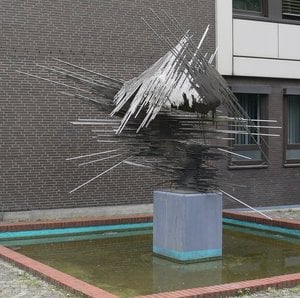
Plastik, (2) (1980) di Norbert Kricke: Un'Esplorazione Minimalista della Forma
- Artista: Norbert Kricke
- Data: 1980
- Mezzo: Scultura in Metallo
Soggetto e Descrizione
“Plastik, (2)” è una sorprendente scultura in metallo realizzata dal pittore tedesco Norbert Kricke nel 1980. L'opera si presenta come una rappresentazione astratta di un albero, costruita da tubi metallici interconnessi. Questi tubi sono disposti meticolosamente per imitare la struttura ramificata di un albero naturale, con il materiale metallico che forma ciò che sembra essere foglie. La scultura è situata in un ambiente urbano, come testimoniato dagli edifici visibili sullo sfondo. Due panchine aggiungono un elemento umano e suggeriscono uno spazio per la contemplazione o l'interazione con l'opera d'arte. Tre piante in vaso contribuiscono ad ammorbidire l'estetica industriale, introducendo forme organiche nella composizione.
Stile e Tecnica: Influenze Minimaliste & L’Art Informel
“Plastik, (2)” di Kricke esemplifica sia il Minimalismo che elementi dell'"Art Informel". La costruzione geometrica della scultura e l'uso di materiali industriali sono tratti distintivi del movimento minimalista, che mirava a ridurre l'arte alla sua forma essenziale ed eliminare le immagini rappresentative. Tuttavia, la qualità organica e fluida dei rami e il senso generale di crescita dinamica suggeriscono un’influenza dall'"Art Informel", un movimento artistico europeo del dopoguerra caratterizzato dall'astrazione spontanea e gestuale. La tecnica di Kricke coinvolge una saldatura e un assemblaggio abili di tubi metallici per creare questa complessa, ma apparentemente semplice struttura. La scelta del metallo conferisce un senso di permanenza e forza industriale, mentre le linee fluide introducono un elemento di fragilità.
Contesto Storico: ZERO Group & Astrazione del Dopoguerra
Quest'opera è stata creata in un periodo di significativo sperimentalismo artistico nell'Europa del dopoguerra. Kricke era associato al gruppo ZERO, una collettiva internazionale di artisti che rifiutavano le nozioni tradizionali d'arte e abbracciavano materiali industriali e processi tecnologici. ZERO mirava a creare arte che riflettesse l’attenzione dell’epoca per la scienza, la tecnologia e l’esplorazione spaziale. “Plastik, (2)” si allinea con questo spirito attraverso l'uso del metallo – un materiale sinonimo di industria – e la sua forma astratta, che si discosta dalle rappresentazioni tradizionali della natura. La scultura riflette anche una tendenza più ampia nell’arte del dopoguerra verso l’astrazione, poiché gli artisti cercavano nuovi modi per esprimere emozioni e idee al di là delle forme figurative convenzionali.
Simbolismo e Impatto Emotivo
Sebbene astratta, “Plastik, (2)” evoca potenti associazioni simboliche. La forma dell'albero, anche resa in metallo, suggerisce crescita, resilienza e connessione con la natura – temi che risuonano profondamente nell’esperienza umana. La presenza della scultura in un ambiente urbano crea una suggestiva giustapposizione tra il naturale e l'artificiale, invitando alla riflessione sul rapporto dell'umanità con l'ambiente circostante. L'opera ispira un senso di calma contemplazione; le linee fluide e la composizione equilibrata creano un effetto visivamente armonioso. È imponente nelle dimensioni e delicata nell’esecuzione, invitando gli spettatori ad apprezzare la bellezza dei materiali industriali trasformati in una suggestiva dichiarazione artistica.
Opere correlate


Biografia dell'artista
Norbert Kricke: Sculpting the Flow of Space and Time
Norbert Kricke (1922-1984) wasn’t merely a sculptor; he was an architect of perception, a pioneer who wrestled with the very essence of space and movement. Born in Düsseldorf during a period of profound societal upheaval following World War II, Kricke’s artistic journey was deeply intertwined with the post-war desire to rebuild—not just physical structures, but also the foundations of human experience. His work, often characterized by its stark minimalism and evocative use of wire, steel, and concrete, represents a pivotal moment in the evolution of abstract sculpture, bridging the gap between the formal rigor of the Constructivists and the expressive freedom of L’Art Informel.
Kricke's early artistic training under Richard Scheibe and Hans Uhlmann at the Hochschule für Bildende Künste in Berlin provided him with a crucial grounding in traditional sculptural techniques. However, he quickly moved beyond mere representation, seeking to capture something far more elusive: the dynamic quality of space itself. This shift was profoundly influenced by his exposure to the theories of John Anthony Thwaites, particularly their exploration of “Forms of Water,” which posited that space and time were inextricably linked—a concept Kricke sought to embody in his sculptures.
The Dawn of Raumplastik
Kricke’s breakthrough came with the development of what he termed *Raumplastiken* – ‘spatial sculptures.’ These weren't static objects; they were investigations into the very fabric of space, utilizing wire as a primary medium. Unlike earlier sculptors who focused on mass and volume, Kricke concentrated on line—the fundamental element that defines form and creates the illusion of depth. He meticulously crafted these lines, often employing complex geometric patterns, to suggest movement and dynamism within a confined space. This approach was revolutionary, challenging conventional notions of sculpture as a three-dimensional object and instead presenting it as an active participant in shaping our perception.
Early examples like *Raumplastik Gelb* (1951) demonstrate this shift powerfully. The work’s seemingly simple arrangement of wire immediately draws the eye, inviting viewers to trace the lines and contemplate their relationship to the surrounding space. This focus on line continued to evolve throughout his career, culminating in works that appeared almost fluid, capturing the essence of movement without depicting it literally.
Connections to L'Art Informel and Beyond
Kricke’s work resonated deeply with the burgeoning L’Art Informel movement, a post-war European artistic current characterized by its rejection of formal constraints and embrace of spontaneous expression. However, Kricke distinguished himself within this group through his rigorous intellectual approach and his systematic exploration of spatial relationships. He also maintained close ties with ZERO, a German collective that similarly challenged traditional sculptural conventions, and the Nouveau Réalisme movement in France, demonstrating a broad awareness of international artistic trends.
His collaboration with Yves Klein on exploring the properties of light and space further solidified his position as a key figure in the avant-garde. The influence of Walter Gropius is also notable, particularly in Kricke’s design for water configurations for the new university complex in Baghdad – a project that underscored his belief in the interconnectedness of art, science, and human experience.
Major Works and Legacy
Throughout his career, Kricke created numerous significant works, including the iconic *Water Forest* sculpture outside the Gelsenkirchen Opera House (1957), a testament to his fascination with flowing water and its transformative power. His wire sculptures for Münster Theatre (1955/56) and fountains for the University of Baghdad showcased his versatility and technical skill. Perhaps most notably, Kricke served as director of the Düsseldorf Art Academy from 1972 until his death in 1984, shaping a generation of artists.
Kricke’s legacy extends far beyond his individual creations. He fundamentally altered our understanding of sculpture, demonstrating that form and space are not mutually exclusive but rather inextricably linked. His pioneering use of wire as a medium—a material often associated with industry and construction—transformed it into a tool for exploring the most profound questions about human perception and the nature of reality. His work continues to inspire artists today, reminding us of the power of art to challenge conventions and expand our horizons.
Further Exploration
- Plastik, (2) (1980): Explore Norbert Kricke’s ‘Plastik, (2)’ (1980) – a striking metal sculpture blending Minimalist and L’Art Informel influences. A unique German artwork for collectors. Link to Artwork Database
- Raumplastik grosse kurve i, (2) (1980): Discover Norbert Kricke’s ‘Raumplastik grosse kurve i,’ a striking Minimalist sculpture in a park setting. Explore this 1980 German artwork's metal form & integration with nature. Link to Artwork Database
- Raum-Zeit-Plastik, (1956): Discover Norbert Kricke’s ‘Raum-Zeit-Plastik’ (1956) – a striking concrete architectural photograph. Minimalist, geometric & evocative of mid-century German art. Link to Artwork Database
- Norbert Kricke - Wikipedia: Link to Wikipedia
norbert kricke
1922 - 1984
Informazioni rapide
- Artistic Movement Or Style: Minimalist Sculpture, L’Art Informel, ZERO group
- Artists Who Influenced This Artist: ['Richard Scheibe, Hans Uhlmann],\n "Artists or movements influenced by this artist": ["Yves Klein", "John Anthony Thwaites"]\n}']
- Date Of Birth: November 30, 1922
- Date Of Death: June 28, 1984
- Full Name: Norbert Kricke
- Nationality: German
- Notable Artworks:
- Plastik, (2) (1980)
- Raumplastik grosse kurve i, (2) (1980)
- Raum-Zeit-Plastik, (1956)
- Place Of Birth: Düsseldorf, Germany
Articoli correlati

I 10 Capolavori in Bronzo che Hanno Rivoluzionato la Storia dell'Arte | ArtsDot
Esplora i 10 capolavori in bronzo che hanno segnato la storia dell'arte! Da Michelangelo a Rodin, scopri le storie e le tecniche dietro queste statue iconiche. Trova riproduzioni artistiche di alta qualità per decorare casa tua con ArtsDot.com.

L'Eredità Duratura della Scultura in Bronzo: Storia, Tecniche e Interpretazioni Contemporanee
Esplora la storia e l'arte della scultura in bronzo con . Scopri tecniche antiche, maestri iconici e consigli per collezionisti esperti. Acquista riproduzioni di alta qualità!

The Enduring Form: Exploring Themes & Techniques in Sculpture Across Historical Periods
Explore the rich history of sculpture from ancient masterpieces to contemporary innovations. Discover key techniques, influential artists & investment potential for discerning art collectors.

I 10 Capolavori Bronzei che Hanno Rivoluzionato la Storia dell'Arte | ArtsDot
Esplora i 10 capolavori bronzei che hanno segnato la storia dell'arte! Da Rodin a Michelangelo, scopri le storie e le tecniche dietro queste sculture iconiche. Trova riproduzioni d'arte di alta qualità per decorare la tua casa con ArtsDot.com.

The Enduring Form: Sculpture Across History, Technique & Emotional Resonance
Explore the rich history of sculpture with ArtsDot. Discover key techniques, influential artists & investment potential for discerning collectors. Expert insights into valuing and collecting timeless masterpieces.
