


 Anteprima in scala reale
 Condividi
 Condividi
 Dettagli
 Guida
Guida

 Scarica
 Articoli simili
 Radiografia
 Slideshow
 Statistiche
Progression


 Leggi tutto
Giclée / Stampe d'arte
Stampa giclée o su tela di qualità museale, con produzione rapida e diverse opzioni di finitura. ( Ordina la riproduzione dipinta a mano Passa all'immagine digitale)




































Scegli tra le nostre dimensioni predefinite, che rispettano le proporzioni originali dell'opera d'arte.

È possibile inserire dimensioni personalizzate per adattare l'opera a una cornice o a uno spazio specifico. Se la dimensione selezionata non corrisponde alle proporzioni dell'immagine originale, procederemo al ritaglio dell'opera o all'estensione dell'immagine con un bordo specchiato o a tinta unita. Un mockup digitale ti verrà inviato per approvazione prima dell'inizio della produzione.
Si prega di notare che l'anteprima a schermo non riflette il ritaglio o l'estensione effettivi. Solo il mockup mostrerà accuratamente la composizione finale.
Sebbene siano disponibili dimensioni personalizzate, si raccomanda di selezionare una dimensione dall'elenco predefinito per preservare le proporzioni originali.
Consegna in tutto il mondo () in 2 settimane invece delle normali 4/5 settimane. (25 Settembre)

Spedizione espressa gratuita in tutto il mondo

Tela in lino di alta qualità

Assicurazione completa sulla spedizione

Garanzia di rimborso dei dazi doganali

Garanzia di perfetta fedeltà cromatica

Politica di reso entro 100 giorni (solo per difetti di fabbricazione)

Garanzia di rimborso al 100%

Sconto per acquisti multipli
 L'opzione vetro è disponibile solo per dimensioni inferiori a 110 cm

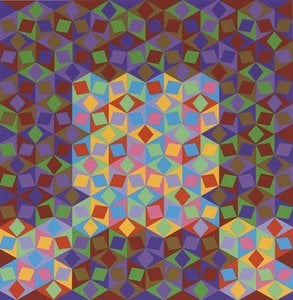
Progression
Giclée / Stampe d'arte
Dimensioni della riproduzione
-


Prezzo totale
$ 62
Opere correlate



Biografia dell'artista
Horacio García Rossi: Architect of Illusion
Horacio García Rossi (1929 – 2012) stands as a singular figure in the landscape of twentieth-century art, recognized primarily for his pioneering contributions to Op Art and Kinetic Art. Born in Buenos Aires, Argentina, he embarked on an artistic journey marked by intellectual curiosity and a profound engagement with scientific principles—a duality that would permeate his distinctive visual language. His formative years were spent honing his skills at the Escuela de Publicidad de Buenos Aires before furthering his education at the Escuela Nacional de Bellas Artes, establishing a foundation for his subsequent explorations into abstraction and perceptual manipulation. A pivotal moment arrived in 1959 when García Rossi relocated to Paris, initiating a period of intense artistic experimentation within the Groupe de Recherche d’Art Visuel (Grav), alongside luminaries like Eduardo José Nery de Oliveira Goih and Héctor García Miranda. Grav served as a crucible for innovative ideas concerning visual perception, propelling García Rossi toward groundbreaking investigations into optical illusions and movement—concepts that would become central to his oeuvre. He wasn't merely replicating visual phenomena; he was actively reshaping them, challenging viewers’ assumptions about reality itself. This group fostered discussions on how the human eye perceives depth and color, influencing García Rossi’s approach to creating artworks that defied conventional perspective. Garcia Rossi’s artistic style is instantly recognizable by its mesmerizing execution. Utilizing geometric shapes – circles, squares, triangles – arranged in patterns that subtly shift and vibrate across the canvas, he achieved an extraordinary feat: creating artworks that appear to defy conventional perspective. This technique—often described as “optical illusion”—was heavily influenced by developments in mathematics, physics, and cybernetics, reflecting a broader fascination with harnessing scientific understanding to unlock artistic potential. His canvases aren’t passive surfaces; they are active participants in the perceptual process, inviting contemplation on how our eyes perceive depth and movement. He meticulously crafted his compositions, aiming for an unsettling yet captivating experience for the observer—a deliberate disruption of visual expectations. Throughout his prolific career spanning decades, García Rossi exhibited extensively across Europe, North America, and Asia, garnering critical acclaim for his daring explorations of visual perception. His work resides within prestigious collections worldwide, cementing his legacy as a visionary artist who fundamentally altered the trajectory of abstract art. Notably, Palazzo Rossi in Genoa houses a remarkable collection showcasing his artistic achievements alongside other Baroque masterpieces—a testament to his enduring influence on the history of art and a celebration of Argentinian-French cultural exchange. His dedication to pushing artistic boundaries earned him recognition as one of the foremost practitioners of Kinetic Art, demonstrating a commitment to engaging viewers on multiple sensory levels. His exploration into Kinetic Art solidified his reputation as an innovator. García Rossi’s installations incorporated movement – often subtle vibrations or rotations – further amplifying the illusionistic effects achieved in his paintings, pushing the boundaries of artistic expression and demonstrating a commitment to engaging viewers on multiple sensory levels. He wasn't simply interested in static images; he sought to capture the dynamism inherent within our experience of the world. This approach distinguished him from many contemporaries and underscored his belief that art could transcend mere visual representation, fostering a deeper connection between artist and audience.
Horacio García Rossi
1929 - 2012 , Argentina
Informazioni rapide
- Artistic Movement Or Style: Op Art & Kinetic Art
- Artists Or Movements Influenced By This Artist: ["Groupe de Recherche d'Art Visuel"]
- Artists Who Influenced This Artist:
- Eduardo José Nery de Oliveira Goih
- Hector García Miranda
- Date Of Birth: Luglio 24, 1929
- Date Of Death: Settembre 5, 2012
- Full Name: Horacio Garcia Rossi
- Nationality: Argentino-Francese
- Notable Artworks: ['Progressione']
- Place Of Birth: Buenos Aires, Argentina