


 Anteprima in scala reale
 Condividi
 Condividi
 Dettagli

 Scarica immagine
 Articoli simili
 Radiografia
 Slideshow
untitled (4219)


 Leggi tutto
Riproduzione a olio fatta a mano
Olio su tela dipinto a mano nelle tue dimensioni e con la tua cornice, realizzato su ordinazione dai nostri artisti. ( Passa alla stampa Passa all'immagine)




P118B $10

P118H $10

P118W $10

P438Z $10

P508JH $12

P508YH $12

P805H $10

P805Z $10

P919BZ $10

P919G $10

P919XJ $10

P959ZH $10

P968JZ $12

W106C $8

W218G $10

W218JH $8

W218Y $10

W307PJ $10

W316G $10

W316PJ $8

W316Y $10

W398PJ $8

W4111J $10

W500HY $15

W500JH $15

W692G $12

W849H $8

W940BG $15

W953PJ $8




Scegli tra le nostre dimensioni predefinite, che rispettano le proporzioni originali dell'opera d'arte.

È possibile inserire dimensioni personalizzate per adattare l'opera a una cornice o a uno spazio specifico. Se la dimensione selezionata non corrisponde alle proporzioni dell'immagine originale, provvederemo a ritagliare l'opera o a estendere il dipinto con elementi aggiuntivi dipinti a mano. Un mockup digitale ti sarà inviato per approvazione prima dell'inizio della produzione.
Si prega di notare che l'anteprima a schermo non riflette il ritaglio o l'estensione effettivi. Solo il mockup mostrerà accuratamente la composizione finale.
Sebbene siano disponibili dimensioni personalizzate, consigliamo di selezionare una dimensione dall'elenco predefinito per preservare le proporzioni originali.
Dopo l'ordine, il team di ArtsDot.com contatterà il cliente via e-mail per le istruzioni e fornirà un'anteprima del mockup
Consegna in tutto il mondo () in 3/4 settimane anziché nelle normali 5 settimane. (7 Agosto). Nessun compromesso sulla qualità.

Spedizione espressa gratuita in tutto il mondo

Tela in lino di alta qualità

Assicurazione completa sulla spedizione

Garanzia di rimborso dei dazi doganali

Garanzia di fedeltà cromatica dell'originale

Politica di reso entro 60 giorni (solo per difetti di fabbricazione)

Garanzia di rimborso al 100%

Sconto per acquisti multipli
 L'opzione vetro è disponibile solo per dimensioni inferiori a 110 cm

untitled (4219)
Tecnica di riproduzione
Dimensioni della riproduzione
-


Prezzo totale
$ 263
Descrizione dell'opera
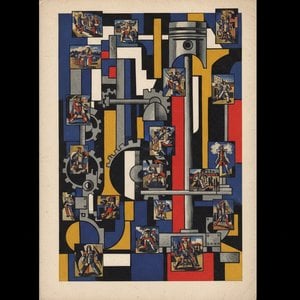
Unveiling the Mechanical Muse: An Exploration of Léger’s “Untitled (4219)”
Fernand Léger's "Untitled (4219)" presents a captivating visual paradox – a scene brimming with classical subject matter – a woman and horse – rendered through the rigorously fractured lens of early Cubism. This work, dating from an unknown period within Léger’s prolific career (1881-1955), embodies his unique approach to modernity: not rejecting representation entirely, but actively engaging with the burgeoning influence of industrial forms and a rapidly changing world. The painting immediately draws the eye to the central figures – a woman in a vibrant red dress, confidently mounted upon a horse whose mane explodes in a brilliant yellow. Yet, this familiar tableau is dramatically deconstructed through Léger’s signature technique. The horse and rider are fragmented into geometric planes, echoing the shapes of machinery and urban structures that dominated the early 20th century. This isn't simply an artistic exercise; it’s a profound commentary on the relationship between humanity and technology.
- Cubist Fragmentation: Léger’s use of geometric forms, characteristic of Cubism, breaks down traditional perspective and representation.
- Mechanical Influence: The fragmented forms directly reflect the impact of industrialization – a key theme in Léger's work.
- Bold Color Palette: The striking juxtaposition of red and yellow adds to the painting’s dynamism and visual intensity.
A Symphony of Forms: Technique and Materiality
Léger’s technique is immediately recognizable, a meticulous layering of paint applied with a deliberate, almost sculptural quality. He employed a dry brushstroke, building up thick impasto in certain areas to create a tactile surface that emphasizes the three-dimensionality of his fragmented forms. The black and white palette intensifies this effect, highlighting the sharp angles and planes of the composition. The artist’s meticulous attention to detail is evident in the rendering of the horse's musculature and the woman’s flowing dress – even within the fractured perspective, a sense of anatomical accuracy prevails. This careful construction suggests a desire not just for visual impact but also for a profound understanding of form, mirroring Léger’s earlier architectural studies.
Symbolism Within the Machine Age
Beyond its purely formal qualities, “Untitled (4219)” is rich in symbolic meaning. The horse, traditionally representing power and nobility, is rendered as a mechanical entity, suggesting a shift in societal values and the rise of industrial dominance. The woman’s confident posture speaks to female agency within this new landscape, while the inclusion of a clock and bowls adds further layers of interpretation. These objects – symbols of time and domesticity – are presented alongside the fragmented forms, creating a tension between the past and the future, tradition and modernity. The placement of the clock in the upper right corner subtly introduces themes of measurement and control, central concerns within Léger’s exploration of the machine age.
Emotional Resonance and Artistic Legacy
"Untitled (4219)" is more than just a visually arresting artwork; it's a powerful statement about humanity’s place in an increasingly mechanized world. Léger’s ability to translate the dynamism of industrial forms into a compelling visual language cemented his position as one of the most important figures of early 20th-century modern art. This piece exemplifies his unique vision, inviting viewers to contemplate the complex relationship between form, function, and human experience. A hand-painted reproduction offers an unparalleled opportunity to appreciate the depth and sophistication of Léger’s artistic legacy.


Biografia dell'artista
vitae e formazione
Fernand Léger, pittore, scultore e filmmaker francese, nacque il 4 febbraio 1881 ad Argentan, Orne, nella bassa Normandia. Suo padre allevava bovini e Léger iniziò la sua formazione come architetto nel 1897-1899. Successivamente si trasferì a Parigi nel 1900, sostenendosi con il lavoro di disegnatore architettonico.sviluppo artistico
Le prime opere di Léger furono influenzate dall'impressionismo, come visto in Le jardin de ma mère (Il giardino di mia madre) (1905). Dopo aver frequentato la scuola d'arte decorativa e l'Académie Julian, iniziò a lavorare seriamente come pittore a 25 anni. Il suo stile si evolse in una forma personale di cubismo, che i critici definirono "tubismo" per la sua enfasi su forme cilindriche.Cubismo e il gruppo dei Puteaux
Nel 1910, Léger espose al Salon d'automne insieme a Jean Metzinger e Henri Le Fauconnier. Entrò nel gruppo dei Puteaux, noto anche come la sezione d'or (la sezione aurea), insieme ad altri artisti come Francis Picabia e Marcel Duchamp.Guerra e la sua influenza sull'opera di Léger
Le esperienze di Léger nella Prima Guerra Mondiale ebbero un impatto significativo sulla sua opera. Durante il suo tempo al fronte, produsse schizzi di pezzi d'artiglieria, aerei e soldati. Il suo dipinto Soldier with a Pipe (1916) riflette questo periodo.Lavoro successivo e eredità
Il lavoro post-bellico di Léger, caratterizzato da forme meccaniche lisce, lo legò alla tradizione della pittura figurativa francese. I suoi paesaggi animati del 1921 mostrarono figure e animali in forme armoniose e razionalizzate.- visualizza le opere di Fernand Léger su ArtsDot
- altro sul Fernand Léger su Wikipedia
- scopri il Musée National Fernand Légère (Francia) con ArtsDot
- La donna seduta (100 x 81 cm, tubismo)
- Elemento macchina (cubismo)

Fernand Léger
1881 - 1955 , Francia
Informazioni rapide
- Artisti Influenti:
- Cézanne
- Impressionismo
- Artisti Influenzati: ['Pop Art']
- Data Di Nascita: 4 febbraio 1881
- Luogo Di Nascita: Argentan, Francia
- Movimento Artistico: Cubismo, Tubismo
- Nazionalità: Francese
- Nome Completo: Fernand Léger
- Opere Notevoli:
- La Grande Parata
- L'Elemento Macchina
- Donna Seduta
- The City
Articoli correlati

John Nost Sartorius: Equestrian Portraiture & the Shifting Social Landscape of 18th-Century England
Explore the captivating equestrian art of John Nost Sartorius (1759-1828). Discover his detailed paintings of racehorses, hunting scenes & aristocratic life. Learn about collecting Sartorius's work and its lasting value.

Crimson Threads of Narrative: Exploring Symbolism & Representation in Artworks Featuring the Red Dress
Explore the rich symbolism of the red dress in art history! From ancient power displays to iconic portraits like Cézanne’s 'Madame Cezanne', discover the cultural and artistic significance behind this captivating color. Expert analysis & insights.

I Maestri del Nero: I 10 Dipinti Più Famosi Dominati dall'Avorio Scuro |
Esplora i 10 dipinti più iconici dominati dal nero avorio! Da Rembrandt a Goya, scopri la storia, le tecniche e l'impatto di capolavori senza tempo. Trova riproduzioni d'arte di alta qualità per decorare casa con .
Fernand Léger: I 25 Capolavori che Hanno Definito l'Arte Moderna | ArtsDot
Esplora i 25 capolavori di Fernand Léger, pioniere del cubismo e del tubismo. Scopri la storia, le tecniche e l'impatto dell'arte moderna francese. Stampe d'arte e riproduzioni su ArtsDot.com.

I 10 Dipinti Più Famosi Dominati dal Nero: Maestri e Storie d'Arte
Esplora i 10 dipinti più iconici dominati dal nero, da Caravaggio a Munch. Scopri storie, tecniche e il potere espressivo di artisti come Rembrandt e Goya. Trova stampe d'arte di alta qualità per la tua casa su .



