


 Anteprima in scala reale
 Condividi
 Condividi
 Dettagli
 Guida
Guida

 Scarica
 Articoli simili
 Radiografia
 Slideshow
 Statistiche
Church Sancellemoz Assy
 Acrylic On Canvas
- WallArt
- Naive Art / Primitivism
 1947
1947- Modern
 45.0 x 122.0 cm
 Leggi tutto
Riproduzione a olio fatta a mano
Olio su tela dipinto a mano nelle tue dimensioni e con la tua cornice, realizzato su ordinazione dai nostri artisti. ( Passa alle stampe Passa all'immagine digitale)




P118B $10

P118H $10

P118W $10

P438Z $10

P508JH $12

P508YH $12

P805H $10

P805Z $10

P919BZ $10

P919G $10

P919XJ $10

P959ZH $10

P968JZ $12

W106C $8

W218G $10

W218JH $8

W218Y $10

W307PJ $10

W316G $10

W316PJ $8

W316Y $10

W398PJ $8

W4111J $10

W500HY $15

W500JH $15

W692G $12

W849H $8

W940BG $15

W953PJ $8




Scegli tra le nostre dimensioni predefinite, che rispettano le proporzioni originali dell'opera d'arte.

È possibile inserire dimensioni personalizzate per adattare l'opera a una cornice o a uno spazio specifico. Se la dimensione selezionata non corrisponde alle proporzioni dell'immagine originale, provvederemo a ritagliare l'opera o a estendere il dipinto con elementi aggiuntivi dipinti a mano. Un mockup digitale ti sarà inviato per approvazione prima dell'inizio della produzione.
Si prega di notare che l'anteprima a schermo non riflette il ritaglio o l'estensione effettivi. Solo il mockup mostrerà accuratamente la composizione finale.
Sebbene siano disponibili dimensioni personalizzate, consigliamo di selezionare una dimensione dall'elenco predefinito per preservare le proporzioni originali.
Dopo l'ordine, il team di ArtsDot.com contatterà il cliente via e-mail per ricevere le istruzioni e fornirà un'anteprima del mockup
Consegna in tutto il mondo () in 3/4 settimane anziché nelle normali 5 settimane. (22 Settembre). Nessun compromesso sulla qualità.

Spedizione espressa gratuita in tutto il mondo

Tela in lino di alta qualità

Assicurazione completa sulla spedizione

Garanzia di rimborso dei dazi doganali

Garanzia di perfetta fedeltà cromatica

Politica di reso entro 100 giorni (solo per difetti di fabbricazione)

Garanzia di rimborso al 100%

Sconto per acquisti multipli
 L'opzione vetro è disponibile solo per dimensioni inferiori a 110 cm

Church Sancellemoz Assy
Tecnica di riproduzione
Dimensioni della riproduzione
-


Prezzo totale
$ 263
Fernand Léger’s Vision of Faith and Modernity: Church Sancellemoz Assy
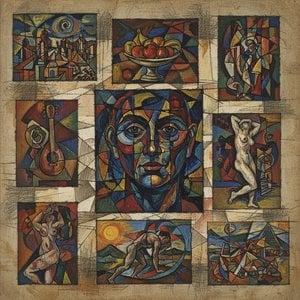
Fernand Léger's "Church Sancellemoz Assy," completed in 1947, stands as a remarkable testament to the artist’s singular approach to sacred art—a fusion of Cubist fragmentation and Naïve Art’s expressive simplicity that defies easy categorization. More than just a depiction of a church interior, it embodies Léger's profound engagement with the burgeoning industrial landscape of post-war France and his unwavering belief in capturing the essence of human experience through geometric forms and bold color palettes. This artwork isn’t merely aesthetically pleasing; it’s a deliberate provocation, urging viewers to reconsider traditional representations of religious spaces and embracing a new visual vocabulary rooted in observation and abstraction.A Synthesis of Influences: Cubism Meets Naïve Art
Léger's artistic journey began amidst the formative years of early 20th-century Paris, where he absorbed the revolutionary ideas circulating within the Cubist movement spearheaded by Picasso and Braque. However, Léger rejected the purely intellectual pursuit of abstraction championed by his peers, opting instead for a stylistic blend that prioritized direct perception and emotional resonance. This decision resulted in “Church Sancellemoz Assy,” which retains the fractured planes characteristic of Cubism—evident in the stylized depiction of architectural elements—yet simultaneously imbues it with the vibrant spontaneity and tactile quality associated with Naïve Art. The artist deliberately eschewed meticulous realism, favoring simplified shapes and bold hues to convey a sense of immediacy and spiritual fervor.The Church Interior: A Geometric Landscape
The painting’s composition is dominated by geometric forms—rectangles, squares, and circles—that create an illusionistic landscape within the confines of the church walls. These shapes aren't merely decorative; they represent Léger’s attempt to distill the complexities of human experience into fundamental visual elements. The central figures are rendered in a stylized manner, their bodies simplified into geometric volumes that echo the architectural structure itself. This technique underscores Léger’s conviction that abstraction could serve as a conduit for conveying spiritual truths—a belief deeply influenced by his fascination with machines and industrial processes. Notice how the clock on the wall is represented as a series of intersecting planes, mirroring the rhythmic patterns found in urban environments.Color and Symbolism: Bold Expressions of Faith
The color scheme employed in “Church Sancellemoz Assy” is deliberately vibrant—primarily yellows, reds, and blues—creating an atmosphere of warmth and luminosity that contrasts sharply with the muted tones often associated with religious iconography. Léger’s use of color isn't arbitrary; it reflects his desire to express emotion directly, bypassing intellectual contemplation. The placement of vases near the center symbolizes abundance and fertility, mirroring biblical themes of creation and renewal. Furthermore, the depiction of animals—likely stylized representations of saints—adds a layer of symbolic richness, hinting at the artist’s engagement with Christian iconography while simultaneously rejecting conventional artistic conventions.Legacy and Influence: A Pioneer of Modern Sacred Art
“Church Sancellemoz Assy” solidified Léger's position as one of the foremost innovators in modern sacred art—a genre that had largely retreated into stylistic conservatism following centuries of tradition. By embracing abstraction alongside Naïve Art’s expressive qualities, Léger challenged established artistic norms and paved the way for subsequent generations of artists to explore new avenues of visual communication. Its enduring appeal lies not only in its striking aesthetic beauty but also in its profound intellectual engagement with questions of faith, modernity, and human perception—a legacy that continues to inspire collectors and interior designers alike.Opere correlate


Biografia dell'artista
vitae e formazione
Fernand Léger, pittore, scultore e filmmaker francese, nacque il 4 febbraio 1881 ad Argentan, Orne, nella bassa Normandia. Suo padre allevava bovini e Léger iniziò la sua formazione come architetto nel 1897-1899. Successivamente si trasferì a Parigi nel 1900, sostenendosi con il lavoro di disegnatore architettonico.sviluppo artistico
Le prime opere di Léger furono influenzate dall'impressionismo, come visto in Le jardin de ma mère (Il giardino di mia madre) (1905). Dopo aver frequentato la scuola d'arte decorativa e l'Académie Julian, iniziò a lavorare seriamente come pittore a 25 anni. Il suo stile si evolse in una forma personale di cubismo, che i critici definirono "tubismo" per la sua enfasi su forme cilindriche.Cubismo e il gruppo dei Puteaux
Nel 1910, Léger espose al Salon d'automne insieme a Jean Metzinger e Henri Le Fauconnier. Entrò nel gruppo dei Puteaux, noto anche come la sezione d'or (la sezione aurea), insieme ad altri artisti come Francis Picabia e Marcel Duchamp.Guerra e la sua influenza sull'opera di Léger
Le esperienze di Léger nella Prima Guerra Mondiale ebbero un impatto significativo sulla sua opera. Durante il suo tempo al fronte, produsse schizzi di pezzi d'artiglieria, aerei e soldati. Il suo dipinto Soldier with a Pipe (1916) riflette questo periodo.Lavoro successivo e eredità
Il lavoro post-bellico di Léger, caratterizzato da forme meccaniche lisce, lo legò alla tradizione della pittura figurativa francese. I suoi paesaggi animati del 1921 mostrarono figure e animali in forme armoniose e razionalizzate.- visualizza le opere di Fernand Léger su ArtsDot
- altro sul Fernand Léger su Wikipedia
- scopri il Musée National Fernand Légère (Francia) con ArtsDot
- La donna seduta (100 x 81 cm, tubismo)
- Elemento macchina (cubismo)

Fernand Léger
1881 - 1955 , Francia
Informazioni rapide
- Artisti Influenti:
- Cézanne
- Impressionismo
- Artisti Influenzati: ['Pop Art']
- Data Di Nascita: 4 febbraio 1881
- Luogo Di Nascita: Argentan, Francia
- Movimento Artistico: Cubismo, Tubismo
- Nazionalità: Francese
- Nome Completo: Fernand Léger
- Opere Notevoli:
- La Grande Parata
- L'Elemento Macchina
- Donna Seduta
- The City
Articoli correlati
Cubismo Espressionista: 10 Capolavori che Hanno Definito un Movimento Artistico Rivoluzionario
Esplora i 10 capolavori che hanno rivoluzionato l'arte con il Cubismo Espressionista! Scopri Picasso, Braque e altri maestri. Quadri famosi, tecniche innovative e colori audaci ti aspettano su ArtsDot.com. Trova la tua prossima opera d'arte!

Redefining Nature: A Collector's Guide to the Geometric Beauty of Cubist Landscapes
Explore the revolutionary world of Cubist landscapes. Discover how masters like Picasso and Braque redefined nature through geometric beauty, and learn expert tips for curating these transformative masterpieces in your modern home collection.

Astrazione Geometrica: 10 Capolavori che Hanno Definito un Movimento Artistico
Esplora i 10 capolavori dell'Astrazione Geometrica: Mondrian, Malevich e Kandinsky rivoluzionano l'arte moderna. Scopri la storia, i colori e le tecniche di questi movimenti iconici. Stampe d'arte di alta qualità su ArtsDot.com!

Arte Industriale: 10 Capolavori che Rivoluzionano l'Estetica e Decorano la Casa
Esplora 10 capolavori di Monet, Manet e altri maestri che catturano l'essenza dell'arte industriale. Scopri storie, tecniche e colori unici per decorare la tua casa con stampe su tela di alta qualità. ArtsDot.com: arte collezione online.

Fernand Léger: I 25 Capolavori che Hanno Definito l'Arte Moderna | ArtsDot
Esplora i 25 capolavori di Fernand Léger, pioniere del cubismo e del tubismo. Scopri la storia, le tecniche e l'impatto dell'arte moderna francese. Stampe d'arte e riproduzioni su ArtsDot.com.


