


 Anteprima in scala reale
 Condividi
 Condividi
 Dettagli

 Scarica immagine
 Articoli simili
 Radiografia
 Slideshow
untitled (9919)

 Leggi tutto
Giclée / Stampe d'arte
Stampa giclée o su tela di qualità museale, con produzione rapida e diverse opzioni di finitura. ( Passa alla versione dipinta a mano Passa all'immagine)




P118B $10

P118H $10

P118W $10

P438Z $10

P508JH $12

P508YH $12

P805H $10

P805Z $10

P919BZ $10

P919G $10

P919XJ $10

P959ZH $10

P968JZ $12

W106C $8

W218G $10

W218JH $8

W218Y $10

W307PJ $10

W316G $10

W316PJ $8

W316Y $10

W398PJ $8

W4111J $10

W500HY $15

W500JH $15

W692G $12

W849H $8

W940BG $15

W953PJ $8




Scegli tra le nostre dimensioni predefinite, che rispettano le proporzioni originali dell'opera d'arte.

È possibile inserire dimensioni personalizzate per adattare l'opera a una cornice o a uno spazio specifico. Se la dimensione selezionata non corrisponde alle proporzioni dell'immagine originale, procederemo al ritaglio dell'opera o all'estensione dell'immagine con un bordo specchiato o a tinta unita. Un mockup digitale ti verrà inviato per approvazione prima dell'inizio della produzione.
Si prega di notare che l'anteprima a schermo non riflette il ritaglio o l'estensione effettivi. Solo il mockup mostrerà accuratamente la composizione finale.
Sebbene siano disponibili dimensioni personalizzate, si raccomanda di selezionare una dimensione dall'elenco predefinito per preservare le proporzioni originali.
Consegna in tutto il mondo () in 2 settimane invece delle normali 4/5 settimane. (8 Agosto)

Spedizione espressa gratuita in tutto il mondo

Tela in lino di alta qualità

Assicurazione completa sulla spedizione

Garanzia di rimborso dei dazi doganali

Garanzia di fedeltà cromatica dell'originale

Politica di reso entro 60 giorni (solo per difetti di fabbricazione)

Garanzia di rimborso al 100%

Sconto per acquisti multipli
 L'opzione vetro è disponibile solo per dimensioni inferiori a 110 cm

untitled (9919)
Giclée / Stampe d'arte
Dimensioni della riproduzione
-


Prezzo totale
$ 63
Descrizione del pezzo
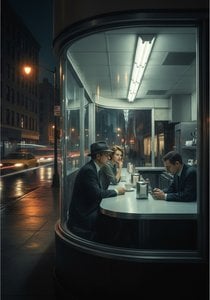
The Quiet Resonance of a Late-Night Diner
Edward Hopper's "Untitled (9919)," painted in 1942, isn’t merely a depiction of a vintage automobile and its occupant; it’s a distilled essence of American loneliness, a poignant snapshot of urban isolation rendered with remarkable precision and evocative light. The painting immediately draws the viewer into a scene of quiet contemplation, a moment suspended between the mundane and the melancholic. Hopper masterfully utilizes the geometry of the car's interior – the sharply defined dashboard, the prominent steering wheel, the angled windows – to create a sense of contained space, mirroring perhaps the internal landscape of the figure within.
The color palette is deliberately restrained, dominated by warm browns and yellows that suggest the aged leather and worn surfaces of the vehicle. These earthy tones are contrasted with the cool blues and greens of the exterior landscape, creating a subtle tension between the interior world of the driver and the anonymous city beyond. Hopper’s signature use of light – a diffused, almost artificial glow emanating from an unseen source – casts long shadows and highlights textures, lending the scene a palpable sense of depth and realism. It's not a vibrant, celebratory illumination; rather, it feels like the muted light of a late-night street, casting a contemplative mood.
A Master of Realism: Hopper’s Approach
Hopper was a pivotal figure in American Realism, moving beyond mere representation to capture the emotional and psychological complexities of everyday life. He wasn't interested in grand narratives or heroic figures; instead, he focused on the quiet moments, the unspoken anxieties, and the subtle gestures that define the human experience. His meticulous attention to detail – from the wrinkles around the driver’s eyes to the worn fabric of the seat – speaks volumes about his commitment to authenticity. Hopper's technique involved layering thin washes of paint, building up color gradually to create a luminous effect and capturing the nuances of light and shadow with astonishing accuracy.
Born in Nyack, New York, in 1882, Hopper’s early life instilled a deep appreciation for observation and detail. His artistic journey began with commercial illustration but quickly evolved into a profound exploration of American identity. His work often reflects the isolation and alienation prevalent in modern urban environments – themes that resonated deeply during the tumultuous years leading up to and including World War II. The painting’s composition, with its solitary figure seemingly lost in thought, powerfully embodies this sense of detachment.
Symbolism and Emotional Impact
The driver's posture—leaning slightly forward, absorbed in a book or document—suggests a retreat from the outside world, a desire for solitude. The open window offers a glimpse of a darkened landscape, hinting at an unseen city teeming with life yet inaccessible to the figure within. There’s a subtle tension between observation and detachment; the driver is present but not truly engaged. This ambiguity is central to the painting's enduring appeal.
"Untitled (9919)" isn’t simply a portrait of a man in a car; it’s a meditation on loneliness, contemplation, and the quiet rhythms of modern life. It invites viewers to contemplate their own experiences of isolation and the search for meaning in an increasingly complex world. Hopper's ability to capture such profound emotions with such understated elegance solidifies his place as one of America’s most enduring artists.
Opere correlate


Biografia dell'artista
**primi anni di vita e influenze**
Edward Hopper, un illustre pittore e incisore realista americano, nacque il 22 luglio 1882 a Upper Nyack, New York. La sua famiglia, di origine prevalentemente olandese, gli offrì una crescita confortevole che permise di coltivare le sue inclinazioni artistiche fin da giovane. - **Ispirazioni:** L'opera di Hopper fu influenzata dalle opere di Ralph Waldo Emerson e dai maestri impressionisti francesi Édouard Manet ed Edgar Degas. - **Formazione iniziale:** Iniziò gli studi artistici con un corso per corrispondenza nel 1899, per poi trasferirsi alla New York School of Art and Design.**Stile artistico e temi**
Edward Hopper's rappresentazioni spare e accuratamente calcolate riflettevano la sua visione personale della vita americana moderna. La sua opera può essere caratterizzata da: - **Scenari urbani e rurali:** Entrambi gli ambienti venivano raffigurati con un mix unico di realismo ed emozione profonda. - **Luce:** Una maestria nella luce, spesso usata per evocare sentimenti di isolamento o contemplazione. - **Figure:** Spesso senza volto o sullo sfondo, enfatizzando l'ambiente rispetto alle figure.**Opere notevoli e il loro significato**
- House by the Railroad (Museum of Modern Art, New York, United States), un esempio della capacità di Hopper di evocare un senso di malinconia attraverso una composizione semplice ma potente. - Reclining Nude (50 x 35 cm, New Realism, Watercolour), che dimostra la sua versatilità nel catturare la figura umana.**Eredità e influenza**
- **Influenza su artisti futuri:** Lo stile unico di Hopper ha influenzato numerosi artisti, tra cui Pierre Sanford Ross, noto per i suoi scenari urbani e rurali. - **Popolarità duratura:** Le sue opere continuano a catturare il pubblico con i loro temi senza tempo della solitudine e dell'essere umano.**Esplora di più su ArtsDot**
- [https://ArtsDot.com/@/edward-hopper](Edward Hopper's artworks) - /it/art/show/art-8xyffg-it/Buy art inspired by the masters)- Esplora il mondo dell'arte con la vasta collezione di ArtsDot.
- Scopri come l'eredità di Edward Hopper continua a ispirare artisti e amanti dell'arte.
**Riferimenti**
- [https://ArtsDot.com/@/edward-hopper](Wikipedia: Edward Hopper) - [https://en.wikipedia.org/wiki/edward_hopper](Wikipedia: Edward Hopper's biography)
Edward Hopper
1931 - 1967 , Stati Uniti d'America
Informazioni rapide
- Artisti Influenti:
- Ralph Waldo Emerson
- Édouard Manet
- Edgar Degas
- Artisti Influenzati: ['Pierre Sanford Ross']
- Data Di Nascita: 22 luglio 1882
- Luogo Di Nascita: Upper Nyack, Stati Uniti
- Movimento Artistico: Realismo americano
- Nazionalità: Americana
- Nome Completo: Edward Hopper
- Opere Notevoli:
- House by the Railroad
- Nighthawks
- Gas
- Chop Suey
- Summertime
Articoli correlati

Echoes of Urban Life: A Visual Exploration of Street Scenes in Art History
Explore the captivating world of realism in art history! Discover iconic street scenes & genre paintings from masters like Courbet & Brown. Expert analysis & museum-quality reproductions at ArtsDot.
Edward Hopper: Realismo Americano, Solitudine Urbana e la Poetica di un Maestro
Esplora il mondo di Edward Hopper, maestro del realismo americano. Analisi approfondite delle sue opere più iconiche, la poetica della solitudine urbana e l'influenza sull'arte moderna. Scopri la sua eredità con ArtsDot.

Realismo Americano: 10 Capolavori che Hanno Definito un'Epoca | ArtsDot
Esplora i 10 capolavori del Realismo Americano con ArtsDot. Scopri Andrew Wyeth, Edward Hopper e George Bellows. Quadri iconici, storie uniche e riproduzioni di alta qualità per la tua casa. Esplora la collezione online!

The Ashcan School: Realism, Urban Life & the Democratization of American Art
Explore the revolutionary Ashcan School! Discover how artists like Henri & Sloan challenged tradition with gritty realism, capturing urban life in early 20th-century America. Learn about their impact on American art history.

Robert Henri e la Scuola Ashcan: Un Realismo Urbano Rivoluzionario
Esplora la rivoluzionaria Scuola Ashcan e Robert Henri, il suo fondatore. Scopri il realismo urbano americano, le tematiche sociali e l'impatto duraturo di questo movimento artistico unico.



