


 Anteprima in scala reale
 Condividi
 Condividi
 Dettagli

 Scarica immagine
 Articoli simili
 Radiografia
 Slideshow
untitled (6282)


 Leggi tutto
Giclée / Stampe d'arte
Stampa giclée o su tela di qualità museale, con produzione rapida e diverse opzioni di finitura. ( Ordina la riproduzione dipinta a mano Acquista download)




P118B $10

P118H $10

P118W $10

P438Z $10

P508JH $12

P508YH $12

P805H $10

P805Z $10

P919BZ $10

P919G $10

P919XJ $10

P959ZH $10

P968JZ $12

W106C $8

W218G $10

W218JH $8

W218Y $10

W307PJ $10

W316G $10

W316PJ $8

W316Y $10

W398PJ $8

W4111J $10

W500HY $15

W500JH $15

W692G $12

W849H $8

W940BG $15

W953PJ $8




Scegli tra le nostre dimensioni predefinite, che rispettano le proporzioni originali dell'opera d'arte.

È possibile inserire dimensioni personalizzate per adattare l'opera a una cornice o a uno spazio specifico. Se la dimensione selezionata non corrisponde alle proporzioni dell'immagine originale, procederemo al ritaglio dell'opera o all'estensione dell'immagine con un bordo specchiato o a tinta unita. Un mockup digitale ti verrà inviato per approvazione prima dell'inizio della produzione.
Si prega di notare che l'anteprima a schermo non riflette il ritaglio o l'estensione effettivi. Solo il mockup mostrerà accuratamente la composizione finale.
Sebbene siano disponibili dimensioni personalizzate, si raccomanda di selezionare una dimensione dall'elenco predefinito per preservare le proporzioni originali.
Consegna in tutto il mondo () in 2 settimane invece delle normali 4/5 settimane. (17 Agosto)

Spedizione espressa gratuita in tutto il mondo

Tela in lino di alta qualità

Assicurazione completa sulla spedizione

Garanzia di rimborso dei dazi doganali

Garanzia di fedeltà cromatica dell'originale

Politica di reso entro 60 giorni (solo per difetti di fabbricazione)

Garanzia di rimborso al 100%

Sconto per acquisti multipli
 L'opzione vetro è disponibile solo per dimensioni inferiori a 110 cm

untitled (6282)
Giclée / Stampe d'arte
Dimensioni della riproduzione
-


Prezzo totale
$ 62
Descrizione del pezzo
The Architecture of Solitude
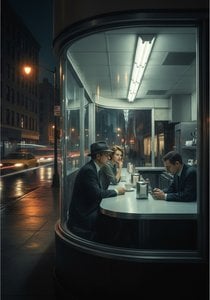
In the quiet, monochromatic depths of Edward Hopper’s "Untitled (6282)", we encounter more than just a snapshot of mid-century American life; we enter a profound meditation on the human condition. Painted in 1953, this evocative work serves as a masterful distillation of the anxieties and quiet contemplations that defined American modernism. The scene unfolds within the dim, atmospheric confines of a restaurant, where the bustle of urban existence is stripped down to its most skeletal, emotional essence. Through his meticulous use of light and shadow, Hopper captures a moment frozen in time, inviting the viewer to linger in the stillness of a world that feels simultaneously populated and profoundly lonely.
The composition is a study in detachment. Two women occupy bar stools, their postures conveying a palpable sense of stillness that defies the potential energy of a public space. Their gazes are notably averted, suggesting an inward journey of introspection rather than any outward connection with their surroundings. While a man stands nearby, seemingly engaged in the mundane ritual of ordering, his figure remains distant and unremarkable, serving only to emphasize the absence of genuine interaction. This spatial arrangement—the carefully positioned chairs and the gaps between figures—creates a rhythmic sense of isolation, making the diner feel like a stage where the actors are lost in their own private dramas.
Mastery of Light and Realism
Hopper’s technique is rooted in a distinctive realism that transcends mere representation to achieve something far more expressive. Eschewing flamboyant brushstrokes or distracting color palettes, he relies on a precise, almost clinical attention to detail to build his narrative. In this black and white rendering, the absence of color forces the eye to focus on the interplay of light and texture. The stark illumination highlights the faces of the figures, pulling them from the gloom, while deep, velvety shadows envelop the corners of the diner, creating an atmosphere of mystery and weight. This chiaroscuro effect is not merely a stylistic choice but a psychological tool, used to delineate the boundaries between the seen and the unseen, the public and the private.
Every element within the frame contributes to this heavy, contemplative mood. From the scattered bottles that hint at the passage of time to the solitary potted plant that offers a singular, fragile touch of life, the details are rendered with an unwavering accuracy. For the collector or interior designer, this piece offers a sophisticated focal point; its muted tones and structural clarity allow it to integrate seamlessly into modern, minimalist, or classic settings, providing a window into a period of intense psychological depth. To possess a reproduction of such a work is to hold a fragment of American history—a piece that does not merely decorate a wall but commands the emotional temperature of a room.
Opere correlate


Biografia dell'artista
**primi anni di vita e influenze**
Edward Hopper, un illustre pittore e incisore realista americano, nacque il 22 luglio 1882 a Upper Nyack, New York. La sua famiglia, di origine prevalentemente olandese, gli offrì una crescita confortevole che permise di coltivare le sue inclinazioni artistiche fin da giovane. - **Ispirazioni:** L'opera di Hopper fu influenzata dalle opere di Ralph Waldo Emerson e dai maestri impressionisti francesi Édouard Manet ed Edgar Degas. - **Formazione iniziale:** Iniziò gli studi artistici con un corso per corrispondenza nel 1899, per poi trasferirsi alla New York School of Art and Design.**Stile artistico e temi**
Edward Hopper's rappresentazioni spare e accuratamente calcolate riflettevano la sua visione personale della vita americana moderna. La sua opera può essere caratterizzata da: - **Scenari urbani e rurali:** Entrambi gli ambienti venivano raffigurati con un mix unico di realismo ed emozione profonda. - **Luce:** Una maestria nella luce, spesso usata per evocare sentimenti di isolamento o contemplazione. - **Figure:** Spesso senza volto o sullo sfondo, enfatizzando l'ambiente rispetto alle figure.**Opere notevoli e il loro significato**
- House by the Railroad (Museum of Modern Art, New York, United States), un esempio della capacità di Hopper di evocare un senso di malinconia attraverso una composizione semplice ma potente. - Reclining Nude (50 x 35 cm, New Realism, Watercolour), che dimostra la sua versatilità nel catturare la figura umana.**Eredità e influenza**
- **Influenza su artisti futuri:** Lo stile unico di Hopper ha influenzato numerosi artisti, tra cui Pierre Sanford Ross, noto per i suoi scenari urbani e rurali. - **Popolarità duratura:** Le sue opere continuano a catturare il pubblico con i loro temi senza tempo della solitudine e dell'essere umano.**Esplora di più su ArtsDot**
- [https://ArtsDot.com/@/edward-hopper](Edward Hopper's artworks) - /it/art/show/art-8xyffg-it/Buy art inspired by the masters)- Esplora il mondo dell'arte con la vasta collezione di ArtsDot.
- Scopri come l'eredità di Edward Hopper continua a ispirare artisti e amanti dell'arte.
**Riferimenti**
- [https://ArtsDot.com/@/edward-hopper](Wikipedia: Edward Hopper) - [https://en.wikipedia.org/wiki/edward_hopper](Wikipedia: Edward Hopper's biography)
Edward Hopper
1931 - 1967 , Stati Uniti d'America
Informazioni rapide
- Artisti Influenti:
- Ralph Waldo Emerson
- Édouard Manet
- Edgar Degas
- Artisti Influenzati: ['Pierre Sanford Ross']
- Data Di Nascita: 22 luglio 1882
- Luogo Di Nascita: Upper Nyack, Stati Uniti
- Movimento Artistico: Realismo americano
- Nazionalità: Americana
- Nome Completo: Edward Hopper
- Opere Notevoli:
- House by the Railroad
- Nighthawks
- Gas
- Chop Suey
- Summertime
Articoli correlati

Edward Hopper: Le 25 Opere Iconiche che Definiscono l'America Moderna | ArtsDot
Esplora le 25 opere iconiche di Edward Hopper, il maestro del realismo americano. Scopri la luce, la solitudine e l'atmosfera unica dei suoi quadri più famosi. Stampe d'arte e riproduzioni su ArtsDot.com per arredare casa con stile. Esplora la collezione online!

Realismo Americano: 10 Capolavori che Hanno Definito un'Epoca | ArtsDot
Esplora i 10 capolavori del Realismo Americano con ArtsDot. Scopri Andrew Wyeth, Edward Hopper e George Bellows. Quadri iconici, storie uniche e riproduzioni di alta qualità per la tua casa. Esplora la collezione online!

Bianco Sublime: I 10 Dipinti Più Famosi Dominati dal Colore Bianco | .it
Esplora i 10 dipinti più celebri dominati dal bianco, da Monet a Malevich. Scopri la storia, le tecniche e l'impatto di queste opere iconiche. Trova stampe su tela e riproduzioni d'arte di alta qualità per decorare casa con stile su .
Edward Hopper: Realismo Americano, Solitudine Urbana e la Poetica di un Maestro
Esplora il mondo di Edward Hopper, maestro del realismo americano. Analisi approfondite delle sue opere più iconiche, la poetica della solitudine urbana e l'influenza sull'arte moderna. Scopri la sua eredità con ArtsDot.

American Realism: Social Commentary & Artistic Representation in Early 20th-Century Painting
Explore the powerful social commentary & artistic representation of American Realism. Discover key artists like Bellows & Sloan, and understand the movement's lasting impact on 20th-century art history.



