
- Home

- Stampa su tela
- Alfred Jacob Miller
- Taking the
 Ordina la riproduzione Acquista download
 Invia
Invia
 Condividi
 Dettagli opera
 Aggiungi ai preferiti

 Scarica
 Simili
 Radiografia
 Slideshow
Taking the
 Watercolor
- WallArt
- Contemporary Realism
 1837
1837- 19th Century
 27.0 x 20.0 cm
 Amon Carter Museum of American Art
 Scopri di più
Giclée / Stampa d'arte
Stampa giclée o su tela di qualità museale, con produzione rapida e diverse opzioni di finitura.




P118B $10

P118H $10

P118W $10

P438Z $10

P508JH $12

P508YH $12

P805H $10

P805Z $10

P919BZ $10

P919G $10

P919XJ $10

P959ZH $10

P968JZ $12

W106C $8

W218G $10

W218JH $8

W218Y $10

W307PJ $10

W316G $10

W316PJ $8

W316Y $10

W398PJ $8

W4111J $10

W500HY $15

W500JH $15

W692G $12

W849H $8

W940BG $15

W953PJ $8




Scegli tra le nostre dimensioni predefinite, che rispettano le proporzioni originali dell'opera d'arte.

È possibile inserire dimensioni personalizzate per adattare l'opera a una cornice o a uno spazio specifico. Se la dimensione selezionata non corrisponde alle proporzioni dell'immagine originale, procederemo al ritaglio dell'opera o all'estensione dell'immagine con un bordo specchiato o a tinta unita. Un mockup digitale ti verrà inviato per approvazione prima dell'inizio della produzione.
Si prega di notare che l'anteprima a schermo non riflette il ritaglio o l'estensione effettivi. Solo il mockup mostrerà accuratamente la composizione finale.
Sebbene siano disponibili dimensioni personalizzate, si raccomanda di selezionare una dimensione dall'elenco predefinito per preservare le proporzioni originali.
Consegna in tutto il mondo () in 2 settimane invece delle normali 4/5 settimane. (22 Luglio)

Spedizione espressa gratuita in tutto il mondo

Tela in lino di alta qualità

Assicurazione completa sulla spedizione

Garanzia di rimborso dei dazi doganali

Garanzia di fedeltà cromatica

Politica di reso entro 60 giorni (solo per difetti)

Garanzia di rimborso al 100%

Sconto per acquisti multipli
 L'opzione vetro è disponibile solo per dimensioni inferiori a 110 cm

Taking the
Giclée / Stampa d'arte
Dimensioni riproduzione
-


Prezzo totale finale
-
Descrizione dell'opera
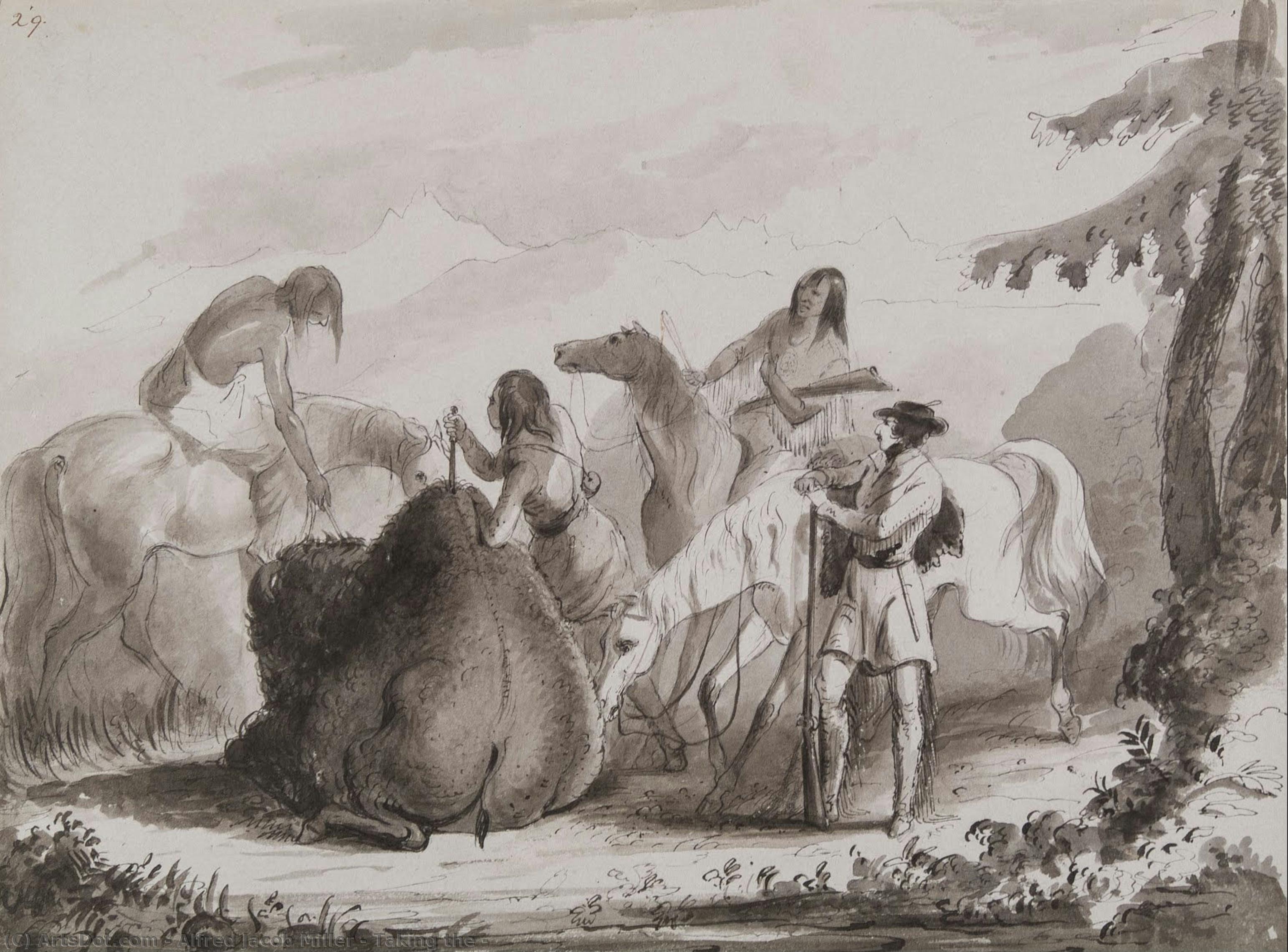
Taking the Hump Rib
Alfred Jacob Miller’s “Taking the Hump Rib” stands as an arresting testament to the Romantic spirit of American art—specifically, its fascination with the untamed frontier and the portrayal of indigenous cultures amidst the grandeur of the Rocky Mountains. Completed in 1837, this watercolor painting captures a pivotal moment during William Drummond Stewart's expedition into the West, documenting not merely scenery but also the complex interactions between European observers and Native American communities. The artwork’s composition immediately draws the eye to a central scene: a group of men—likely fur traders—engaged in assisting a horseman struggling to ascend a steep incline, aptly named “Hump Rib.” Miller skillfully employs watercolor techniques—characterized by delicate washes and subtle gradations of color—to convey both the ruggedness of the landscape and the palpable tension within the tableau. The muted palette—dominated by browns, greens, and blues—reflects the prevailing atmospheric conditions of the region during that time, lending an air of authenticity to the depiction. Beyond its technical prowess, “Taking the Hump Rib” resonates with deeper symbolic significance. It embodies the Romantic ideal of confronting nature’s challenges head-on, mirroring Stewart's ambition to explore and document the wilderness while simultaneously acknowledging the vulnerability of human endeavor against its formidable forces. The horseman represents not only physical exertion but also the pursuit of progress—a theme central to the burgeoning American Westward expansion. Simultaneously, Miller subtly portrays the collaborative spirit between Europeans and Native Americans, highlighting the necessity of mutual respect and understanding in navigating unfamiliar territories. The painting’s emotional impact is undeniable. It evokes a sense of immediacy and drama, transporting viewers back to 1837 and immersing them in the sights and sounds of the expedition. Miller's meticulous observation—evident in the detailed rendering of clothing, equipment, and facial expressions—transforms the scene into more than just a visual record; it becomes a window into the human experience within the context of an era defined by exploration, discovery, and cultural exchange.- Artist: Alfred Jacob Miller
- Year Created: 1837
- Medium: Watercolor
- Dimensions: 27 x 20 cm
- Location: Private Collection
Historical Context: The Fur Trade Era and Stewart’s Expedition
The painting emerged during the height of the fur trade era—a period marked by intense competition between European nations for control over lucrative trading routes in North America. William Drummond Stewart's expedition aimed to establish a foothold for the American Fur Company (AFC) among Native American tribes, primarily the Crow and Pawnee. Miller’s artwork serves as invaluable documentation of this undertaking, capturing not only the physical landscape but also the social dynamics inherent in intercultural encounters. The AFC sought to forge alliances with indigenous peoples while simultaneously exploiting their resources—a complex relationship that fueled both economic prosperity and cultural disruption.Technique: Watercolor Rendering and Observational Detail
Miller’s masterful watercolor technique—characterized by layering translucent washes of pigment—allowed him to achieve remarkable luminosity and tonal subtlety. He meticulously studied the effects of light on the terrain, skillfully capturing the rugged contours of the mountains and the diffuse glow of twilight. Furthermore, Miller's keen eye for detail extended beyond mere topographical representation; he painstakingly rendered clothing, equipment, and facial expressions, conveying a profound understanding of human behavior within the context of an unfamiliar environment.Symbolism: Confrontation with Nature and Collaboration Between Cultures
“Taking the Hump Rib” embodies several symbolic motifs that encapsulate the Romantic worldview prevalent during Miller’s time. The arduous climb represents humanity's struggle against nature—a recurring theme in Romantic art—while simultaneously symbolizing ambition and aspiration. Simultaneously, the collaborative effort between Stewart and his men underscores the importance of mutual respect and understanding in navigating intercultural relations—a sentiment particularly pertinent to the historical context of the fur trade era.Opere simili


Biografia dell'artista
Alfred Jacob Miller: Un Pioniere dell'Arte del West Americano
- Nato: 2 gennaio 1810, Baltimora, Stati Uniti d'America
- Morto: 1874
Primi Anni e Formazione Artistica
Il viaggio di Alfred Jacob Miller iniziò a Baltimora, nel Maryland, dove nacque in una famiglia di nove figli. Suo padre, un mercante e locandiere, gli fornì un'infanzia stabile. Frequentando l'Accademia John D. Craig, Miller non ricevette istruzione artistica formale. Tuttavia, si crede che abbia ricevuto le prime lezioni dal rinomato artista Thomas Sully, gettando le basi per i suoi futuri impegni artistici. Un momento cruciale arrivò nel 1832 quando Miller viaggiò a Parigi per studiare arte. Fu ammesso come uditore alle lezioni di disegno dal vivo all'École des Beaux-Arts, immergendosi nelle tradizioni artistiche europee e affinando le sue capacità attraverso l'osservazione diligente e la pratica.L'Espedizione nel West e lo Svolgimento Artistico
La carriera di Miller prese una svolta drammatica quando incontrò Sir William Drummond Stewart, un aristocratico scozzese con una passione per il West americano. Nel 1837, Stewart commissionò a Miller di accompagnarlo in una spedizione di caccia alle Montagne Rocciose, documentando i paesaggi e le culture incontrate lungo il percorso. Questo viaggio si rivelò trasformativo per lo sviluppo artistico di Miller. Meticolosamente schizzò scene di nativi americani, trappolieri, fauna selvatica e vita di frontiera, catturando l'essenza del West americano con notevole dettaglio e sensibilità. Al suo ritorno a New Orleans, Miller trasformò questi schizzi in una serie di dipinti che avrebbero stabilito la sua reputazione come figura significativa nell'arte americana.Stile e Opere Notabili
Lo stile artistico di Miller è caratterizzato da un insolito mix di realismo e romanticismo. Ha accuratamente raffigurato i dettagli della vita di frontiera - abbigliamento, attrezzature, paesaggi - imbuendo al contempo le sue opere di un senso di dramma e avventura. Alcuni dei suoi dipinti più celebrati includono:- Il Lago il Suo Petto Solitario si Espande verso il Cielo
- Scena del Campo (Sioux)
- Big Bowl (Un Capo Crow)
- Argali - Pecora di Montagna
- Indiani Serpente che Sparano ad un Alce
- Indiano Shoshone e il Suo Cavallo Domestico
Eredità e Significato Storico
L'eredità di Alfred Jacob Miller come pioniere dell'arte del West americano è saldamente stabilita. Fu tra i primi artisti a catturare lo spirito e l'essenza del West americano con tale autenticità e abilità artistica. I suoi dipinti continuano a ispirare artisti e appassionati d'arte, fornendo una finestra su un'epoca passata. Il lavoro di Miller è stato esposto in gallerie e musei negli Stati Uniti, consolidando il suo posto come contributore significativo allo sviluppo dell'arte americana. Le sue raffigurazioni dettagliate dei nativi americani offrono una preziosa documentazione storica, mentre le sue rappresentazioni romanticizzate catturano l'attrazione e l'avventura della frontiera.
Alfred Jacob Miller
1810 - 1874 , Stati Uniti d'America
Dati rapidi
- Artistic Movement Or Style: Realismo e Romanticismo
- Artists Who Influenced This Artist: ['Thomas Sully']
- Date Of Birth: 2 gennaio 1810
- Date Of Death: 26 giugno 1874
- Full Name: Alfred Jacob Miller
- Nationality: Americano
- Notable Artworks:
- Lake Her Lone Bosom Expands
- Camp Scene (Sioux)
- Big Bowl (A Crow Chief)
- Place Of Birth: Baltimora, USA
Articoli correlati

Sir Alfred James Munnings: I 25 Capolavori che Celebrano la Bellezza del Cavallo e della Campagna Inglese
Esplora i 25 capolavori di Alfred James Munnings, pittore inglese celebrato per la sua arte equestre e i paesaggi rurali. Scopri storie, tecniche e colori unici. Stampe d'arte e riproduzioni su ArtsDot.com!

Alfred Jacob Miller: Chronicling the American West Through Artistic Observation & Narrative
Explore the captivating art of Alfred Jacob Miller, chronicler of the American West. Discover his iconic paintings, techniques & lasting legacy – a valuable addition to any serious collection. Learn more at ArtsDot.

I 25 Capolavori del Metropolitan Museum di New York: Arte, Storia e Decorazioni Raffinate
Esplora i 25 capolavori del Metropolitan Museum di New York! Scopri la storia, gli artisti (Van Gogh, Monet, Rembrandt) e le emozioni dietro dipinti iconici. Trova riproduzioni artistiche di alta qualità per decorare casa con stile su ArtsDot.com.

I Capolavori del DIA di Detroit: 25 Opere d'Arte Indimenticabili per la Tua Casa
Esplora i 25 capolavori del Detroit Institute of Arts! Van Gogh, Monet, Rembrandt e altri maestri. Scopri storie, tecniche e colori che hanno reso queste opere immortali. Trova riproduzioni artistiche di alta qualità per la tua casa su ArtsDot.com.

James Abbott McNeill Whistler: I 25 Capolavori che Definirono un'Epoca - Arte e Decorazioni di Lusso
Esplora i 25 capolavori di James Abbott McNeill Whistler, il maestro dell'estetismo e dei notturni. Scopri la storia, le tecniche e l'armonia unica nei suoi dipinti più famosi. Stampe d'arte e riproduzioni di alta qualità su ArtsDot.com.


