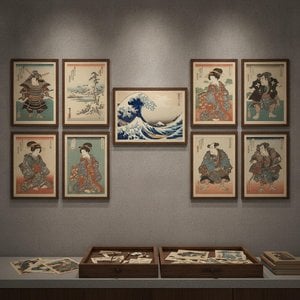
A Legacy of Timeless Elegance
Born in the Fukuoka Prefecture, Yoshimura Tadao emerged as a profound voice within the Nihonga tradition, a style of Japanese-style painting that breathes life into classical themes through delicate pigments and silk. His artistic journey began with rigorous formal training at the Tokyo Art School, where he studied under the esteemed Matsuoka Eikyu. This foundational period was marked by an intense devotion to historical accuracy and aesthetic refinement, as he sought to bridge the gap between ancient Japanese heritage and a modern painterly sensibility.
Yoshimura’s work is characterized by a deep, scholarly connection to Japan's storied past. He possessed a unique ability to evoke the atmosphere of bygone eras, particularly through his fascination with the Imperial treasures of the Shosoin Temple. By studying these ancient artifacts, he developed a meticulous technique that allowed him to render the fine details of historical attire and furnishings with breathtaking precision. His paintings often serve as windows into the Tempyo Era, capturing not just the visual splendor of the 8th century, but also its very essence through a polished and harmonious atmosphere.
Mastery of Historical Genre Painting
The evolution of Yoshimura’s style saw him developing a new form of historical genre painting that drew inspiration from the classical Yamato-e tradition. His compositions were far more than mere recreations; they were poetic interpretations of history. In works such as Warm Sunshine and Summer Breeze, one can observe his mastery of nature and detail, where carefully observed flowers like hollyhocks and pinks are integrated into scenes of classical elegance. This careful observation allowed him to create a sense of vitality within the stillness of his subjects.
His career was marked by significant recognition within the prestigious Japanese art circles. He was a frequent and successful participant in the Teiten exhibition series, where his talent earned him both acclaim and distinction:
- Exhibition Success: His ability to move from being a regular exhibitor to receiving special awards and eventually achieving jury-free status highlights his rising stature in the art world.
- Artistic Milestones: Notable works presented at various Teiten exhibitions include Seigin ryoku, Tachibana Daijorō—a depiction of an Asuka-period princess—and Mochi no tsukiyo.
- Institutional Recognition: His contributions to the medium were significant enough that he eventually served on the organizing committee for these vital exhibitions.
Through his dedication to the Nihonga movement, Yoshimura Tadao left an indelible mark on Japanese art. By blending the meticulousness of historical research with a soulful, evocative brushstroke, he ensured that the beauty of Japan's ancient civilizations would continue to resonate with viewers long after the era they depicted had passed into legend.
Kérdések és válaszok
Kereshetem Yoshimura Tadao műveit kulcsszavak alapján is?
Yoshimura Tadao művei kulcsszavakra bontva is felfedezhetők a művész Kulcsszavak szerint oldalán, ahol minden kulcsszó a hozzá tartozó alkotásokat gyűjti össze.
Hol és 어느 해 született Yoshimura Tadao?
Yoshimura Tadao Fukuoka városban született, 1898 évben.
Yoshimura Tadao műveit színspektrum szerint is felfedezhetem?
Yoshimura Tadao művei színek szerinti csoportosítással is felfedezhetők a művész Színindex oldalán.