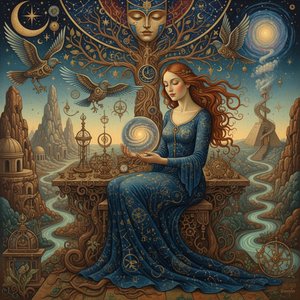
Early Life, Family and Training
Nadia Werba was born in Paris, France, around 1925 or 1926. Born into a Jewish family, her early years were shaped by the movement of her parents, who fled Paris in 1933 to find safety in Argentina. This displacement moved the family from the streets of France to the landscape of South America, where Nadia Werba would spend much of her formative time. In Argentina, she began to look at the world through a lens of study and observation, enrolling at the University of Buenos Aires to study philosophy and literature.
It was during these years in Argentina that her hands first learned the weight of a brush. She began her formal artistic training under the painter Demetrio Urruchua, a man who helped shape her early understanding of form. This period of study provided the foundation for a life spent between different cultures and mediums. Her curiosity eventually pulled her back toward Europe, leading her to return to Paris after the Second World War.
In Paris, her education became more specialized. She attended the Sorbonne, focusing on French Literature, while simultaneously refining her technique in painting. During this time, she studied under André Lhote and Fernand Léger. These years of study, moving between the intellectual rigor of literature and the physical practice of painting, helped define the multifaceted nature of her later work.
Artistic Activity in Rome and Madrid
In 1951, the move to Rome with her husband, the journalist Hank Werba, marked a shift toward a professional life in the galleries. It was during these years in Italy that she began to establish her presence through individual exhibitions. The focus remained on the physical act of creation, a practice that would eventually lead the family to Madrid in 1956.
The Spanish capital became a central hub for her work. She became part of a group of Spanish Expressionists, finding a place among artists who shared a specific visual language. During this period, she also turned her attention to teaching, founding the Platero group of intuitive drawing to work with children. Her presence in the Spanish art scene grew steadily, leading to international recognition for her work and her country.
By the early 1960s, her work was selected for major international stages. She represented Spain at the New York International Fair in 1963 and was chosen to represent the country at the Venice Biennale in 1964. These years were defined by a steady movement between the studio and the public eye, as her reputation expanded beyond the local galleries of Madrid.
Career in Cinema and Film Direction
After settling in Spain, her focus shifted toward the lens. She moved from the canvas to the set, finding a new way to frame the world. This transition led her to direct the short film Piero Gherardi in 1967. Her work in cinema was not limited to short formats; she eventually moved into feature films. This period saw the creation of My Mother, My Daughter in 1981 and Eva's Dreams in 1982.
Her films traveled beyond the borders of Spain. They were presented at the Venice Film Festival and the Berlin Film Festival, finding audiences in these international spaces. She also spent time documenting the lives of others, including a special film about Roberto Rossellini. Her camera captured specific, unvarnished moments, often looking at the subject through an anthropological lens.
Later Years and Artistic Evolution
After her years in Spain, Nadia Werba returned to Rome with her family. During this period, she sought out new technical disciplines, studying mural technique and ceramics at the San Giacomo School of Art. This focus on form and surface marked a shift in her practice, moving beyond the canvas to explore the tactile qualities of clay and the structural demands of wall-based art.
The loss of her husband in 1993 did not halt her creative output. Instead, she continued to work through the years, maintaining a practice that spanned painting, sculpture, and ceramics. Her life became a movement between Rome and Paris, a rhythm that supported her continued engagement with these different mediums. Her hands remained busy with the physical requirements of her various crafts, evolving through the quiet persistence of daily practice.
Where to See the Works Today
Her paintings can be found in several institutional collections across Europe. In Spain, her work is held in the Reina Sofia in Madrid and the Museum of Contemporary Art in Barcelona. Her presence extends to Belgium, where her pieces are part of the collection at the Ixelles Museum in Brussels.
Other traces of her visual output remain in smaller, specific repositories. An untitled work from about 1975 is kept in the Biblioteca Museu Víctor Balaguer in Viladecans. These locations hold the physical remains of her practice, from the canvases she painted to the objects she shaped.
Kérdések és válaszok
Milyen időszakra bontható Nadia Werba pályafutása?
Nadia Werba munkásságának időrendi áttekintése a művész Krónika oldalán érhető el, ahol az alkotások fejezetről fejezetre, a készítés sorrendjében követhetők egymást.
Megtekinthető Nadia Werba művei technikánként csoportosítva?
Nadia Werba alkotásainak meghatározott technikában való kereséséhez használja a művész Minden médium oldalát.
Hol találhatók Nadia Werba művei művészeti stílusok szerint csoportosítva?
Nadia Werba művei stílusirányzat szerinti csoportosításban tekinthetők meg a művész Összes művészeti irányzat oldalán.
Hol tekinthetném meg Nadia Werba összes művét?
Nadia Werba minden alkotása megtekinthető a ez a weboldal oldalán, az alkotó Összes műalkotás oldalán keresztül.