The Life and Artistic Evolution of Herb Aach
Born in Cologne, Germany, Herb Aach was a painter and writer whose journey took him from the Weimar Republic to New York City in 1938. After serving in the United States Army during World War II, he returned to New York to study under John Ferren and Rufino Tamayo at the Brooklyn Museum Art School. His education continued in Mexico City at the Escuela de Pintura y Escultura. Aach’s practice involved a period of relative isolation in Hazleton, Pennsylvania, between 1954 and 1963, before he returned to New York City. He became a dedicated educator at Queens College, where he taught studio art and color theory, eventually serving as the chairman of the arts department.
Technique and Color Theory
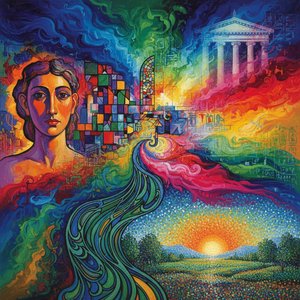
Aach’s work was defined by an intense interest in color theory and color relationships. His technical approach evolved significantly over time; he utilized pigments from the Art Crayon Company and DuPont, eventually incorporating fluorescent paints to achieve a sense of inner light. In his Precession of Equinoxes series, he applied thin layers of gesso to create surfaces reminiscent of Giotto's frescoes, using sharp lines to separate regions of color. Beyond the canvas, Aach was a notable writer who edited and translated Goethe's Theory of Colours. His artistic legacy is preserved in collections such as the Metropolitan Museum of Art and the Albright-Knox Art Gallery.
Kérdések és válaszok
Mely Herb Aach művei a legnézettebbek?
Herb Aach műveire vonatkozó statisztikusok a művész Statisztikák oldalán érhetőek el.
Hol és 어느 해 született Herb Aach?
Herb Aach Cologne városban született, 1923 évben.
Hol tekinthetők meg Herb Aach műveit egy 3D-s galériában?
Herb Aach művei megtekinthetők a művész virtuális, 3D-s galériájában, a 3D Galéria oldalon.
Hol találhatók Herb Aach alkotásai színpaletta szerint csoportosítva?
A Színpaletták alapján oldalon Herb Aach művei színpalettájuk alapján vannak csoportosítva.