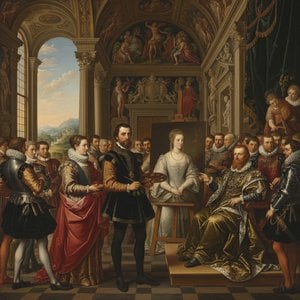
The Master of Transition: The Life and Legacy of Bernhard Strigel
In the twilight of the Middle Ages, as the rigid structures of the Gothic era began to dissolve into the luminous dawn of the Northern Renaissance, there emerged a painter of profound versatility and technical grace. Bernhard Strigel, born in the Swabian city of Memmingen around 1461, was not merely a chronicler of his time but a bridge between two worlds. While history often reserves its brightest spotlights for giants like Albrecht Dürer, Strigel occupied a vital space in the artistic landscape, weaving together the meticulous, spiritual intensity of the Flemish Primitives with the burgeoning humanism and portraiture of the German Renaissance.
Strigel’s journey began within the intimate confines of a family workshop, likely under the guidance of Hans Strigel I. This early immersion in the craft provided him with a foundation rooted in the stylistic precepts of the great Netherlandish masters. The influence of artists such as Jan van Eyck and Rogier van derようになった Weyden is palpable in his early works, where a devotion to hyper-realistic detail and a profound sense of spatial depth command the viewer's attention. His mastery of perspective and foreshortening allowed him to breathe life into religious iconography, transforming flat surfaces into windows of divine presence.
As his career matured, Strigel’s artistic language underwent a fascinating evolution. The pious, meticulously detailed altarpieces that defined his early years—characterized by vibrant color palettes and the ethereal beauty of medieval saints—gradually gave way to a more secular and psychological focus. This shift was mirrored by the changing political and religious tides of the Holy Roman Empire. His later works reveal an engagement with the Danube School and the subtle, realistic portraiture techniques of Hans Holbein, demonstrating an artist who refused to remain stagnant, instead constantly absorbing the shifting aesthetics of his era.
Imperial Splendor and the Art of Portraiture
Perhaps the most defining chapter of Strigel’s life occurred in 1515, when he was summoned to Vienna by Emperor Maximilian I. This appointment as court painter elevated him from a regional master to an artist of international significance. In the imperial court, Strigel found a patron who demanded not only technical excellence but also the ability to project power and dynastic legitimacy through imagery. It was during this period that he produced some of his most enduring masterpieces, including the monumental Emperor Maximilian I with His Family.
This particular work stands as a landmark in German art history, representing one of the earliest and most successful examples of group portraiture in the region. Through it, Strigel captured more than just faces; he captured the weight of an empire and the intricate web of Habsburg alliances. His ability to arrange figures within a complex spatial arrangement, utilizing light and shadow to create a sense of breathing reality, showcased a sophisticated understanding of composition that anticipated the developments of the high Renaissance.
Beyond the grand scale of imperial commissions, Strigel’s talent extended into the delicate realm of drawing and small-scale works. He was celebrated as a great draughtsman, particularly noted for his innovative use of reds and whites on paper. These works, such as Saints Catherine and Dorothy, exhibit a brilliant mastery of reflection and light, proving that his ability to evoke emotion was just as potent in the subtle strokes of a pen as it was in the sweeping brushstrokes of an altarpiece.
A Lasting Impression on the Northern Renaissance
The significance of Bernhard Strigel lies in his role as a stylistic conduit. He stood at the crossroads of tradition and innovation, successfully synthesizing the following elements into a cohesive artistic identity:
- Flemish Realism: The meticulous attention to texture, light, and botanical detail inherited from the Netherlandish tradition.
- Swabian Tradition: A deep connection to the regional workshops of Memmingen and the Ulm school, which provided his foundational aesthetic.
- Renaissance Humanism: An evolving interest in portraiture and the psychological depth of the individual, driven by his service to the imperial court.
- Technical Innovation: The advanced use of perspective, foreshortening, and color harmony that helped transition German art from Gothic rigidity to Renaissance fluidity.
Though the ravages of time and the religious upheavals of the Reformation led to the loss or misattribution of many works from his workshop, the surviving fragments of Strigel’s oeuvre remain a testament to his brilliance. He remains a pivotal figure whose work reflects the very heartbeat of a changing Europe—a painter who could capture both the celestial light of a saint and the terrestrial majesty of an Emperor with equal, breathtaking precision.
Kérdések és válaszok
Kereshetem Hans Strigel műveit kulcsszavak alapján is?
Hans Strigel Kulcsszavak szerint oldala a művész alkotásait kulcsszavak alapján csoportosítja.
Hans Strigel műveit színspektrum szerint is felfedezhetem?
Hans Strigel Színindex oldala a művész alkotásait színek szerint csoportosítja.
Létezik-e egy időrendi áttekintés Hans Strigel műveiről?
Hans Strigel műveletei időrendi sorrendben tekinthetők meg a művész Műalkotások időrendje oldalán.