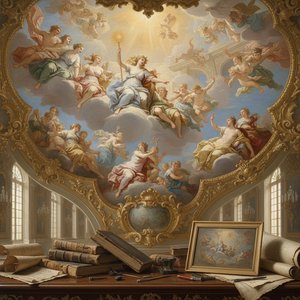
The Venetian Legacy of Giandomenico Tiepolo
In the luminous heart of eighteenth-century Venice, a period defined by the decadent splendor of the Rococo, Giandomenico Tiepolo emerged as a master of both grand spectacle and intimate human drama. Born in 1727, his life was inextricably woven into the fabric of one of art history's most formidable dynasties. As the son of the legendary Giovanni Battista Tiepolo, Giandomenico did not merely inherit a name; he inherited a visual language of light, movement, and theatricality. While much of his early career was spent in the shadow of his father’s monumental frescoes, Giandomenico possessed a singular creative spirit that allowed him to transcend mere imitation, eventually carving out a niche that blended the epic scale of his lineage with a poignant, often satirical, observation of Venetian life.
The formative years of Tiepolo’s development were characterized by a profound apprenticeship within the very workshops that decorated the palaces of Europe. Working alongside his father on ambitious projects, such as the breathtaking frescoes in Würzburg, Giandomenico mastered the technical complexities of large-scale composition and the innovative "oil sketch" technique. This method, which allowed for a more fluid and spontaneous capture of emotion, became a cornerstone of his approach. Through these collaborations, he learned to manipulate light to create depth and drama, yet he also began to develop an interest in much smaller, more delicate subjects that departed from the heroic myths favored by the previous generation.
A Mastery of Movement and Character
As his artistic identity matured, Giandomenico’s work began to exhibit a fascinating duality. On one hand, he maintained the grand tradition of Venetian decorative art, contributing significantly to opulent interiors like those found in Vicenza’s Villa Valmarana. On the other hand, he turned his gaze toward the streets and theaters of Venice, finding inspiration in the Commedia dell'arte. It is within this realm that his most enduring and evocative imagery resides—specifically his celebrated series featuring Punchinello. Through these characters, Tiepolo moved away from the divine and the mythological to explore the whimsical, the grotesque, and the deeply human.
His technical prowess was not limited to the brush; he was also a gifted etcher, using the medium to explore fine lines and atmospheric textures. This versatility allowed him to capture a wide spectrum of themes:
- Religious Devotion: Works such as The Agony in the Garden demonstrate his ability to handle profound spiritual tension with classical grace.
- Architectural Fantasies: His depictions of imaginary structures, like the View of the Gothic Pavilion, showcase a mastery of perspective and a romanticized vision of architectural grandeur.
- Social Satire: Through his etchings, he captured the fleeting, often melancholic essence of Venetian society, using masks and puppets to mirror the complexities of human identity.
Historical Significance and Enduring Spirit
The historical significance of Giandomenico Tiepolo lies in his role as a bridge between the soaring heights of the Baroque-Rococo era and the more introspective, observational styles that would follow. While he carried the torch of his father's monumentalism, he also anticipated the shift toward a more psychological and social realism. His ability to oscillate between the epic scale of a palace fresco and the intimate wit of a character study makes his oeuvre a unique window into the soul of late eighteenth-century Venice.
Ultimately, Tiepolo’s legacy is one of profound adaptability and emotional depth. He did not simply replicate the glory of the past; he reinterpreted it through a lens of contemporary observation. Whether through the sweeping narratives of his early training or the biting, beautiful etchings of his later years, Giandomenico Tiepolo remains a vital figure whose work continues to captivate with its blend of theatrical magic and tender humanity.
Gyakran Ismételt Kérdések
Hogyan találhatom meg Giandomenico Tiepolo műveit egy adott színpalettában?
A Színpaletták szerint oldalon Giandomenico Tiepolo művei színpalettájuk alapján vannak csoportosítva.
Mely történelmi korszakban alkotott Giandomenico Tiepolo?
Giandomenico Tiepolo a Early Modern korszakban alkotott. Ez az időszak a művész tevékenységét a történelembe helyezi.
Giandomenico Tiepolo műveit hangulat alapján is böngészhetem?
Giandomenico Tiepolo művei hangulat alapján is böngészhetők a művész Hangulat alapú gyűjtemény oldalán, amely a alkotásokat az átélhető hangulatuk szerint csoportosítja.
Hol találhatók Giandomenico Tiepolo művei szín szerinti csoportosítással?
Giandomenico Tiepolo művei színek szerinti csoportosítással is felfedezhetők a művész Színspektrum index oldalán.
Hol találhatók Giandomenico Tiepolo művei művészeti stílusok szerint csoportosítva?
Giandomenico Tiepolo művész alkotásainak különböző irányzatait a művész Összes irányzat oldalán tekintheti meg, ahol a műalkotások stílusirányzat szerinti csoportosításban láthatóak.
Mely Giandomenico Tiepolo művei a legnézettebbek?
Giandomenico Tiepolo műveire vonatkozó statisztikusok a művész Statisztika oldalán érhetőek el.
Giandomenico Tiepolo műveit témák szerint is felfedezhetem?
Giandomenico Tiepolo művei témánként is felfedezhetők a művész Témakör-atlasz oldalán.
Van-e elérhető 3D virtuális túra Giandomenico Tiepolo művei között?
Virtuális látogatás is lehetséges: Giandomenico Tiepolo 3D Múzeum oldala egy háromdimenziós galériában mutatja be a művész alkotásait.