

- 61.0 x 40.0 cm


A kép az Ön választásai alapján készült: , .
A gyűjtemény leírása
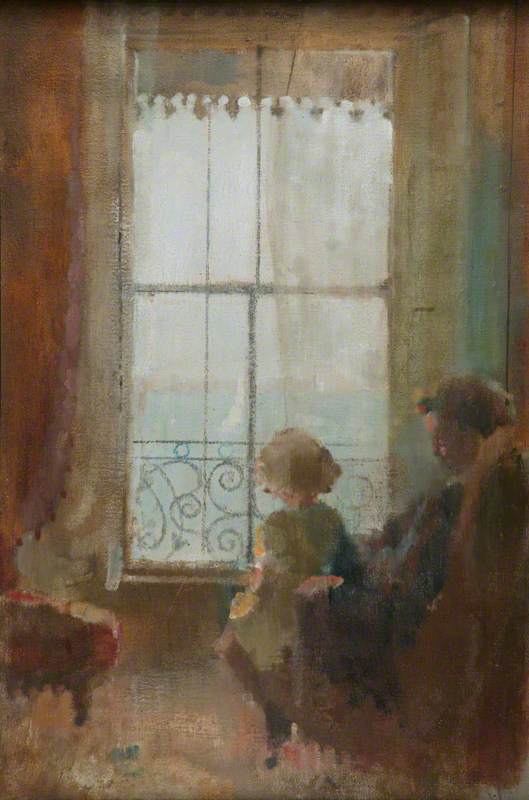
Experience 'The Window' by Thomas James Carr, a captivating realist painting from 1945. A beautiful Euston Road School piece depicting domestic life. Hand-painted reproduction available.
A művész életrajza
Thomas James Carr (1909-1999) was a British artist of the Euston Road School, known for his realist paintings of domestic scenes and landscapes in Ireland & England. Explore his legacy through artworks depicting everyday life and rural beauty.
 Összes részlet megjelenítése
Kézzel készített olajfestmény reprodukció
Kézzel festett olajvastú vászon, az Ön által választott méretben és keretben, művészeink készítik meglévőre. ( Váltás nyomtatványra Áttérés digitális képre)
Ez a műalkotás szerzői jogi védelem alatt áll
Az ezen az oldalon megjelenített műalkotások szerzői jogi védelem alatt állnak, ami azt jelenti, hogy törvényileg nem készíthetünk és nem adhatunk el belőlük pontos másolatokat. Ez a védelem olyan nemzetközi megállapodások alapján érvényesül, mint például a Berni Egyezmény és a nemzeti jogszabályok által, beleértve azokat is, amelyeket meghatározott Az USA szerzői jogi törvénye – 17. cím.
Mint tiszteletes és törvényes alternatívát, olyan egyedi, kézzel festett alkotásokat kínálunk, amelyek az eredetiből merítnek inspirációt. Tapasztalt és professzionális művészeink alaposan tanulmányozzák az eredeti stílusát, hangulatát és művészeti esszenciáját, hogy egy olyan új, egyedi alkotást hozzunk létre, amely ugyanazt az érzést kelti – miközben önálló, eredeti alkotásként létezik.
Ez a módszer teljes mértékben megfelel a szerzői jogi szabályozásnak, mivel nem tartalmazza a védett műalkotás másolását vagy duplikálását. Ehelyett ez egy kreatív újinterpretáció – egy új festmény, amely az eredetivel való összefüggései miatt hatással van rá, de nem az az.
Több információ erről a festményről
 Megtekintés
 Küldés
 Megosztás
 Részletek
 Útmutató

 Letöltés
 Hasonló darabok
 X-ray felvétel
 Diavetítés
 Kérdések és válaszok
 Statisztika
Rendelje meg festményét négy egyszerű lépésben
Ne siessen! Bármely választ módosítható; az rendelési összesítőben megjelenő ár minden egyes döntésre reagál.
1 Az első lépés négyből
Melyik méretet szeretné?
Ezek a méretek megőrzik az eredeti festmény arányait. A rajz bemutatja a választott méretet egy falon, egy kétszáz centiméteres kanapé felett.
Vagy adja meg a saját méreteit
Válasszon előre meghatározott méreteink közül, amelyek megfelelnek a műalkotás eredeti arányainak.

Írja be a kívánt szélességet és magasságot, hogy illeszkedjen a keretéhez vagy a falához. Mivel ez kézzel festett alkotás, egy eltérő formájú méret esetén a művész akár festhet is valamivel többet a kép körül, vagy korolathat is belőle — az Ön döntésének megfelelően. A festés megkezdése előtt küldünk egy digitális tervezetet jóváhagyásra. Az oldalon látható kép nem tartalmazza a végeredményt — csak a tervezet mutatja meg a valódi eredményt.
2 A négy lépésből a második
Hogyan kívánja előkészíteni: feltekercselve, vászonra feszítve vagy keretezve?
Az alábbi árak az első lépésben választott méretre vonatkoznak.
Válaszd ki a feszített vászon széleit
Válassza ki a keretet

Fehér Ft1

Elmosódott szélek Ft1

Kiterjesztett Ft1

P118B Ft10

P118H Ft10

P118W Ft10

P438Z Ft10

P508JH Ft12

P508YH Ft12

P805H Ft10

P805Z Ft10

P919BZ Ft10

P919G Ft10

P919XJ Ft10

P959ZH Ft10

P968JZ Ft12

W106C Ft8

W218G Ft10

W218JH Ft8

W218Y Ft10

W307PJ Ft10

W316G Ft10

W316PJ Ft8

W316Y Ft10

W398PJ Ft8

W4111J Ft10

W500HY Ft15

W500JH Ft15

W692G Ft12

W849H Ft8

W940BG Ft15

W953PJ Ft8

H24-GOLD Ft30

H24-SILVER Ft30

H36-GOLD Ft45

H36-SILVER Ft45
Keretezett
Keretprofil: . A kerettel együtt vett teljes méret: .
3 A négy lépésből a harmadik
Szeretne változtatni valamit a festményen?
A legtöbb ember nemet mond erre. Mivel minden festmény kézzel készül, művészünk képes az Ön igényei szerint is átalakítani azt.
A megrendelést követően a ArtsDot.com csapat e-mailt küld a vásárlónak az instrukciókkal, és biztosítja a tervezeti előnézetet
4 A négy lépés közül a negyedik
Néhány felületfinisz
Mindegyik opcionális. A már kiválasztott válaszok nem jelentnek plusz költséget.
Ki festette?
Világszerte elérhető szállítás () 3-4 hét alatt a szokásos 5 hét helyett. (4 november). A minőség nem kérdőjelezhető.
Egy felirat, mint egy múzeumban?
A gravírozott bronztábla részletei
This elegant plaque features the artist's name and the title of the artwork, finely engraved for a timeless presentation.
It is made from bronze with a refined, elegant finish. The text is precisely laser-engraved for a sharp and permanent result. Measuring 9x2 cm, the plaque is compact yet easy to read. It's built to be durable and scratch-resistant, offering a professional, museum-quality look. Mounting is simple thanks to the included adhesive backing.
Átlátszó akril tábla részletei
The plaque includes essential engraved details such as the artist's name, the title of the artwork, the date it was created, the type of media used-like oil on canvas or watercolor-a brief description of the piece, and a QR code that links to the complete artwork information.
It is crafted from clear acrylic, offering a sleek, modern appearance. The text is UV-engraved in black to ensure strong visual contrast. With a size of 10x15 cm, it ensures optimal readability. It comes equipped with two metal hooks for secure wall mounting. The plaque is designed to be weather-resistant, making it suitable for various environments, and it includes interactive features that work seamlessly with smartphone scanning.
Fekete akril tábla részletei
This elegant plaque includes engraved information such as the artist's name, the title of the artwork, the date it was created, the type of media used (like oil on canvas or watercolor), a short description of the artwork, and a QR code for quick access to more information.
The plaque itself is made from refined black acrylic with a premium finish. The text is laser-engraved in white for high contrast and readability. Its size is 10x15 cm, designed to be easy to read. It comes with two metal hooks for professional mounting. The design is sleek and fits any interior style. It is also weather-resistant and durable, with built-in digital integration for mobile compatibility.
Egy védőréteg?
Mikor lenne szüksége rá?
✓ Ellenőrizés és rendelés
Az Ön által megrendelt festmény

The Window
Reprodukciós technika
Reprodukció mérete
-

Kiváló mesterművész
Nagyobb részletesség, finomság és bővített gyártási idő
-

Reprodukció keretezése
-
-
A bármely oldalsó méretét túlszálaló 105 cm (kb. 41 hüvelyk) meghaladó műalkotások vagy reprodukciók esetében a keret összeszerelhető készletként, szétszerelve kerül szállításra. Ez a módszer biztosítja a biztonságos szállítást, és megakadályozza a szállítás során fellépő sérüléseket.
Szakmész összeszerelést igényel – ez nem DIY (önösszeszerelhető) termék.
A készletet egy tapasztalt keretező szakembernek kell összeszerelnie és a vásznat feszítenie kell, fa ragasztó (nem tartalmazza a csomag), vásznfeszítő fogó és szorítók használatával, amelyek a ragasztó száradásáig a keretrészeket egymáshoz vuôngjba tartják. A helytelen összeszerelés vagy a nem egyenletes vásznfeszítés maradandó károsíthatja a műalkotást, és ez nem része a garanciánknak.
 A bármely oldalsó méretét túlszálaló 105 cm (kb. 41 hüvelyk) meghaladó műalkotások vagy reprodukciók esetében a keret összeszerelhető készletként, szétszerelve kerül szállításra. Ez a módszer biztosítja a biztonságos szállítást, és megakadályozza a szállítás során fellépő sérüléseket.
A készlet tartalmazza az összes tömörfa rudat, pontosan méretre vágva.
A mellékelt csavarokkal, valamint a sarokszerekhez szükséges faütő ragasztóval kell összeszerelnie (ez nem tartalmazható a csomagban), így a keretrendezőnek külön kell beszereznie.
A csomag nem tartalmazza a szükséges professzionális eszközöket: egy vászonfeszítőt és klipseket a rácsok vízszintes tartásához a ragasztó megszáradásáig.
Fontos:
A sarokcsatlakozásokhoz fánylagra van szükség, a keretrudakat szorítókapcsokkal kell rögzíteni, amíg a rag teljesen meg nem szárad, a kész keretre feszített vászonhoz pedig vászonfeszítő fogat szükséges. Ezek egyike sem található meg a készletben. Kérjük, rendelés előtt győződjön meg róla, hogy rendelkezik tapasztalt keretező szakemberrel.

Névtábla
-
-

Védőréteg (Lakk)
Fényes lakk (intenzívabb színek, védelem a fény és a nedvesség hatása ellen)
-

Műalkotásom egyedi igényre szabása
Példák a módosíthatóságra: az arc kicserélése az ügyfél fotójára; háziállat hozzáadása (pl. macska helyett kutya); rejtett üzenet elhelyezése a háttérben; a háttér tájainak vagy elemeinek megváltoztatása.
-

Sürgős
Világszerte szóló szállítás () mindössze 3-4 hét alatt, a szokásos 5 hét helyett. (4 november). A minőség nem kérdőjelezhető.
-
Express szállítás
Világszerte elérhető szállítás területre 5 héten belül. (11 november).
A szállítás díja tartalmazza
Összesített ár
Ft 101631
Az üvegkeretes opció csak 110 cm alatti méretben érhető el
Minden rendelés mellé tartalmazva
- Ingyenes globális expressz szállítás
- Prémium minőségű len vászon
- Teljes körű szállítási biztosítás
- Vámvisszatérítési Garancia
- Hiteles színarányosság garancia
- 100 napos visszaküldési lehetőség (csak hibás termékek esetén)
- 100% pénzvisszatérítési garancia
- Több darab vásárlásakor kedvezmény


Hasonló műalkotások


Thomas James Carr
1909 - 1999
A művész életrajza
Thomas James Carr: Weaver of Domestic Landscapes
Thomas James Carr (1909-1999) wasn’t a name that frequently echoed through the halls of 20th-century art, yet his quietly observant paintings offer a compelling window into the heartland of America – and, crucially, Ireland. Often categorized within the Euston Road School, a movement known for its restrained realism and focus on everyday life, Carr possessed a unique ability to imbue seemingly simple scenes with a profound sense of atmosphere and human connection. His work isn’t about grand pronouncements or dramatic gestures; it's a subtle exploration of rural existence, family routines, and the enduring beauty found in the commonplace.
Born in Belfast, Northern Ireland, into a comfortable family with strong connections to the stockbroking world – his grandfather was a watercolourist – Carr’s early life instilled within him an appreciation for visual representation. He received his initial artistic training at Oundle School in England, where he studied under E.M.O'R. Dickey and Christopher Perkins, gaining foundational skills in draughtsmanship and composition. A pivotal moment arrived in 1927 when he moved to London and enrolled at the Slade School of Art, studying under Henry Tonks. This period exposed him to a wider range of artistic approaches, though it was his subsequent year spent in Settignano, near Florence, that truly shaped his aesthetic sensibilities. Immersed in the Italian landscape and art tradition, Carr developed a deeper understanding of light, color, and the expressive potential of paint – a shift evident in the warmth and luminosity he brought to his later works.
Returning to London, Carr established himself as a respected painter of domestic scenes. He wasn’t simply documenting reality; he was actively interpreting it. His paintings frequently depict rural life—farmers tending their fields, families gathered around tables, or solitary figures engaged in quiet pursuits. While often described as a realist, Carr's work transcends mere imitation. He employed a loose, painterly technique, favoring broad brushstrokes and a muted color palette to create a sense of depth and atmosphere. Notably, he was included in the 1934 Objective Abstractionists exhibition at Zwemmer’s gallery, suggesting an awareness of modern artistic trends without fully embracing abstraction himself. This inclusion highlights his willingness to engage with contemporary art while maintaining his own distinct visual language.
Carr's career unfolded across several decades, punctuated by exhibitions in London and Ireland. He found a supportive audience at the Leicester Galleries, Redfern Gallery, and Agnew’s, showcasing his work alongside prominent artists of the time. During World War II, he returned to Northern Ireland and took on commissions from the War Artists’ Advisory Committee, capturing scenes of parachute manufacture and the construction of Short Sunderland flying-boats in Belfast – a testament to his adaptability and ability to depict industrial subjects with sensitivity. Following the war, he taught at the Belfast College of Art and later moved to Newcastle, County Down, where he continued to paint until his death in 1999. His final years were marked by a renewed focus on landscape painting, reflecting a lifelong connection to the natural world.
The Euston Road School and Carr’s Place Within It
Carr's association with the Euston Road School is central to understanding his artistic development and legacy. This group of artists, led by William Coldstream, formed a distinct movement within British painting in the mid-20th century. The Euston Road School rejected the overtly expressive styles of earlier movements, instead prioritizing observation, restraint, and a subtle exploration of form and color. They were deeply influenced by the work of Cézanne and focused on capturing the essence of their subjects rather than simply reproducing them realistically.
Carr’s paintings align closely with the Euston Road School's principles. Like his colleagues – Victor Pasmore, Claude Rogers, and others – he eschewed dramatic compositions or overtly emotional subject matter. Instead, he sought to create paintings that were quietly evocative, inviting viewers to contemplate the beauty and complexity of everyday life. His use of light and color is particularly noteworthy, reflecting a deep understanding of how these elements can shape our perception of a scene. While he shared a common aesthetic with the Euston Road School, Carr’s work also retained a distinctly Irish sensibility – a sensitivity to the landscape, the rhythms of rural life, and the cultural traditions of his homeland.
Themes and Symbolism in Carr's Work
Carr’s paintings are rich in subtle symbolism and thematic resonance. At their core, they explore themes of family, community, and the relationship between humans and nature. His depictions of rural life often convey a sense of nostalgia for a simpler time – a longing for connection to the land and to traditional values. The figures in his paintings are rarely idealized; they are presented as ordinary people engaged in everyday activities, reflecting Carr’s belief that beauty can be found in the mundane.
The landscapes he painted are equally significant. They aren't merely scenic representations but rather expressions of a deep connection to the natural world. Carr frequently employed muted color palettes and atmospheric effects to create a sense of mood and atmosphere, evoking the changing seasons and the rhythms of rural life. The use of light is particularly important – it’s often diffused and subtle, creating a feeling of quiet contemplation.
Legacy and Historical Significance
Thomas James Carr may not be as widely celebrated as some of his contemporaries, but his work holds considerable historical significance. He represents a vital link between the realist traditions of British painting and the emerging trends of mid-20th-century art. His association with the Euston Road School helped to shape the course of British painting, while his distinctive style – characterized by its quiet observation, atmospheric effects, and subtle symbolism – continues to resonate with viewers today.
Carr’s paintings offer a valuable glimpse into the social and cultural landscape of Ireland and Britain during the 20th century. They document the rhythms of rural life, the values of community, and the enduring beauty of the natural world. His legacy lies not in grand gestures or revolutionary innovations but in his ability to capture the essence of everyday life with quiet grace and profound insight.
Kapcsolódó cikkek

The Hague School: Realism, Atmosphere & the Dawn of Dutch Impressionism
Explore the Hague School's pivotal role in Dutch art history. Discover realism, atmospheric landscapes & its influence on Impressionism. Learn about key artists like Mauve & Maris with ArtsDot.

James Abbott McNeill Whistler 25 Mesterműve: Hangulatok és Elegancia a Falakon
Fedezze fel James Abbott McNeill Whistler 25 legszebb művét! Ismerje meg a Nocturnok, portrék és az amerikai impresszionizmus mesterét. Elegáns faliképek otthonába – ArtsDot.com kínálatából. Böngésszen online!

A Hudson River Iskola 10 Mesterműve: Tájképfestészet és Amerika Lelke – ArtsDot
Fedezze fel a Hudson River Iskola 10 legikonikusabb műalkotását! Frederic Church, Thomas Cole és más amerikai festők romantikus tájképei. Vászonkép másolatok, faliképek otthonába – ArtsDot.com kínálatából. Explore the full collection online!