Megtekintés
 Küldés
 Megosztás
 Részletek

 Letöltés
 Hasonló darabok
 X-ray felvétel
 Diavetítés
Call
 Oil On Canvas
- WallArt
- Surrealism
 1944
1944- 19th Century
 155.0 x 150.0 cm
 Összes részlet megjelenítése
Giclée / Műnyomat
Múzeumi minőségű giclée vagy vászonnyomat, gyors gyártással és rugalmas finomítási lehetőségekkel. ( Kézzel festett másolat rendelése Kép letöltése)




P118B $10

P118H $10

P118W $10

P438Z $10

P508JH $12

P508YH $12

P805H $10

P805Z $10

P919BZ $10

P919G $10

P919XJ $10

P959ZH $10

P968JZ $12

W106C $8

W218G $10

W218JH $8

W218Y $10

W307PJ $10

W316G $10

W316PJ $8

W316Y $10

W398PJ $8

W4111J $10

W500HY $15

W500JH $15

W692G $12

W849H $8

W940BG $15

W953PJ $8




Válasszon előre meghatározott méreteink közül, amelyek megfelelnek a műalkotás eredeti arányainak.

Megadhat saját méreteket is egy konkrét kerethez vagy helyszínhez igazítva. Amennyiben a kiválasztott méret nem egyezik az eredeti kép arányokkal, a műalkotást le fogjuk vágni, vagy kiegészítjük a képet tükrözött vagy egyszínű szélekkel. A gyártás megkezdése előtt egy digitális tervezetet küldünk jóváhagyásra.
Kérjük, vegye figyelembe, hogy a képernyőn látható előnézet nem tükrözi a tényleges levágást vagy kiegészítést. Csak a tervezet mutatja pontosan a végső kompozíciót.
Bár az egyedi méretek is elérhetőek, az eredeti arányok megőrzése érdekében azt javasoljuk, hogy válasszon a előre meghatározott listából származó méretet.
Világszerte történő kiszállítás területére mindössze 2 hét alatt, a szokásos 4-5 hét helyett. (14 augusztus)

Ingyenes globális expressz szállítás

Prémium minőségű len vászon

Teljes körű szállítási biztosítás

Vámvisszatérítési Garancia

Hiteles színpontosság garancia

60 napos visszaküldési lehetőség (csak hibás termékek esetén)

100% pénzvisszatérítési garancia

Több darab vásárlása esetén kedvezmény
 Az üvegkeretes opció csak 110 cm alatti méretben érhető el

Call
Giclée / Műnyomat
Reprodukció mérete
-


Összesített ár
$ 62
Gyűjthető leírása
A Haunting Dialogue Between Life and Death: Paul Delvaux’s “Call”
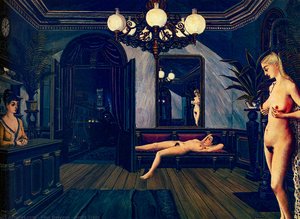
Paul Delvaux's "Call," completed in 1944, is not merely a painting; it’s an immersion into the unsettling beauty of mortality. This arresting oil on canvas immediately commands attention with its dramatic juxtaposition of opulent decay and vibrant indifference. The scene unfolds within a richly appointed interior – a luxurious room rendered with meticulous detail – where a nude woman sits poised, her gaze fixed upon a skeletal figure reaching towards her. Outside, a bustling cityscape, complete with a grand staircase and anonymous figures, continues its oblivious progress, highlighting the profound disconnect between human experience and the relentless march of time. The painting’s melancholic mood speaks to universal themes of existence, loss, and the seductive allure of oblivion, solidifying Delvaux's place as a key figure in Surrealism.
Technical Mastery and Romantic Resonance
- Technique: Delvaux’s mastery is immediately apparent in the rich, layered texture achieved through his skillful application of oil paint. Visible brushstrokes contribute to an astonishing sense of depth and realism, particularly evident in the rendering of the woman's form and the intricate details of the architectural setting. The directional lighting – a hallmark of Romanticism – dramatically sculpts the scene, emphasizing the central figures while casting deep shadows that heighten the atmosphere’s somber quality.
- Perspective & Composition: The use of linear perspective draws the viewer into the expansive cityscape beyond, creating a powerful sense of depth and reinforcing the painting's thematic concerns. Delvaux expertly divides the composition between the intimate interior scene and the vast outdoor vista, mirroring the duality within the artwork itself – the personal confrontation with death versus the indifferent flow of the world.
- Color Palette: The dominant blues, reds, and earthy tones evoke a sense of both grandeur and profound sadness, reflecting the painting’s core themes. These colors are not simply decorative; they actively contribute to the emotional weight of the piece.
Symbolism and Historical Context
The skeletal figure, a traditional symbol of mortality, is rendered with chilling realism, its reach towards the woman representing the inescapable nature of death. She embodies earthly beauty and perhaps innocence, vulnerable in the face of this inevitable reality. The juxtaposition of the luxurious interior – a product of human ambition and desire – with the chaotic city reflects the broader anxieties of the interwar period, marked by social upheaval and a growing sense of disillusionment. Delvaux’s work emerged during a time when Surrealism was challenging conventional notions of reality and exploring the subconscious mind, and “Call” exemplifies this movement's fascination with dreamlike imagery and unsettling juxtapositions.
A Timeless Masterpiece for Collection and Interior Design
"Call" transcends its historical context to offer a profoundly moving meditation on the human condition. This meticulously crafted reproduction captures not only Delvaux’s technical brilliance but also the emotional power of his original vision. Its size (155 x 150 cm) makes it suitable for both grand and intimate spaces, while its evocative imagery will undoubtedly spark conversation and contemplation. Whether adorning a private collection or serving as a focal point in an interior design scheme, this artwork offers a unique opportunity to own a piece of Surrealist history – a haunting reminder of life’s fleeting beauty and the enduring presence of death.
Hasonló műalkotások


A művész életrajza
A Dream Weaver: Paul Delvaux’s Enchanting World
Paul Delvaux, a name synonymous with haunting beauty and unsettling dreams, was born in 1897 in the small Belgian village of Wanze. His early life, steeped in both rigorous academic training – Greek and Latin studies were paramount – and the fantastical worlds conjured by Jules Verne and Homer’s *Odyssey*, laid the foundation for a uniquely captivating artistic vision. This inherent duality—the ordered discipline of classical education juxtaposed with the boundless imagination of childhood literature—would become a defining characteristic of his oeuvre. Initially, his parents steered him towards a career in architecture, a path he dutifully pursued at the Académie Royale des Beaux-Arts in Brussels. However, the structured demands of mathematics proved too restrictive for his artistic spirit, and he ultimately abandoned this ambition to dedicate himself fully to painting. This decision, though initially met with some resistance from his family, marked the beginning of his extraordinary journey into the realm of Surrealism, albeit one he resisted being rigidly categorized within.The Seeds of a Surrealist Style
Delvaux’s artistic transformation began with a profound encounter with the work of Giorgio de Chirico. De Chirico's paintings—characterized by stark, enigmatic scenes populated by shadows, classical architecture, and an unsettling sense of isolation—resonated deeply with Delvaux, unlocking a new pathway for his creativity. He was particularly drawn to the way de Chirico evoked a feeling of unease and disorientation through carefully constructed spaces and ambiguous figures. This influence is immediately apparent in his early works, which began to feature nude figures set against imposing architectural structures or within vast, desolate landscapes—a departure from the more traditional landscapes he had previously painted. Furthermore, Delvaux’s artistic development was also shaped by the work of Flemish Expressionists like Constant Permeke and Gustave De Smet, whose somber palettes and emotionally charged brushwork added a layer of intensity to his own style. These influences combined to create a distinctive visual language—one that balanced classical precision with dreamlike irrationality.The Language of Dreams: Recurring Motifs
Delvaux’s artistic language is rich in symbolism, yet he consistently resisted attempts at straightforward psychoanalytic interpretation. His paintings are populated by recurring motifs that contribute to the overall atmosphere of mystery and unease. The female nude, a central figure in many of his works, often appears passive or melancholic, embodying both desire and vulnerability—a poignant contrast against the often-sterile environments she inhabits. Trains and railway stations frequently appear as symbols of transition, displacement, and the anxieties of modernity; they represent journeys into the unknown, leaving behind familiar landscapes for uncertain destinations. Skeletons, far from being merely morbid emblems of death, are presented with a haunting beauty, serving as reminders of mortality that permeate even the most idyllic scenes—a subtle acknowledgment of the ephemeral nature of existence. Classical architecture provides a backdrop of order and permanence, yet it is often rendered strangely distorted or incomplete, suggesting a fragility beneath the surface. These elements – trains, nudes, skeletons, classical structures – are not merely decorative; they are integral to the emotional and psychological impact of his work, creating a complex tapestry of meaning.From Wanze to Recognition: A Career Shaped by Isolation
Delvaux’s artistic journey was marked by periods of isolation and self-doubt. Despite achieving some recognition in Belgium during the 1930s, he struggled to gain international acclaim until after World War II. The war years brought a period of travel through Italy, where he encountered the influence of early 16th-century Italian Mannerist painting—a style characterized by its dramatic use of perspective and elongated figures. This exposure further refined his artistic sensibilities, adding a layer of sophistication to his already distinctive style. Following the war, Delvaux continued to develop his unique vision, producing some of his most iconic works, including *Night Train* (1947), *Sleeping Venus* (1953), and *The Summer* (1962). These paintings—characterized by their haunting beauty, enigmatic atmosphere, and meticulous detail—established him as one of the leading Surrealist painters of his generation. He held teaching positions at the Académie Royale des Beaux-Arts in Brussels from 1950 to 1962, passing on his knowledge and inspiring a new generation of artists.A Lasting Legacy: The Enduring Power of Dreams
Paul Delvaux died in 1994 in Veurne, leaving behind a remarkable body of work that continues to captivate audiences worldwide. His paintings are exhibited in major museums across Europe and North America, including the Tate Gallery in London and the Musée d’Art Moderne de la Ville de Paris. Delvaux's influence can be seen in the work of numerous contemporary artists who explore themes of memory, desire, and the subconscious—a testament to the enduring power of his artistic vision. He demonstrated that Surrealism could exist beyond the confines of automatic writing and dream analysis, embracing instead a meticulous technique and a deeply personal exploration of the human psyche. The Paul Delvaux Museum in Saint-Idesbald, Belgium, houses the world’s largest collection of his work, offering visitors a unique opportunity to immerse themselves in the enchanting world of this extraordinary artist—a world where dreams and reality intertwine, creating images that are both unsettling and profoundly beautiful.
Paul Delvaux
1897 - 1994 , Belgium
A művészről röviden
- Artistic Movement Or Style: Surrealista
- Artists Or Movements Influenced By This Artist: ['Klasszikus festészet']
- Artists Who Influenced This Artist:
- Giorgio de Chirico
- René Magritte
- Date Of Birth: 1897. szeptember 23.
- Date Of Death: 1994. július 20.
- Full Name: Paul Delvaux
- Nationality: Belgiumi
- Notable Artworks:
- Éjszakai vonat
- Alvó Vénusz
- Nyár
- Szürke Város
- Place Of Birth: Wanze, Belgium
Kapcsolódó cikkek

Paul Cézanne 25 Mesterműve: A Modern Művészet Úttörői | ArtsDot
Fedezze fel Paul Cézanne 25 legikonikusabb művét! Ismerje meg a posztimpresszionizmus úttörőjének festményeit, technikáját és inspirációit. Vászonképek, portrék, tájképfestmények – minden otthonba. Böngéssze gyűjteményünket a ArtsDot-on!

Paul Klee Mesterművei: A 25 Legikonikusabb Festmény, Amelyek Életet Színeznek – ArtsDot
Fedezze fel Paul Klee 25 legikonikusabb festményét! Merüljön el az absztrakt művészet, expresszionizmus és kubizmus világában. Művészi történetek, színes kompozíciók és inspiráló dekorációs ötletek várják Önt a ArtsDot-on. Explore the full collection online!

A Tájkép Mesterei: 10 Képi Gyöngyem a Természet Szerelemről – ArtsDot.com
Fedezze fel a 10 legikonikusabb tájkép festményt! Monet, Van Gogh és más mesterek művei inspirálnak. Művészeti reprodukciók magas minőségben – tökéletes dekoráció otthonába. Böngésszen ArtsDot.com-on!

The Enigmatic Realm of Paul Delvaux: Surrealism, Memory & the Poetics of Disquiet
Explore the haunting dreamscapes of Paul Delvaux, a master of Surrealism. Discover his iconic motifs, classical influences & enduring legacy with ArtsDot.com.

Evocations of Place: A Historical Journey Through Landscape Art
Explore the rich history of landscape art with ArtsDot. Discover renowned artists, movements like Impressionism & Romanticism, and expert guidance for collecting timeless pieces. Find your perfect serene escape today!