


 Előnézet
 Megosztás
 Megosztás
 Részletek
 Útmutató

 Letöltés
 Hasonló darabok
 X-ray felvétel
 Diavetítés
 Statisztika
From Line
 Painting
- WallArt
- Mono-ha
 Contemporary
 227.0 x 181.0 cm
 Fukuoka Ázsiai Művészeti Múzeum
 Tovább olvasom
Az ezen az oldalon megjelenített műalkotások szerzői jogi védelem alatt állnak, ami azt jelenti, hogy törvényileg nem készíthetünk és nem adhatunk el belőlük pontos másolatokat. Ez a védelem olyan nemzetközi megállapodások alapján érvényesül, mint például a Berni Egyezmény és a nemzeti törvények által, beleértve azokat is, amelyeket meghatározott Az USA szerzői jogi törvénye – 17. cím.
Mint tiszteletes és törvényes alternatívát, olyan egyedi, kézzel festett alkotásokat kínálunk, amelyek az eredetiből merítnek inspirációt. Tapasztalt és professzionális művészeink alaposan tanulmányozzák az eredeti stílusát, hangulatát és művészeti esszenciáját, hogy egy olyan új, egyedi alkotást hozzunk létre, amely ugyanazt az érzést kelti – miközben önálló, eredeti alkotásként létezik.
Ez a módszer teljes mértékben megfelel a szerzői jogi szabályozásnak, mivel nem tartalmazza a védett műalkotás másolását vagy duplikálását. Ehelyett ez egy kreatív újinterpretáció – egy új festmény, amely az eredetivel való összefüggései miatt hatással van rá, de nem az az.
Kézzel készített olajfestmény reprodukció
Kézzel festett olajvastú vászon, az Ön által választott méretben és keretben, művészeink készítik meglévőre. ( Váltás nyomtatványra Áttérés digitális képre)




P118B Ft10

P118H Ft10

P118W Ft10

P438Z Ft10

P508JH Ft12

P508YH Ft12

P805H Ft10

P805Z Ft10

P919BZ Ft10

P919G Ft10

P919XJ Ft10

P959ZH Ft10

P968JZ Ft12

W106C Ft8

W218G Ft10

W218JH Ft8

W218Y Ft10

W307PJ Ft10

W316G Ft10

W316PJ Ft8

W316Y Ft10

W398PJ Ft8

W4111J Ft10

W500HY Ft15

W500JH Ft15

W692G Ft12

W849H Ft8

W940BG Ft15

W953PJ Ft8




Válasszon előre meghatározott méreteink közül, amelyek megfelelnek a műalkotás eredeti arányainak.

Írja be a kívánt szélességet és magasságot, hogy illeszkedjen a keretéhez vagy a falához. Mivel ez kézzel festett alkotás, egy eltérő formájú méret esetén a művész akár festhet is valamivel többet a kép körül, vagy korolathat is belőle — az Ön döntésének megfelelően. A festés megkezdése előtt küldünk egy digitális tervezetet jóváhagyásra. Az oldalon látható kép nem tartalmazza a végeredményt — csak a tervezet mutatja meg a valódi eredményt.
A rendelést követően a ArtsDot.com csapata e-mailt küld az ügyfélnek az instrukciókért, és biztosít egy előnézeti képet (mockup).
Világszerte elérhető szállítás () 3-4 hét alatt a szokásos 5 hét helyett. (24 október). A minőség nem kérdőjelezhető.

Ingyenes globális expressz szállítás

Prémium minőségű len vászon

Teljes körű szállítási biztosítás

Vámvisszatérítési Garancia

Tökéletes színarányosság garancia

100 napos visszaküldési garancia (csak gyártási hibás termékek esetén)

100% pénzvisszatérítési garancia

Több darab vásárlásakor kedvezmény
 Az üvegkeretes opció csak 110 cm alatti méretben érhető el

From Line
Reprodukciós technika
Reprodukció méretei
-


Összesített ár
Ft 84175
The Poetics of Presence: A Meditation on Lee Ufan’s From Line
In the quiet intersection where Eastern philosophy meets Western minimalism, Lee Ufan’s From Line emerges as a profound meditation on existence and the passage of time. As a central figure of the Mono-ha movement, Lee does not merely paint; he orchestrates a delicate dialogue between the void and the mark. This particular work serves as a breathtaking example of his ability to transform a canvas into a living, breathing landscape of thought. The composition, characterized by its rhythmic verticality, invites the viewer into a space where the distinction between the painted stroke and the surrounding emptiness begins to dissolve, creating an atmosphere of deep contemplation.
The visual journey of From Line is one of mesmerizing movement. At first glance, the eye is drawn to the series of vertical lines that traverse the canvas, creating a sense of depth and dimension that defies the two-dimensional surface. These strokes, reminiscent of traditional Eastern brushwork, possess a weight and texture that suggest the relentless flow of a waterfall or the steady descent of rain through a misty forest. A subtle horizontal line cuts through the center, acting as a horizon of sorts, providing a structural anchor that balances the kinetic energy of the vertical elements. This careful arrangement creates a profound sense of harmony, where every interval and every void plays a vital role in the overall equilibrium of the piece.
Mastery of Materiality and Technique
Technically, the work is a masterclass in controlled spontaneity. Lee Ufan utilizes the relationship between color and space to evoke raw emotion, employing a palette that—while appearing simple—carries immense psychological weight. The interplay of light and shadow within the strokes suggests a physical presence, as if the paint itself is an organic material emerging from the canvas. In some iterations of this series, Lee has even paired Japanese powdered mineral pigments with Western canvas, dipping his brush in cobalt-blue paint and pulling it across the support in one continuous, decisive motion. This method ensures that each trace captures a moment of pure, unrepeatable action, making the painting a record of its own creation.
For the discerning collector or interior designer, this piece offers more than just aesthetic beauty; it provides a focal point of serenity. The way the lines move from fullness to near-invisibility allows the artwork to breathe within a room, interacting with the surrounding architecture and light. It is a work that demands a slow gaze, rewarding those who approach it with patience.
A Bridge Between Worlds
To understand From Line, one must look toward the artist's profound intellectual journey. Born in 1936, Lee’s early life was steeped in the disciplined rhythms of a traditional Confucian household, where calligraphy and inkbrush painting served as his first languages. His later immersion in Western phenomenology—engaging with thinkers like Heidegger and Merleau-Ponty—allowed him to bridge the gap between being and nothingness. This synthesis is palpable in the artwork; it is a piece that exists in the tension between the physical mark of the brush and the infinite potential of the empty space.
Owning a high-quality reproduction of such a masterpiece allows one to bring this sense of philosophical depth into a modern living space. Whether placed in a minimalist gallery-style lounge or a quiet study, From Line acts as an anchor of calm, reminding the viewer of the beauty found in simplicity and the profound resonance of a single, well-placed stroke.
Gyakran Ismételt Kérdések
Milyen érzést kelt a "From Line"?
A „From Line”, Lee Ufan alkotása egy Tranquil érzelmi hangulatot közvetít.
Milyen technika és stílus jellemzi „From Line”, Lee Ufan alkotása alkotást?
A „From Line”, Lee Ufan alkotása ötvözi a Painting technikát a Mono-ha stílussal. A technika és a művészeti irány a mű elkészítését és stílusát írja le.
Hová sorolható a "From Line" Lee Ufan életművében?
A "From Line" megosztja Lee Ufan többi művével a Mono-ha stílust és a rögzített témákat: eastern aesthetics, phenomenology, mono-ha movement, minimalist abstraction, nature of materials, zen philosophy.
Hasonló műalkotások


A művész életrajza
The Philosophy of Presence: The Life and Vision of Lee Ufan
In the quiet intersection where Eastern contemplative traditions meet the rigorous inquiries of Western phenomenology, the work of Lee Ufan resides. Born in 1936 in Haman-gun, Gyeongsangnam-do, Lee’s early life was steeped in the disciplined rhythms of a traditional Confucian household. His childhood was not merely an era of growth but one of profound cultural immersion, where the delicate strokes of calligraphy and the rhythmic beauty of inkbrush painting served as his first languages. This foundational training in the classical arts provided him with a deep-seated reverence for the materiality of ink and paper, a sensitivity that would later become the heartbeat of his minimalist masterpieces.
Lee’s journey took a transformative turn in 1956 when he moved to Yokohama, Japan, seeking new intellectual horizons. While his initial studies at Seoul National University focused on painting, it was his immersion in the study of philosophy at Nihon University that would ultimately redefine his artistic trajectory. By engaging with the profound works of thinkers like Martin Heidegger and Maurice Merleau-Ponty, Lee began to develop a theoretical framework that sought to bridge the gap between being and nothingness. He did not merely wish to paint objects; he sought to explore the very essence of existence through the interaction of space, matter, and perception.
The Architect of Mono-ha and Dansaekjo
As the late 1960s approached, Lee Ufan emerged as the preeminent theorist and driving force behind the Mono-ha, or "School of Things" movement. This was not a movement defined by the creation of new forms, but rather by a radical reconsideration of what already exists. Through his seminal essays, Lee advocated for an art that emphasized the relationship between natural and man-made materials—stones, steel, glass, and wood—allowing them to exist in their raw, unadulterated state. His philosophy was a deliberate antidote to the Eurocentric dominance of the era, proposing a methodology of de-westernization that favored the experiential engagement of the viewer with the site.
Parallel to his influence in Japan, Lee’s artistic spirit breathed life into the Dansaekjo movement in South Korea. This "monotone art" emphasized the meditative process of painting, where the repetitive application of pigment became a ritualistic act of connection between the artist's hand and the canvas. His work during this period moved away from expressive abstraction toward a more restrained, rhythmic aesthetic that celebrated the subtle nuances of texture and tone. In doing so, he helped establish a uniquely Korean modernism that resonated far beyond the borders of the peninsula.
A Legacy of Marks and Silence
The mature works of Lee Ufan, such as his celebrated From Point and From Line series, serve as breathtaking meditations on time and decay. In these pieces, a single brushstroke begins with intense saturation and gradually fades into nothingness, tracing the inevitable passage of time and the ephemeral nature of existence. Each mark is an event; each void is a presence. The viewer is invited to witness the dialogue between the painted trace and the untouched canvas, a relationship that mirrors the profound interconnectedness of all things in the natural world.
Throughout his storied career, Lee has navigated the complexities of history—from the political turbulence of post-war Korea to his life as a cultural wanderer between Kamakura and Paris. His achievements have been recognized with the highest honors, including the Legion of Honour and the Praemium Imperiale. Today, his legacy is physically anchored in the Lee Ufan Museum on Naoshima island, a collaborative marvel designed with architect Tadao Ando. This space, where light and shadow dance across concrete walls, stands as a testament to Lee’s lifelong pursuit: an art that does not demand attention through noise, but commands reverence through its profound, resonant silence.

Lee Ufan
1936 -
Gyors információk
- Artistic Movement Or Style: Minimalism, Mono-ha
- Artists Or Movements Influenced By This Artist:
- Mono-ha
- Dansaekjo Yesul
- Artists Who Influenced This Artist:
- Martin Heidegger
- Maurice Merleau-Ponty
- Date Of Birth: 1936
- Full Name: Lee Ufan
- Nationality: Korean
- Notable Artworks:
- From Point series
- From Line series
- Place Of Birth: Haman-gun, Korea
Kapcsolódó cikkek
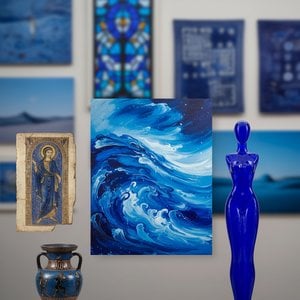
The Allure of Azure: Exploring the Symbolic & Aesthetic Depths of Blue in Art History
Explore the rich history of blue in art! Discover its symbolism, from ancient pigments to modern masterpieces by Kandinsky & Seurat. Uncover the psychological impact and cultural meanings behind this captivating hue.

Claude Monet 25 Mesterműve: A Fény és a Szín Zsenialitása – ArtsDot.com
Fedezze fel Claude Monet 25 legikonikusabb mesterművét! Ismerje meg az impresszionizmus zseniális festőjének történetét, a fény és szín varázsát. Vásároljon exkluzív reprodukciókat otthona dekorációjához a ArtsDot.com-on!

A kék árnyalatai: 10 ikonikus festmény a Slate Blue szín jegyében | ArtsDot.com
Fedezze fel a 10 legikonikusabb festményt, melyeket a Slate Blue szín ural! Monet, Renoir és más mesterek művei inspirálnak. Vászonképek eladás, otthon dekoráció tippek a ArtsDot.com-on. Explore the full collection online!

Minimalista Művészet: A Top 10 Legikonikusabb Darab a Lakberendezésben
Fedezze fel a top 10 minimalista műalkotást! Mark Rothko, Agnes Martin és más ikonikus festők letisztult világát. Inspirálódjon modern képekkel, absztrakt vászonképekkel és hozzon létre nyugtató belső teret. Prémium minőségű reprodukciók a ArtsDot.com-on!

Azure Visions: Exploring Representations of the Blue Dress in Western Art History
Explore the rich history of the blue dress in Western art! Discover its symbolism, from Renaissance masterpieces to modern interpretations by artists like Martin & Schiele. Uncover cultural meanings and artistic techniques.