

 Megtekintés
 Küldés
 Megosztás
 Részletek
 Útmutató

 Letöltés
 Hasonló darabok
 X-ray felvétel
 Diavetítés
 Q&A
Q&A Statisztika
Mending nets

- 164.0 x 133.0 cm


 Összes részlet megjelenítése
Giclée / Műnyomat
Múzeumi minőségű giclée vagy vászonnyomat, gyors gyártással és rugalmas finomítási lehetőségekkel. ( Kézzel festett másolat rendelése Áttérés digitális képre)




P118B Ft10

P118H Ft10

P118W Ft10

P438Z Ft10

P508JH Ft12

P508YH Ft12

P805H Ft10

P805Z Ft10

P919BZ Ft10

P919G Ft10

P919XJ Ft10

P959ZH Ft10

P968JZ Ft12

W106C Ft8

W218G Ft10

W218JH Ft8

W218Y Ft10

W307PJ Ft10

W316G Ft10

W316PJ Ft8

W316Y Ft10

W398PJ Ft8

W4111J Ft10

W500HY Ft15

W500JH Ft15

W692G Ft12

W849H Ft8

W940BG Ft15

W953PJ Ft8




Válasszon előre meghatározott méreteink közül, amelyek megfelelnek a műalkotás eredeti arányainak.

Írja be a keretének vagy a falának megfelelő szélességet és magasságot. A nyomatot csak le lehet vágni, soha nem tehető nagyobbá, mint az eredeti kép, így egy eltérő alakú méretnél a kép egy része elveszik. Mielőtt bármit kinyatintanánk, küldünk egy digitális próbamodellt jóváhagyásra. Az oldalon látható kép nem tartalmazza a valós levágást — ezt csak a próbamodell mutatja meg.
Világszerte történő kiszállítás területére mindössze 2 hét alatt, a szokásos 4-5 hét helyett. (3 november)

Ingyenes globális expressz szállítás

Prémium minőségű len vászon

Teljes körű szállítási biztosítás

Vámvisszatérítési Garancia

Hiteles színarányosság garancia

100 napos visszaküldési lehetőség (csak hibás termékek esetén)

100% pénzvisszatérítési garancia

Több darab vásárlásakor kedvezmény
 Az üvegkeretes opció csak 110 cm alatti méretben érhető el

Mending nets
Giclée / Műnyomat
Reprodukció mérete
-


Összesített ár
Ft 20306
Introduction to Mending Nets by Joaquín Sorolla Y Bastida
Joaquín Sorolla y Bastida’s “Mending Nets,” painted in 1901, is more than just a depiction of domestic labor; it's an exquisite distillation of the Spanish light and life that defined his artistic vision. This oil on canvas masterpiece, measuring 164 x 133 cm and currently residing within the Museo Nacional de San Carlos in Mexico City, offers a poignant glimpse into the rhythms of everyday existence – a theme central to Sorolla’s celebrated oeuvre. The painting captures four women engaged in the seemingly simple act of repairing fishing nets, transforming an ordinary scene into a study of collaboration, warmth, and the enduring spirit of community.
A Masterclass in Light and Color
Sorolla's genius lies primarily in his masterful manipulation of light. He was renowned for his ability to capture the intense, almost palpable quality of sunlight, particularly during the Spanish summers. In “Mending Nets,” this is immediately evident in the way the warm tones – ochres, yellows, and subtle pinks – bathe the figures and the surrounding space. The light doesn’t simply illuminate; it seems to emanate from within the scene itself, creating a sense of palpable warmth and inviting the viewer into the intimate atmosphere of the room. His brushwork is loose and expressive, contributing to the painting's vibrant energy and conveying a feeling of movement and spontaneity.
Symbolism and Social Commentary
Beyond its technical brilliance, “Mending Nets” carries subtle symbolic weight. The act of mending nets represents not just practical work but also resilience, community, and the cyclical nature of life. The women’s cooperative efforts speak to a strong sense of social connection – a value deeply rooted in Spanish culture. Sorolla was keenly observant of his subjects, and this painting offers a rare glimpse into the lives of ordinary people, elevating them to the status of artistic heroes. The inclusion of everyday objects—the bowl, chairs, spoon—adds to the realism and reinforces the sense that we are witnessing an authentic moment frozen in time.
Historical Context and Artistic Significance
"Mending Nets" was created during a period of significant artistic innovation in Spain. Sorolla’s work aligns with the *luminismo*, a style characterized by its emphasis on light, color, and atmospheric effects, influenced by Impressionism but firmly rooted in Spanish traditions. The painting reflects the burgeoning interest in depicting everyday life – a departure from the grand historical or mythological subjects that had dominated much of European art. Sorolla’s focus on the lives of ordinary people was revolutionary for his time, and “Mending Nets” stands as a testament to this bold artistic vision. It's important to note that Sorolla’s career was tragically cut short by a boating accident in 1923, leaving behind a legacy of luminous paintings that continue to captivate audiences worldwide.
Collecting and Displaying This Masterpiece
A hand-painted reproduction of “Mending Nets” offers an exceptional opportunity to bring the brilliance of Joaquín Sorolla into your home or office. Whether adorning a study, living room, or gallery space, this artwork will undoubtedly become a focal point, sparking conversation and admiration. Consider its scale – 164 x 133 cm – when planning your display; it’s ideally suited for larger rooms where its vibrant colors can truly shine. The painting's depiction of warmth and collaboration makes it a particularly fitting addition to spaces designed for relaxation and social interaction.
Kérdések és válaszok
Mennyire harmonikusak „Mending nets”, Joaquín Sorolla alkotása színei?
A „Mending nets”, Joaquín Sorolla alkotása színei Softly Mixed Palette harmóniát mutatnak be. A harmónia azt írja le, hogyan kapcsolódnak egymáshoz a színek.
Mit ábrázol a „Mending nets”, Joaquín Sorolla alkotása?
„Mending nets”, Joaquín Sorolla alkotása a következőket ábrázolja: net mending, spanish women, domestic scene, sorolla style, warm light, collaboration, mexican art.
Milyen más neveken ismert Joaquín Sorolla?
Joaquín Sorolla más néven is ismert: Joaquín Sorolla y Bastida, Sorolla.
Hasonló műalkotások


A művész életrajza
A Life Bathed in Light: The World of Joaquín Sorolla
Joaquín Sorolla y Bastida, a name synonymous with the radiant light and vibrant energy of Spain, was more than just a painter; he was a chronicler of his nation’s soul. Born in Valencia in 1863, Sorolla's early life was marked by tragedy. Orphaned at the tender age of two following a cholera epidemic that claimed both parents, young Joaquín and his sister were raised by their maternal aunt and uncle. This early experience with loss perhaps instilled within him a profound appreciation for the fleeting beauty of life – a sentiment that would permeate his art. Though hardship shadowed his beginnings, it did not dim the spark of artistic talent that quickly became apparent. He received initial instruction in Valencia, demonstrating an aptitude that led to studies under established artists like Cayetano Capuz and José Benlliure, eventually culminating in a four-year grant to study in Rome. It was there, amidst the classical grandeur of Italy, that Sorolla began to forge his unique artistic path, absorbing influences while simultaneously developing a style distinctly his own.From Historical Narratives to Sun-Drenched Realism
Sorolla’s early work reflected the prevailing academic trends of the time – large-scale historical and mythological scenes. He was initially commissioned to paint grand narratives for royal patrons, depicting heroic battles and allegorical figures with meticulous detail. However, a pivotal shift occurred as he returned to Spain and began to truly observe the world around him. He found himself captivated by the everyday lives of his countrymen, particularly those along the Valencian coast. The intense Mediterranean sunlight, the shimmering sea, and the vibrant energy of the people became his primary subjects. This transition wasn’t immediate; Sorolla continued to explore social realism with works like Sad Inheritance (1899), a powerful depiction of children afflicted by polio bathing in the sea – a painting that garnered significant acclaim but also revealed a darker, more compassionate side to his artistic vision. This work, exhibited at the Universal Exhibition in Paris, brought him widespread recognition and cemented his position as a leading figure in Spanish art. Yet, it was his increasingly focused exploration of light and color, inspired by Impressionism though never fully embracing its tenets, that would define his legacy. He wasn’t merely *depicting* light; he was attempting to *capture* its very essence, the way it danced on water, illuminated skin, and transformed ordinary moments into scenes of extraordinary beauty.Master of Luminism: A Unique Artistic Voice
Sorolla's technique became instantly recognizable – a bravura display of brushwork, characterized by loose, energetic strokes that conveyed movement and atmosphere. He worked *en plein air* whenever possible, directly confronting the challenges of capturing fleeting light conditions. This dedication to painting outdoors resulted in canvases brimming with life and immediacy. His beach scenes, perhaps his most iconic works, are not simply picturesque representations of leisure; they are studies in luminosity, reflections, and the joyful interaction between people and their environment. Paintings like Children on the Seashore and Sewing the Sail exemplify this mastery – figures bathed in golden light, rendered with a remarkable sense of spontaneity and vitality. He wasn’t interested in meticulous detail; rather, he sought to convey the *impression* of reality, prioritizing atmosphere and emotion over precise representation. This approach earned him comparisons to Impressionists like Monet and Renoir, but Sorolla's work possessed a unique Spanish character – a warmth, intensity, and emotional depth that set it apart.Key Achievements & Recognition
- 1892: Gold medal at the National Exhibition in Madrid for Another Marguerite.
- 1894: Acclaimed for The Return from Fishing: Hauling the Boat, acquired by the Musée du Luxembourg.
- 1899: Grand Prix and medal of honor at the Universal Exhibition in Paris for Sad Inheritance.
- 1900-1923: Extensive exhibitions throughout Europe and the United States, establishing international recognition.
- 1912-1928: Commissioned to create Vision of Spain for the Hispanic Society of America (completed posthumously).
- Present Day: Works held in major museums worldwide, including the Museo Sorolla in Madrid.
Legacy and Enduring Influence
By the early 20th century, Joaquín Sorolla was internationally renowned. He exhibited widely throughout Europe and the United States, receiving numerous accolades and commissions. His most ambitious undertaking, Vision of Spain, a series of fourteen monumental murals commissioned by the Hispanic Society of America, remains a testament to his artistic vision and technical skill. Though he suffered a stroke in 1920 that curtailed his painting activity, Sorolla’s influence continued to grow after his death in 1923. His work inspired generations of artists, not only in Spain but around the world. Today, his paintings are held in major museums globally, including the Museo Sorolla in Madrid – a former home transformed into a dedicated space for showcasing his art. Sorolla’s legacy extends beyond his technical brilliance; he captured a specific moment in Spanish history and culture, immortalizing the beauty of its landscapes and the spirit of its people. He remains a master of light, color, and emotion—a painter whose work continues to resonate with audiences today, reminding us of the power of art to illuminate our world.
Joaquín Sorolla
1863 - 1923 , Spanyolország
Rövid információk
- Artistic Movement Or Style: Luminizmus, Impresszionizmus
- Artists Or Movements Influenced By This Artist: ['Impressionizmus']
- Artists Who Influenced This Artist:
- Pradilla
- Bastien-Lepage
- Menzel
- Date Of Birth: 27 Feb 1863
- Date Of Death: 10 Aug 1923
- Full Name: Joaquín Sorolla y Bastida
- Nationality: Spanyol
- Notable Artworks:
- A1930
- Bathing Time
- White Slave Trade
- Typical Sorianos
- Children on the Seashore
- Sewing the Sail
- Place Of Birth: Valencia, Spanyolország
Kapcsolódó cikkek

Rafael de Penagos: A Study in Spanish Portraiture & Artistic Identity
Explore the life & art of Rafael de Penagos, a leading Spanish Art Deco illustrator. Discover his iconic 'Penagos Woman', commercial work, and lasting legacy. Learn about this pivotal figure in 20th-century Spanish art history.

Manuel Benedito Vives: A Study of Light, Color & Emotional Resonance in Contemporary Spanish Painting
Explore the captivating world of Manuel Benedito Vives, a celebrated Spanish painter influenced by Sorolla. Discover his masterful portraits, luminous landscapes & enduring legacy – a favorite of the Spanish Royal Family. Art collectors will appreciate this in-depth study.

The Golden Age Reforged: Dramatic Realism & Religious Zeal in Spanish Baroque Art
Explore the dramatic world of Spanish Baroque art! Discover masters like Zurbarán & the powerful influence of religious zeal on painting techniques – a guide for collectors and enthusiasts.
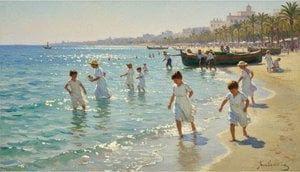
Joaquín Sorolla: Capturing Spanish Light & Life – A Legacy of Impressionism
Explore the luminous world of Joaquín Sorolla, Spanish master of Impressionism. Discover his life, techniques & legacy – a guide for art collectors and enthusiasts. Invest in timeless beauty.

A homokszínű mesterművek világa: 10 ikonikus festmény a ArtsDot kínálatában
Fedezze fel a 10 legikonikusabb homokszínű festményt! Monet, Van Gogh és más mesterek művei inspirálnak. Vászonképek, faliképek otthonába – ArtsDot.com kínálatából. Explore the full collection online!


