
- Főoldal

- Olajfestmény reprodukció
- Georgia O'Keeffe
- Édes Iris fényét
 Nyomat vásárlása Kép letöltése
 Megosztás
 Megosztás
 Details
 Kedvencekhez ad

 Letöltés
 Hasonló alkotások
 X-Ray
X-Ray
 Diavetítés
Édes Iris fényét
 Akvarell
- Falfeldísz
- Precisionist Painting
 1924
1924- Modern kor
 22.0 x 28.0 cm
Kézzel készített olajfestmény reprodukció
Kézzel festett olajvastú vászon, az Ön által választott méretben és keretben, művészeink készítik meglévőre.




P118B $10

P118H $10

P118W $10

P438Z $10

P508JH $12

P508YH $12

P805H $10

P805Z $10

P919BZ $10

P919G $10

P919XJ $10

P959ZH $10

P968JZ $12

W106C $8

W218G $10

W218JH $8

W218Y $10

W307PJ $10

W316G $10

W316PJ $8

W316Y $10

W398PJ $8

W4111J $10

W500HY $15

W500JH $15

W692G $12

W849H $8

W940BG $15

W953PJ $8




 Olvasson tovább
Válasszon előre meghatározott méreteink közül, amelyek megfelelnek a műalkotás eredeti arányainak.

Ön megadhat saját méreteket egy adott kerethez vagy térhez igazításhoz. Ha a kiválasztott méret nem egyezik az eredeti kép arányával, akkor a műalkotást levágjuk, vagy további kézzel festett elemekkel meghosszabbítjuk a festményt. A gyártás megkezdése előtt küldünk Önnek egy digitális előnézetet jóváhagyásra.
Kérjük, vegye figyelembe, hogy a képernyőn megjelenő előnézet nem tükrözi a tényleges vágást vagy kiterjesztést. Csak az előnézet fog pontosan mutatni a végső kompozíciót.
Bár egyedi méretek állnak rendelkezésre, javasoljuk, hogy válasszon egy méretet az előre meghatározott listából az eredeti arányok megőrzése érdekében.
A rendelést követően a ArtsDot.com csapata e-mailt küld az ügyfélnek az instrukciókért, és biztosít egy előnézeti képet (mockup).
Világszerte elérhető szállítás () 3-4 hét alatt a szokásos 5 hét helyett. (1 július). A minőség nem kérdőjelezhető.

Ingyenes globális expressz szállítás

Prémium minőségű len vászon

Teljes szállítási biztosítás

Vámvisszatérítési Garancia

Tökéletes színpontosság garancia

60 napos visszaküldési lehetőség (csak gyártási hibák esetén)

100%-os pénzvisszatérítési garancia

Kedvezmény több termény esetén
 Az üvegkeretes opció csak 110 cm alatti méretben érhető el

Édes Iris fényét
Reprodukciós technika
A reprodukció mérete
-


Összesített ár
-
A műalkotás leírása
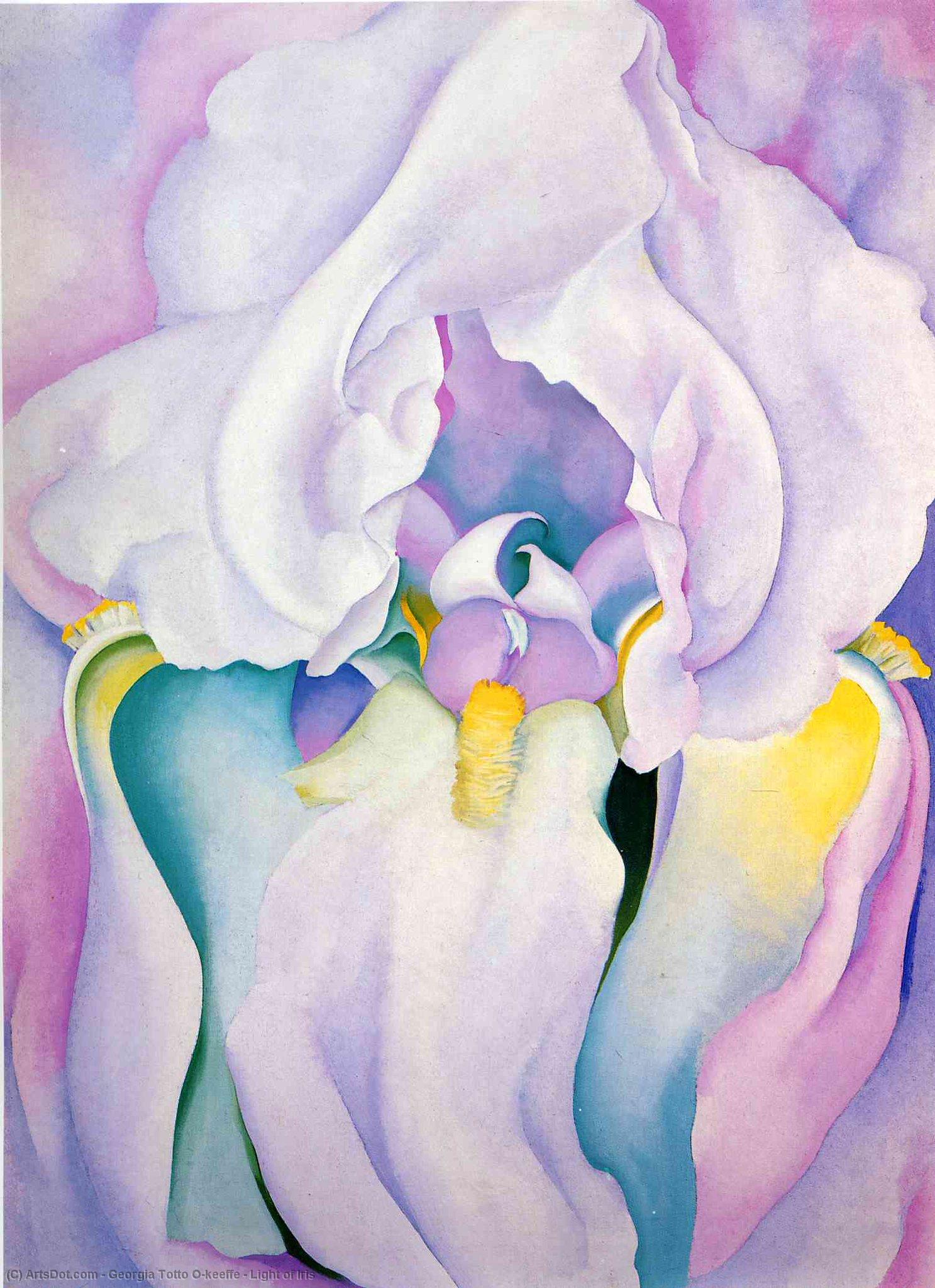
Light of Iris – Georgia O’Keeffe: A Precisionist Masterpiece
Georgia O’Keeffe's *Light of Iris* (1924) stands as an undeniable emblem of American modernism and a testament to her unparalleled ability to distill the essence of nature into breathtaking visual form. This watercolor painting isn’t merely a depiction of three irises; it’s a carefully constructed meditation on beauty, balance, and the subtle interplay between light and color—a characteristic hallmark of O'Keeffe’s oeuvre.Subject and Composition: The Geometry of Floral Elegance
The artwork centers around three iris blossoms arranged in a triangular composition, creating an immediate sense of visual stability. This deliberate arrangement reflects O’Keeffe’s fascination with geometric forms, aligning her work seamlessly with the Precisionist movement—a stylistic trend that prioritized sharp detail and realistic representation. The flowers dominate the canvas, their petals rendered with meticulous precision, inviting viewers to contemplate the intricate textures and subtle variations in hue present within each bloom. Each petal is treated as an individual element contributing to the overall harmony of the piece.Style and Technique: Precisionism’s Delicate Touch
O'Keeffe’s technique embodies the principles of Precisionism without sacrificing emotional resonance. Her fluid, curving lines capture the organic contours of the irises, skillfully juxtaposed against a backdrop of soft pastel shades—primarily lavender, pink, and pale blue. The blending of colors is exceptionally subtle, creating an illusion of depth and enhancing the realism of the floral subjects. Unlike Impressionists who sought to convey fleeting impressions of light and atmosphere, O’Keeffe meticulously builds up layers of pigment to achieve a luminous effect that captures the essence of natural illumination. This careful layering technique contributes significantly to the artwork's ethereal quality.Color Palette and Emotional Impact: Tranquility Captured in Pastel Hue
The color palette—dominated by lavender, pink, and pale blue—immediately evokes feelings of serenity and tranquility. The vibrant hues of the irises contrast beautifully with the muted background, creating a harmonious visual experience that aligns perfectly with O’Keeffe's artistic vision. These colors aren’t merely decorative; they symbolize purity, grace, and contemplation – themes frequently explored in O’Keeffe’s art. Viewing *Light of Iris* is akin to stepping into a dreamscape—a space where beauty transcends mere visual perception.Historical Context and Symbolism: Hope Amidst Geometric Form
Painted in 1924 during the burgeoning American modernist movement, *Light of Iris* reflects O'Keeffe’s pioneering role in redefining artistic expression. The iris flower itself carries rich symbolic significance—representing faith, wisdom, and resurrection – aligning with broader cultural anxieties surrounding the aftermath of World War I. Furthermore, the triangular composition reinforces geometric principles championed by Arthur Wesley Dow, emphasizing balance and harmony as core aesthetic values. O'Keeffe’s masterful execution elevates this simple floral subject to a profound statement about artistic vision and enduring beauty.- Artist: Georgia O’Keeffe
- Year: 1924
- Medium: Watercolor
- Size: 22 x 28 cm
Hasonló műalkotások


A művész életrajza
Early Life and Artistic Foundations
Georgia Totto O’Keeffe, a name synonymous with American modernism, emerged from the unassuming landscape of Sun Prairie, Wisconsin, in 1887. Born into a family of Irish and Hungarian descent engaged in dairy farming, young Georgia displayed an artistic inclination early on, deciding by age ten that she would dedicate her life to art. This determination was nurtured through lessons with local watercolorist Sara Mann, followed by formal studies at the School of the Art Institute of Chicago from 1905 to 1906 and later at the University of Virginia. However, it was her encounter with Arthur Wesley Dow’s principles – emphasizing personal expression and a harmonious balance of color and line – that truly ignited her artistic path. Dow's teachings steered O’Keeffe away from strict realism toward a more subjective and emotionally resonant approach to art, an approach that would define her career. These formative years weren’t without their challenges; periods of illness and dissatisfaction led her to temporarily abandon painting, but the creative impulse always drew her back, evolving with each new experience and influence.New York and the Stieglitz Circle
A pivotal moment arrived in 1916 when O’Keeffe’s abstract charcoal drawings were discovered by Alfred Stieglitz, a renowned photographer and art dealer. He exhibited her work without her prior knowledge, sparking a dialogue that would profoundly shape both their lives and the course of American art. Stieglitz recognized an exceptional talent in O’Keeffe, one that resonated with his own modernist sensibilities. He invited her to New York City in 1918, providing not only professional support but also fostering a deep personal connection. Their relationship blossomed into marriage in 1924, creating a dynamic artistic partnership and intellectual exchange. Stieglitz championed O’Keeffe’s work, showcasing it at his gallery “291” and promoting her as a leading figure in the American avant-garde. During this period, she began to develop her signature style – bold, simplified forms and intensely saturated colors – initially expressed through depictions of New York skyscrapers and, most famously, magnified flower paintings. These floral works, often interpreted (though consistently denied by O’Keeffe herself) as veiled representations of female anatomy, challenged conventional notions of beauty and sexuality in art.The Allure of the Southwest
While New York provided a crucial platform for her early success, it was the landscapes of the American Southwest that truly captured O’Keeffe’s imagination and profoundly influenced her artistic vision. Her first visit to New Mexico in 1929 marked the beginning of a lifelong love affair with the region's stark beauty, vibrant colors, and unique cultural heritage. The vastness of the desert, the dramatic rock formations, and the ancient Pueblo architecture resonated deeply within her, inspiring a new series of paintings that reflected the spirit of the land. Works like *Cow’s Skull: Red, White, and Blue* (1931) and *Summer Days* (1936) are powerful testaments to this influence, transforming seemingly mundane objects into iconic symbols of the American West. She eventually settled permanently in New Mexico in 1949 following Stieglitz’s death, establishing a home and studio in Abiquiu that became integral to her artistic process and identity.Technique and Style
O'Keeffe’s distinctive style evolved over decades, yet certain elements remained constant. She favored large-scale canvases, often employing a limited palette of intense colors – reds, blues, yellows, and greens – to create dramatic effects. Her brushwork was typically loose and expressive, prioritizing the suggestion of form over precise detail. She frequently used a technique called “pushing,” where she applied paint in layers, building up texture and depth through repeated applications. This method created a shimmering surface that seemed to vibrate with energy. O’Keeffe's compositions were often carefully constructed, with elements arranged to create a sense of balance and harmony. Her subjects—flowers, landscapes, animals—were rendered with an almost sculptural quality, emphasizing their three-dimensionality and inviting viewers to contemplate them from multiple perspectives. The influence of Arthur Wesley Dow is evident in her use of color and line, but O’Keeffe ultimately developed a unique visual language that was both intensely personal and profoundly influential.Legacy and Enduring Influence
Georgia O'Keeffe continued to paint prolifically throughout her life, experimenting with new subjects and pushing the boundaries of abstraction. Her later works included aerial views of clouds and skies, reflecting a fascination with the vastness and ethereal quality of the natural world. She remained fiercely independent and uncompromising in her artistic vision, refusing to be categorized or defined by prevailing art movements. O’Keeffe’s impact on American art is immeasurable. She paved the way for future generations of female artists, challenging societal norms and asserting her own unique voice in a male-dominated field. Her paintings continue to captivate audiences with their bold simplicity, emotional depth, and evocative power. The establishment of the Georgia O'Keeffe Museum in Santa Fe in 1997 further solidified her legacy, preserving her art and providing a space for ongoing scholarship and appreciation. In 2014, *Jimson Weed/White Flower No. 1* sold for $44.4 million, setting a record price for a work by a female artist – a testament to the enduring value and significance of her artistic contribution. O’Keeffe's influence extends beyond painting; she became an icon of American individualism and self-reliance, inspiring countless artists and admirers with her unwavering commitment to her craft and her unique perspective on the world. Her work remains a powerful reminder of the transformative power of art and the enduring beauty of the natural world.Key Works & Museum Presence
- Red Canna: Exemplifies her early exploration of floral abstraction.
- Cow’s Skull: Red, White, and Blue (1931): A powerful symbol of the American Southwest and a meditation on mortality.
- Summer Days (1936): Captures the essence of the New Mexico landscape with its vibrant colors and simplified forms.
- Jimson Weed/White Flower No. 1: A monumental floral painting that showcases her mastery of scale and composition.
- Georgia O'Keeffe Museum (Santa Fe)
- Museum of Modern Art (New York)
- Art Institute of Chicago
- National Gallery of Art (Washington, D.C.)

Georgia O'Keeffe
1887 - 1986 , Egyesült Államok
Rövid tények
- Artistic Movement Or Style: Modernizmus
- Artists Or Movements Influenced By This Artist:
- Dow
- Modernizmus
- Artists Who Influenced This Artist:
- Arthur Dow
- Stieglitz
- Date Of Birth: November 15, 1887
- Date Of Death: March 6, 1986
- Full Name: Georgia Totto O'Keeffe
- Nationality: Amerikai
- Notable Artworks:
- Red Canna
- Kosfej
- Summer Days
- Place Of Birth: Sun Prairie, USA
Kapcsolódó cikkek

Precisionism: A Study of Industrial Aesthetics & Modern American Art
Explore Precisionism, a pivotal American art movement celebrating the Machine Age. Discover key artists like Sheeler & O'Keeffe, its European roots, and lasting influence on modern aesthetics. Expert analysis for collectors.


The Subdued Radiance of Pastel Palettes: Exploring Emotional Resonance in Art History
Explore the emotional power of pastel palettes in art history! Discover Impressionism, Post-Impressionism & color psychology insights. Find museum-quality reproductions at ArtsDot.

Digitális emlékek lágy átalakulása: Mesterséges intelligencia és akvarellfestészet harmóniája a belső terek megnyugtató atmoszférájának teremtésében
Alakítsa át fotóit egyedi, kézzel készített műalkotássá a ArtsDot-tal! Mesterséges intelligencia és képzett művészek harmóniája. Prémium minőség, teljes kontroll és időtálló örökség. Rendeljen most!

The Subdued Radiance of Pastel: Exploring Nuance & Emotion in Art
Explore the nuanced world of pastel art! Discover its history, techniques & emotional power with expert insights from ArtsDot.com. Find museum-quality reproductions and learn about collecting this delicate medium.

A festészet forradalma: 10 ikonikus akvarellművészeti remekmű, melyek örökre megváltoztatták a művészetet
Fedezze fel a 10 legikonikusabb akvarell festményt, melyek megváltoztatták a művészetet! Ismerje meg Turner, Monet és más mesterek történetét. Vásároljon prémium minőségű reprodukciókat a ArtsDot.com-on – inspiráló faliképek otthonába!



