


 Megtekintés
 Küldés
 Megosztás
 Részletek

 Letöltés
 Hasonló darabok
 X-ray felvétel
 Diavetítés
Vagrants

 Összes részlet megjelenítése
Kézzel készített olajfestmény reprodukció
Kézzel festett olajvastú vászon, az Ön által választott méretben és keretben, művészeink készítik meglévőre. ( Nyomat rendelése Kép letöltése)




P118B $10

P118H $10

P118W $10

P438Z $10

P508JH $12

P508YH $12

P805H $10

P805Z $10

P919BZ $10

P919G $10

P919XJ $10

P959ZH $10

P968JZ $12

W106C $8

W218G $10

W218JH $8

W218Y $10

W307PJ $10

W316G $10

W316PJ $8

W316Y $10

W398PJ $8

W4111J $10

W500HY $15

W500JH $15

W692G $12

W849H $8

W940BG $15

W953PJ $8




Válasszon előre meghatározott méreteink közül, amelyek megfelelnek a műalkotás eredeti arányainak.

Ön megadhat saját méreteket egy adott kerethez vagy térhez igazításhoz. Ha a kiválasztott méret nem egyezik az eredeti kép arányával, akkor a műalkotást levágjuk, vagy további kézzel festett elemekkel meghosszabbítjuk a festményt. A gyártás megkezdése előtt küldünk Önnek egy digitális előnézetet jóváhagyásra.
Kérjük, vegye figyelembe, hogy a képernyőn megjelenő előnézet nem tükrözi a tényleges vágást vagy kiterjesztést. Csak az előnézet fog pontosan mutatni a végső kompozíciót.
Bár egyedi méretek állnak rendelkezésre, javasoljuk, hogy válasszon egy méretet az előre meghatározott listából az eredeti arányok megőrzése érdekében.
A rendelést követően a ArtsDot.com csapata e-mailt küld az ügyfélnek az instrukciókért, és biztosít egy előnézeti képet (mockup).
Világszerte elérhető szállítás () 3-4 hét alatt a szokásos 5 hét helyett. (16 augusztus). A minőség nem kérdőjelezhető.

Ingyenes globális expressz szállítás

Prémium minőségű len vászon

Teljes körű szállítási biztosítás

Vámvisszatérítési Garancia

Hiteles színpontosság garancia

60 napos visszaküldési lehetőség (csak hibás termékek esetén)

100% pénzvisszatérítési garancia

Több darab vásárlása esetén kedvezmény
 Az üvegkeretes opció csak 110 cm alatti méretben érhető el

Vagrants
Reprodukciós technika
Reprodukció mérete
-


Összesített ár
$ 288
A műalkotás leírása
A Haunting Vision of Humanity: Exploring Nolde’s ‘Vagrants’
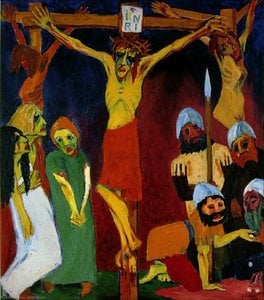
- Subject and Composition: ‘Vagrants’ presents a deeply unsettling encounter with two figures, immediately striking for their exaggerated, almost grotesque facial features reminiscent of clowns or masks. These aren't portraits in the traditional sense; they are archetypes – embodiments of societal outcasts or perhaps internal psychological states. The asymmetrical composition, placing the figures off-center against a dark and expansive background, amplifies the feeling of unease and isolation. Their interaction is ambiguous, leaving the viewer to ponder their relationship and story.
- Expressionist Power & Technique: This work is a prime example of Emil Nolde’s mastery within the German Expressionist movement. The style prioritizes emotional impact over realistic representation. Notice the bold, often clashing colors and the thick, gestural brushstrokes – hallmarks of Expressionism. Nolde employed an impasto technique, building up layers of paint to create a tactile surface that practically vibrates with energy. This isn’t simply *about* seeing figures; it's about *feeling* their presence.
Historical Context & Artistic Influences
- Nolde and Die Brücke: Created during a period of significant social and political upheaval, ‘Vagrants’ reflects the anxieties and alienation felt in early 20th-century Germany. Nolde, though never formally a member, was closely associated with Die Brücke (“The Bridge”), a group of German Expressionist artists who sought to break away from traditional artistic conventions. He shared their interest in raw emotion, primitive art forms (particularly masks), and the exploration of the human condition.
- A Response to Modernity: Nolde’s work can be seen as a response to the rapid industrialization and urbanization transforming Europe at the time. The ‘vagrants’ themselves might symbolize those marginalized by these changes – individuals lost in a modern world that offered little comfort or belonging.
Symbolism & Emotional Resonance
- Masks and Identity: The clown-like faces are particularly potent symbols. Masks traditionally conceal identity, but here they seem to *reveal* a deeper, more disturbing truth about the human psyche. They suggest a loss of individuality, a sense of being trapped by societal expectations or internal demons.
- A Critique of Society?: The painting’s unsettling atmosphere invites interpretation as a critique of social norms and hypocrisy. Nolde often explored themes of alienation and the darker aspects of human nature, challenging viewers to confront uncomfortable truths about themselves and the world around them.
- Echoes of Rousseau: Interestingly, considering the artist’s era, the concept of “natural man” and societal corruption – central to Jean-Jacques Rousseau's philosophy (as outlined in *Emile, or On Education*) – resonates within the painting’s depiction of figures seemingly stripped bare of social pretense.
For Collectors & Interior Design
- A Statement Piece: ‘Vagrants’ is a powerful and thought-provoking artwork that would serve as a striking focal point in any collection. Its bold colors and expressive brushwork demand attention, while its complex symbolism invites ongoing contemplation.
- Interior Harmony: When considering placement, this piece pairs well with interiors featuring neutral palettes or those embracing an eclectic aesthetic. The dark tones of the background can be complemented by rich, warm accents, creating a dramatic and sophisticated atmosphere. Its intensity makes it best suited for spaces intended for quiet reflection rather than high-energy activity.
Hasonló műalkotások



A művész életrajza
Early Life and Artistic Beginnings
Emil Nolde, a name synonymous with vibrant expressionism, was born Hans Emil Hansen on August 7, 1867, in the small village of Nolde, nestled within the Schleswig-Holstein region of Germany. His origins were deeply rooted in rural life—a landscape dominated by agriculture and imbued with strong religious traditions. This formative environment would profoundly shape his artistic sensibilities, imbuing his work with a potent blend of earthy realism and fervent spirituality. Initially, his parents envisioned a more conventional path for their son, hoping he’d pursue a career as a woodcarver or furniture maker—a practical trade suited to the region's economy. However, from a young age, Nolde harbored an unyielding passion for art, a desire that stubbornly resisted societal expectations. He began experimenting with drawing and painting in his late teens, honing his skills through self-study and tireless practice. This early dedication laid the groundwork for his future as one of Germany’s most significant artistic figures.Artistic Development and Influences
Nolde's artistic journey was characterized by a relentless pursuit of knowledge and a willingness to absorb influences from diverse sources. He wasn’t confined to a single style or technique; instead, he actively sought out inspiration from various cultures and art movements. Early in his career, Nolde was deeply affected by the works of Vincent van Gogh and Paul Gauguin—artists known for their bold colors, expressive brushwork, and emotional intensity. He also developed a fascination with traditional folk art, particularly the powerful symbolism and raw emotion conveyed through primitive masks and carvings. These encounters ignited within him a desire to break free from academic conventions and explore new ways of representing the world – a drive that would ultimately lead him to co-found Die Brücke. His travels throughout Europe further broadened his artistic horizons, exposing him to different techniques and perspectives. He spent time in Paris, immersing himself in the Impressionist movement, before returning to Germany with a renewed sense of purpose and a desire to forge his own unique style.Die Brücke and Expressionist Breakthrough
In 1905, Nolde played a pivotal role in establishing Die Brücke (The Bridge), a groundbreaking group of German Expressionist artists. This collective sought to challenge the established norms of the art world and express inner emotions through radical experimentation. The members of Die Brücke—including Ernst Ludwig Kirchner, Erich Heckel, and Karl Schmidt-Rottluff—were united by a shared desire to depict the anxieties and alienation of modern life. Nolde’s contribution to Die Brücke was particularly significant; his intense use of color, distorted forms, and emotionally charged subject matter pushed the boundaries of representation. However, despite his close association with the group, Nolde maintained a somewhat independent path within Die Brücke, often diverging in subject matter and stylistic approach. He frequently focused on religious themes—particularly scenes from the Old Testament—while other members explored urban landscapes and portraits. This divergence ultimately led to his departure from Die Brücke in 1908, but it also allowed him to develop a distinctive artistic voice.Key Themes and Artistic Style
Nolde’s oeuvre is characterized by a remarkable consistency of themes and stylistic elements. Recurring motifs include religious scenes—often imbued with a sense of drama and foreboding—landscapes dominated by turbulent seas and brooding skies, and portraits that capture the essence of his subjects' personalities. A particularly striking aspect of Nolde’s work is his fascination with masks—both as physical objects and symbolic representations of primal emotions. He frequently depicted masks in his paintings, using them to evoke a sense of mystery, power, and vulnerability. His artistic style is defined by several key features: bold, vibrant colors used to convey emotional intensity; distorted forms that emphasize expression over realistic representation; and an innovative use of impasto—a technique involving the thick application of paint to create texture and depth. Nolde’s work is not simply a depiction of reality; it's an exploration of the inner world, a powerful expression of his own emotions and experiences.Notable Works and Historical Significance
Throughout his prolific career, Emil Nolde created a vast body of work that continues to captivate audiences today. Some of his most celebrated paintings include *Masks* (1906-1907), a series of haunting images that explore the power of primitive art; *The Mocking of Christ* (1909), a dramatic depiction of the biblical scene that is both emotionally charged and visually arresting; *Autumn Sea* (1908) - demonstrating his expressive landscape painting. His later works, particularly those created during the 1930s and 40s, are characterized by a somber intensity and a profound sense of isolation. Despite facing criticism and censorship during the Nazi regime—his work was deemed “degenerate” and removed from museums—Nolde continued to paint in secret, producing a remarkable body of watercolor paintings that offer a glimpse into his inner world. Emil Nolde’s legacy as one of Germany's most important Expressionist painters is secure. His innovative use of color, expressive brushwork, and emotionally charged subject matter continue to inspire artists and art lovers around the world.
Nolde Emil
1867 - 1956 , Németország
A művészről röviden
- Artistic Movement Or Style: Északi expresszionizmus, Die Brücke
- Artists Or Movements Influenced By This Artist: ['Rothko']
- Artists Who Influenced This Artist:
- Van Gogh
- Gauguin
- Date Of Birth: 1867. augusztus 7.
- Date Of Death: 1956. április 15.
- Full Name: Emil Nolde / Hans Emil Hansen
- Nationality: német-dán
- Notable Artworks:
- A Krisztus gúnyolása
- Virágkert
- Tengerpart
- Place Of Birth: Nolde, Schleswig-Holstein
Kapcsolódó cikkek

Emile Nolde: A Journey into Expressionist Nature & the Primal Self
Explore the powerful Expressionism of Emile Nolde – a pioneer of emotive landscapes & spiritual themes. Discover his journey, influences, and lasting impact on modern art. Hand-painted reproductions available at ArtsDot.

Merész Művészet: 10 Klasszikus Kép, Amik Bátorítanak és Inspirálnak – ArtsDot.com
Fedezze fel a 10 legmerészebb műalkotást! Van Gogh, Munch és Picasso remekművei inspirálnak. Expresszionizmus, absztrakt festmények – online képkereső és minőségi reprodukciók a ArtsDot.com-on. Otthoni dekorációhoz vagy művészeti gyűjteményébe! Fedezze fel az összes mesterművet a ArtsDot.com oldal

René Magritte 25 Mesterműve: A Szürrealizmus Rejtélyei Vászonra – ArtsDot
Fedezze fel René Magritte 25 legikonikusabb művét! A szürrealizmus rejtélyes világába kalauzoljuk – festmények, történetek és inspiráció otthon dekorációjához. Prémium minőségű reprodukciók a ArtsDot-on. Explore the full collection online!

A kifejezésművészet 10 ikonikus remekműve – Vászonképek és inspiráció a ArtsDot-tól
Fedezze fel a kifejezésművészet 10 legikonikusabb remekművét! Munch, Kirchner, Kandinsky és mások alkotásainak története. Vászonképek, faliképek inspirációval a ArtsDot-tól – minőségi műalkotások otthonába. Explore the full collection online!

Roy Lichtenstein 25 Mesterműve: Pop Art ikonok a faladra | ArtsDot
Fedezze fel Roy Lichtenstein 25 legikonikusabb művét! Ismerje meg a pop art forradalmár festményeit, technikáit és inspirációit. Vászonképek, faliképek – magas minőségben a ArtsDot.com-on. Explore the full collection online!


