

 Megtekintés
 Küldés
 Megosztás
 Részletek
 Útmutató

 Letöltés
 Hasonló darabok
 X-ray felvétel
 Diavetítés
 Kérdések és válaszok
 Statisztika
Panic


 Összes részlet megjelenítése
Az ezen az oldalon megjelenített műalkotások szerzői jogi védelem alatt állnak, ami azt jelenti, hogy törvényileg nem készíthetünk és nem adhatunk el belőlük pontos másolatokat. Ez a védelem olyan nemzetközi megállapodások alapján érvényesül, mint például a Berni Egyezmény és a nemzeti jogszabályok által, beleértve azokat is, amelyeket meghatározott Az USA szerzői jogi törvénye – 17. cím.
Ez a módszer teljes mértékben megfelel a szerzői jogi szabályozásnak, mivel nem tartalmazza a védett műalkotás másolását vagy duplikálását. Ehelyett ez egy kreatív újinterpretáció – egy új festmény, amely az eredetivel való összefüggései miatt hatással van rá, de nem az az.
Giclée / Műnyomat
Múzeumi minőségű giclée vagy vászonnyomat, gyors gyártással és rugalmas finomítási lehetőségekkel. ( Kézzel festett másolat rendelése Áttérés digitális képre)




P118B Ft10

P118H Ft10

P118W Ft10

P438Z Ft10

P508JH Ft12

P508YH Ft12

P805H Ft10

P805Z Ft10

P919BZ Ft10

P919G Ft10

P919XJ Ft10

P959ZH Ft10

P968JZ Ft12

W106C Ft8

W218G Ft10

W218JH Ft8

W218Y Ft10

W307PJ Ft10

W316G Ft10

W316PJ Ft8

W316Y Ft10

W398PJ Ft8

W4111J Ft10

W500HY Ft15

W500JH Ft15

W692G Ft12

W849H Ft8

W940BG Ft15

W953PJ Ft8




Válasszon előre meghatározott méreteink közül, amelyek megfelelnek a műalkotás eredeti arányainak.

Írja be a keretének vagy a falának megfelelő szélességet és magasságot. A nyomatot csak le lehet vágni, soha nem tehető nagyobbá, mint az eredeti kép, így egy eltérő alakú méretnél a kép egy része elveszik. Mielőtt bármit kinyatintanánk, küldünk egy digitális próbamodellt jóváhagyásra. Az oldalon látható kép nem tartalmazza a valós levágást — ezt csak a próbamodell mutatja meg.
Világszerte történő kiszállítás területére mindössze 2 hét alatt, a szokásos 4-5 hét helyett. (18 november)

Ingyenes globális expressz szállítás

Prémium minőségű len vászon

Teljes körű szállítási biztosítás

Vámvisszatérítési Garancia

Hiteles színarányosság garancia

100 napos visszaküldési lehetőség (csak hibás termékek esetén)

100% pénzvisszatérítési garancia

Több darab vásárlásakor kedvezmény
 Az üvegkeretes opció csak 110 cm alatti méretben érhető el

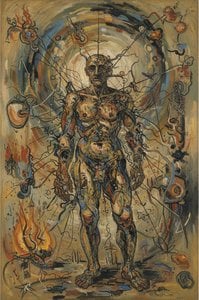
Panic
Giclée / Műnyomat
Reprodukció mérete
-


Összesített ár
Ft 20381
The Raw Nerve of Anxiety: Unpacking André Masson’s “Panic”
André Masson's "Panic," created in 1955, isn’t merely a painting; it’s an excavation. A visceral plunge into the turbulent depths of the human psyche, rendered with a frenetic energy that both unsettles and compels. This etching, executed on paper, captures a moment suspended between chaos and control, reflecting the anxieties simmering beneath the surface of post-war Europe – a period Masson himself deeply inhabited through his pioneering work in Surrealism and Automatism.
The composition immediately assaults the senses. A dominant teal background—a shade suggestive of both twilight and unease—is fractured by swirling, violently intertwined lines in shades of purple and magenta. These aren’t neat, controlled strokes; they are a deliberate act of disruption, mirroring the feeling of being overwhelmed by internal turmoil. The lack of a clear focal point forces the viewer's eye to dart across the surface, mimicking the restless, fragmented experience of panic itself. The overall effect is less about depicting a specific scene and more about conveying an intense emotional state – a raw, unfiltered expression of anxiety.
Automatism: A Journey Beyond Conscious Control
Masson’s technique—Automatism—was central to his artistic practice. Rejecting the constraints of rational thought and deliberate planning, he sought to tap into the unconscious mind through spontaneous action. In “Panic,” this manifests as a seemingly chaotic outpouring of lines, yet beneath the surface lies a carefully orchestrated process. Masson would often begin with sand drawings, allowing the subconscious to dictate the initial forms, then translate these images onto paper using various tools – in this case, etching techniques—to create the final image. This method aimed to bypass conscious control and reveal hidden emotions and associations.
The influence of Surrealism is undeniable, but Masson’s approach extends beyond simple dream imagery. He was deeply interested in primal emotions, exploring themes of violence, eroticism, and metamorphosis – all powerfully represented within the swirling forms of “Panic.” The piece echoes the work of artists like André Breton and Joan Miró, yet possesses a uniquely personal intensity, reflecting Masson's own struggles with psychological turmoil.
Symbolic Echoes: Violence, Repression, and the Unconscious
The imagery within "Panic" is rich in symbolic potential. The tangled lines can be interpreted as representing repressed emotions struggling to surface, a visual manifestation of internal conflict. The use of dark teal and vibrant purples and magentas creates a dramatic contrast, suggesting a battle between opposing forces – perhaps order versus chaos, reason versus instinct. Some viewers have noted the resemblance to organic forms—twisted limbs or distorted figures—suggesting a sense of fragmentation and loss of control.
Interestingly, Masson’s work frequently engaged with themes of violence, reflecting anxieties prevalent in post-war Europe. The piece can be seen as an exploration of the destructive potential within the human psyche – a warning against succumbing to overwhelming fear and losing oneself in the chaos of internal struggle. The title itself—"Panic"—underscores this central theme, encapsulating the feeling of being trapped within one’s own anxieties.
A Legacy of Raw Emotion: Masson's Enduring Impact
“Panic” stands as a powerful testament to André Masson’s innovative approach to art. It’s not a comfortable piece; it demands engagement and invites introspection. His exploration of Automatism, combined with his unflinching portrayal of psychological turmoil, cemented his place as a key figure in the Surrealist movement and beyond. Reproductions of this work continue to resonate today, offering a glimpse into the complexities of the human experience – a reminder that beneath the surface of everyday life, there often lies a turbulent landscape of anxieties and unresolved emotions.
Kérdések és válaszok
Hogyan illeszkedik a "Panic" André Masson témáiba és stílusába?
A "Panic" André Masson Surrealist Automatic Drawing korszakának alkotása, melynek témakörében surrealism, automatism, masson’s exploration, psychological turmoil, anxiety themes, war anxieties, social unrest”, “automatic drawing is feltűlik.
Honnan érkeznek a „Panic”, André Masson alkotása látogatói?
A „Panic”, André Masson alkotása Statisztikák oldala a nyilvános látogatási statisztikákat mutatja be: az alkotás havi látogatottságát, összehasonlításban a művész legnézettebb alkotásaival, valamint a látogatók származási helyét.
Megtekinthetném a(z) „Panic”, André Masson alkotása röntgensugárzásos felvételét?
A „Panic”, André Masson alkotása X-ray felvétel oldala egy interaktív nézegető, amely lehetővé teszi a mű alkotásának eleven optikai rétegei közötti görgetést, beleértve az röntgenszerű felvételt is.
Hasonló műalkotások


A művész életrajza
André Masson: A Surrealist Pioneer’s Journey Through the Unconscious
André Masson, a name synonymous with both surrealism and groundbreaking artistic techniques, was born in Balagny-sur-Thérain, a small town just north of Paris, on January 4th, 1896. His life unfolded as a fascinating tapestry woven from early artistic training, wartime experiences, and an unwavering dedication to exploring the depths of the human subconscious. Masson’s legacy isn't simply defined by his paintings; it resides in his revolutionary approach to artmaking – a method that blurred the lines between conscious control and spontaneous expression, forever altering the landscape of 20th-century art.Early Years and Artistic Foundations
Masson’s artistic journey began at the tender age of eleven when he enrolled at the Académie Royale des Beaux-Arts in Brussels. Under the tutelage of Constant Montald, he received a solid foundation in traditional painting techniques, developing a keen eye for form and composition. However, it was during this period that his initial inclinations towards Cubism began to surface – an early engagement with the radical experimentation taking place within the modern art world. These formative years instilled in him not just technical skill but also a restless curiosity, a desire to push beyond conventional boundaries and delve into uncharted artistic territories.The Surrealist Embrace: Automatic Drawing and Beyond
Masson’s life took a dramatic turn in the mid-1920s when he became deeply immersed in the burgeoning Surrealist movement. He wholeheartedly embraced automatic drawing – a technique that involved creating artwork without conscious control, allowing the subconscious to dictate the hand's movements. This wasn’t merely chance; it was a deliberate attempt to bypass rational thought and tap into the raw, unfiltered imagery residing within the mind. He collaborated closely with other prominent Surrealists like Antonin Artaud, Michel Leiris, Joan Miró, Georges Bataille, Jean Dubuffet, and Georges Malkine, fostering an incredibly vibrant artistic community fueled by shared experimentation and a desire to challenge established norms. Masson’s work during this period frequently explored themes of violence, eroticism, and metamorphosis – subjects that deliberately defied traditional artistic conventions, reflecting a profound shift in perspective.Innovative Techniques: Sand, Glue, and the Canvas
Masson's most distinctive contribution to art lies in his innovative techniques. He developed a method of applying sand and glue directly onto canvas, creating textured, layered paintings based on the unpredictable patterns formed by the materials. This process wasn’t about meticulous control; it was about embracing chance and allowing the resulting shapes to guide the artist’s hand. He also pioneered automatic drawing – numerous pen-and-ink works showcasing his innovative approach to art. These techniques combined to produce a uniquely expressive style, characterized by dynamic lines, biomorphic forms, and a palpable sense of movement. His work during this period often explored violent or erotic themes, reflecting a departure from traditional artistic conventions.War, Exile, and American Influence
The outbreak of World War II dramatically altered the course of Masson’s life. His work was condemned as “degenerate” by the Nazis, forcing him to flee France with the assistance of Varian Fry. He sought refuge in the United States, where he encountered a new wave of artistic experimentation. This period proved profoundly influential, exposing him to American Abstract Expressionists like Jackson Pollock and significantly shaping his own evolving style. Returning to France after the war, Masson settled in Aix-en-Provence, shifting his focus towards landscape painting – a move that reflected a desire for greater naturalism while retaining the expressive qualities of his earlier work.Legacy and Enduring Impact
André Masson’s impact on the art world is undeniable. He wasn't simply an artist; he was a pioneer who redefined the possibilities of artistic expression. His exploration of the subconscious, combined with his innovative techniques, continues to inspire artists today. His influence can be seen across various movements, from Cubism to Abstract Expressionism, solidifying his position as one of the most important figures in modern art history. Masson’s legacy is a testament to the power of artistic experimentation and the enduring allure of the unconscious mind.
André Masson
1896 - 1987 , Franciaország
Rövid információk
- Artistic Movement Or Style:
- Surrealizmus
- Kubbizm
- Artists Or Movements Influenced By This Artist:
- Jackson Pollock
- Körkép
- Artists Who Influenced This Artist: ['André Derain']
- Date Of Birth: Január 4, 1896
- Date Of Death: Október 28, 1987
- Full Name: André Aimé René Masson
- Nationality: Francia
- Notable Artworks:
- Beyond
- Landsc. sziklákkal
- A szerelmek metamorfozása
- Pygmalion
- Place Of Birth: Balagny-sur-Thérain, Franciaország
Kapcsolódó cikkek

Unveiling Inner Worlds: Exploring Psychological Depth in 20th & 21st Century Art
Explore the profound psychological themes within 20th & 21st-century art. Discover Expressionism, Surrealism & more – and learn how to collect impactful pieces with confidence. Expert insights for discerning collectors.

Érzelmi átalakulás a vizuális művészetben: Affektív reprezentáció tanulmánya szín, forma és textúra révén
Mélyreható elemzés az érzelmek ábrázolásáról a művészetben! Fedezze fel, hogyan használják a színek, formák és textúrák az alkotók az affektív kifejezéshez. Szakértői cikkek műgyűjtőknek és művészetkedvelőknek.

A reprezentáción túl: Érzelmek és jelentések megfejtése a modern absztrakt művészetben
Felfedezze az absztrakt művészet mély világát! Ismerje meg a történetét, színek pszichológiáját és legjelentősebb alkotóit. Prémium minőségű reprodukciók és szakértői tanácsadás a ArtsDot-on.

The Architecture of Anxiety: Examining the Raw Emotional Intensity of Expressionism
Explore the raw psychological depth of Expressionism through Munch and Klee. Dive into the anatomy of anxiety today.
André Masson: Automatism, Surrealism & Primal Expression in 20th-Century Art
Explore the revolutionary art of André Masson – pioneer of automatism & Surrealist expression. Discover his powerful imagery, innovative techniques, and lasting influence on modern art. Learn more at ArtsDot.
