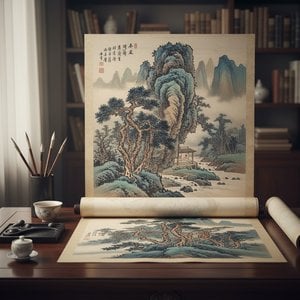
Zhou Sicong (周思聪), born November 21, 1939, passed away January 21, 1996. He remains a celebrated figure in Chinese ink painting and calligraphy, recognized for his masterful depictions of serene landscapes interwoven with narratives drawn from Chinese folklore and everyday life experiences. His artistic journey began amidst the burgeoning cultural revival following Mao Zedong’s death, positioning him as a pivotal voice within the avant-garde movement that sought to redefine traditional aesthetics while retaining its core spirit.
Early Life & Education: Born in Shandong Province, Zhou Sicong received his foundational artistic training at Tsinghua University, where he studied painting and sculpture under renowned instructors like Xu Zhengyu. This rigorous academic grounding instilled in him a deep understanding of classical Chinese art principles—harmony, balance, and the expressive power of brushstrokes—influences that would permeate throughout his oeuvre.
The Avant-Garde Influence: Zhou Sicong’s artistic sensibilities were profoundly shaped by the burgeoning avant-garde movement in China during the late 1950s and early 1960s. Artists like Qi Baishi and Zhang Daqian championed a revitalized approach to ink wash painting, prioritizing emotional resonance over strict adherence to stylistic conventions. Zhou Sicong embraced this spirit, experimenting with bold compositions and vibrant color palettes—a departure from the monochromatic landscapes favored by earlier generations.
Style & Technique: Zhou Sicong’s distinctive style is characterized by a meticulous attention to detail combined with an intuitive grasp of tonal variation. He skillfully employed layering techniques, utilizing multiple washes of ink to create depth and texture—a hallmark of the Shandong School of Ink Painting. His landscapes often depict misty mountains bathed in soft light, capturing fleeting moments of beauty and conveying a sense of contemplative stillness. Recurring motifs from Chinese folklore—dragons, phoenixes, cranes—appear subtly integrated into his compositions, enriching their symbolic significance.
Major Achievements & Recognition
Zhou Sicong’s artistic accomplishments garnered considerable acclaim both domestically and internationally. He was awarded the National Art Prize in 1983 for “Lotus Pond,” a monumental landscape painting that exemplifies his mastery of tonal harmony and compositional balance. His works were exhibited extensively throughout China and abroad, establishing him as one of the foremost practitioners of Shandong School ink painting. Furthermore, he served as professor emeritus at Tsinghua University, nurturing generations of aspiring artists and ensuring the continuation of his artistic legacy.
Notable Paintings:
Among Zhou Sicong’s celebrated paintings are “Lotus Pond,” “Mountains and Streams,” “Pine Trees and Bamboo Grove,” and “Autumn Landscape.” Each piece showcases his exceptional skill in capturing atmospheric conditions and conveying profound emotional depth.
Calligraphy Works:
Zhou Sicong's calligraphy demonstrated a similar dedication to precision and expressive artistry. His poems and prose were imbued with philosophical contemplation and celebrated for their lyrical beauty—reflecting the influence of Taoist thought.
Zhou Sicong’s contribution to Chinese art history extends beyond his individual creations; he championed Shandong School ink painting, fostering a vibrant artistic community and safeguarding its traditions. His unwavering commitment to artistic excellence cemented his place as an icon of modern Chinese landscape art—a testament to the enduring power of beauty and contemplation.
Explore the captivating world of Pu Xinyu (Puru), the last great literati painter. Discover his imperial heritage, masterful ink wash techniques & enduring legacy – a valuable addition to any discerning art collection.
Explore the legacy of Xie Zhiliu, a master of Chinese ink wash painting & prominent figure in modern art. Discover his techniques, influences, and contributions to literati tradition. A guide for discerning collectors.
Koliko je Zhou Sicong-ovih slika dostupno na ArtsDot.com?
1
Po kojim drugim imenima je Zhou Sicong poznat/a?
Ma Sicong
Koja je najbolje ocijenjena slika autora Zhou Sicong na platformi ArtsDot.com?
MORNING DEW ON LOTUS
Tko je Zhou Sicong?
Zhou Sicong: A Legacy of Landscape and Folklore
Zhou Sicong (周思聪), born November 21, 1939, passed away January 21, 1996. He remains a celebrated figure in Chinese ink painting and calligraphy, recognized for his masterful depictions of serene landscapes interwoven with narratives drawn from Chinese folklore and everyday life experiences. His artistic journey began amidst the burgeoning cultural revival following Mao Zedong’s death, positioning him as a pivotal voice within the avant-garde movem
Je li rad autora Zhou Sicong i dalje zaštićen autorskim pravima?
Da, djela ovog umjetnika i dalje su zaštićena autorskim pravima.
Pod kojim drugim imenima ili pseudonimima poznat je/poznata je Zhou Sicong?
Zhou Sicong poznat/a je i pod drugim imenima: Ma Sicong.
Gdje se djela umjetnika Zhou Sicong mogu pronaći grupirana prema tehnici?
Stranica Svi mediji prikazuje djela umjetnika Zhou Sicong grupirana prema tehnici izrade.
U kojim je umjetničkim pravcima Zhou Sicong stvarala/o?
Umjetnički pokreti u kojima je Zhou Sicong stvarao možete vidjeti na stranici Svi umjetnički pravci, koja grupirira djela prema umjetničkom pokretu.
Mogu li proučiti način na koji Zhou Sicong koristi boju u svim svojim djelima?
Profil boja u radovima umjetnika Zhou Sicong možete pogledati na njegovoj stranici Genom palete.