The Forest and the Academy
Before he ever held a brush to canvas, Willibald Wex walked the rugged paths of the German landscape as a forester. This early life among the trees and the quiet rhythms of the woods deeply informed his later vision. He possessed a natural understanding of the terrain, a knowledge born of physical presence within the wild. This intimate connection to nature eventually led him away from the woods and toward the formal discipline of the Royal Academy of Arts in Munich. There, under the guidance of Richard Zimmermann, he began to translate his observations of the natural world into the language of fine art.
His training in Munich provided the technical foundation necessary to capture the immense scale of the mountains. After completing his studies in 1858, he remained in the city, establishing himself within the local artistic community. He became a regular presence in the Munich Art Association and the Munich Glass Palace, where his works were displayed to the public. His life was deeply rooted in the Bavarian landscape, a fact reflected in the subjects he chose to immortalize on canvas.
The Alpine Vision
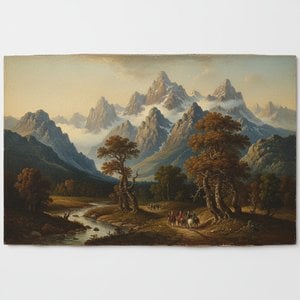
Wex found his true calling in the depiction of the Alps. His paintings often sought to capture the specific character of the mountains, from the jagged peaks to the quiet valleys. His work is characterized by a focus on the dramatic interplay of light and stone, seeking to render the physical reality of the high altitudes with precision. His son, Adalbert Wex, would also follow a path in painting, continuing a family legacy of visual expression.
His catalog includes several notable depictions of these mountain regions, including:
- Konigsee, painted in 1873
- Felsige Gebirgslandschaft
- Landscape: Karlstein Reichenhall
A Legacy of Landscape
The works of Willibald Wex remain tied to the specific geography of his home. His ability to translate the ruggedness of the mountains into a structured composition allowed him to capture the essence of the Bavarian wilderness. Through his eyes, the mountains were not merely background scenery but the primary protagonists of his compositions. His contribution to the tradition of German landscape painting lies in this dedicated observation of the Alpine terrain.
Pitanja i odgovori
U kojem je povijesnom razdoblju stvarala/radio Willibald Wex?
Willibald Wex je stvarala u razdoblju 19th Century. To razdoblje smješta umjetnikov rad u povijesni kontekst.
Gdje mogu pronaći statistiku o djelima umjetnika Willibald Wex?
Stranica Statistika posjeta umjetnika Willibald Wex prikazuje statistiku izračunatu na temelju umjetničkih djela tog umjetnika navedenih na ovaj web-mjesto.
Gdje se umjetnička djela autora Willibald Wex mogu pronaći grupirana prema umjetničkom pravcu?
Umjetnički pokreti u kojima je Willibald Wex stvarao možete vidjeti na stranici Svi umjetnički pravci, koja grupirira djela prema umjetničkom pokretu.
Odakle dolazi Willibald Wex?
Willibald Wex rođen/a je u Germany.