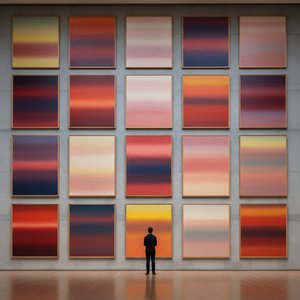
The Abstract Vision of Henry C. Pearson
In the vibrant tapestry of twentieth-century American modernism, few artists navigated the intersection of precision and spontaneity as gracefully as Henry C. Pearson. Born on October 8, 1914, in Kinston, North Carolina, Pearson’s journey was one defined by a profound synthesis of diverse global influences. His early academic foundations at the University of North Carolina and his subsequent studies in theatrical design at Yale University provided him with a unique structural understanding of space and composition. This background in design would later become a cornerstone of his visual language, allowing him to balance the rigorous geometry of hard-edged abstraction with a sense of whimsical movement.
The trajectory of Pearson’s life was irrevocably altered by the Second World War. Serving in the U.S. Army Air Corps, he was tasked with the meticulous creation of maps for the Okinawa campaign. This period of service introduced him to a world where cartography and art converged; the precision required for topographical accuracy began to seep into his creative consciousness. Following the war, his re-enlistment during the occupation of Japan opened a window into an entirely different aesthetic realm. Immersed in the subtle nuances of Japanese art and theatre forms, Pearson developed an appreciation for minimalism and the evocative power of negative space, elements that would later breathe life into his abstract compositions.
A Synthesis of Style and Movement
Upon settling in New York in the early 1950s, Pearson entered a period of intense artistic maturation. Studying at the Art Students League under masters such as Reginald Marsh and Will Barnet, he became part of a burgeoning community of innovators. His work began to reflect a fascinating tension between various modernist currents. While he was loosely associated with the Op Art movement—notably participating in the landmark Responsive Eye exhibition at the Museum of Modern Art in 1965—his true essence lay in a more personal, eclectic exploration. He drew inspiration from the structural purity of Piet Mondrian and the spiritual abstraction of Kasimir Malevich, yet he infused his work with a distinctively human touch.
Pearson’s oeuvre is celebrated for its remarkable versatility, ranging from abstract, multi-colored globes to 'stochastic' or chance-generated paintings that explore the beauty of randomness. His technical repertoire was equally broad, encompassing:
- Hard-edged abstraction: Utilizing clean lines and precise boundaries to create structured, geometric compositions.
- Lithography: Demonstrating a mastery of printmaking through works like Nuee Rouge Violet, where intricate patterns and bold color blends emerge.
- Textural exploration: Creating depth through subtle washes and layered surfaces that evoke atmospheric qualities.
- Sculptural influence: Developing paintings modeled after the rhythmic forms of Dogon sculpture from West Africa.
Legacy and Lasting Significance
Beyond the canvas, Pearson was a man of deep intellectual curiosity, finding profound connections between visual art and literature. His passion for the written word led him to illustrate several poems by the Nobel Prize-winning Irish poet Seamus Heaney, a collaboration that mirrored his own ability to translate linguistic emotion into visual form. This intersection of disciplines highlights the holistic nature of his creative spirit—a spirit that sought meaning not just in shapes and colors, but in the very essence of storytelling.
Today, the legacy of Henry C. Pearson resides in some of the world's most prestigious institutions, ensuring that his contributions to modernism continue to inspire new generations of viewers. His work serves as a testament to the power of an open mind, proving that an artist can find harmony between the rigid lines of a map and the fluid emotions of a color wash. His permanent collections include:
- The Metropolitan Museum of Art
- The Museum of Modern Art (MoMA)
- The Smithsonian American Art Museum
- The North Carolina Museum of Art
Through his ability to weave together the influences of American, Japanese, and African aesthetics, Pearson remains a pivotal figure in the history of abstract art, leaving behind a body of work that is as intellectually stimulating as it is visually captivating.
Pitanja i odgovori
Gdje su djela umjetnika Henry Pearson organizirana prema boji?
Stranica Spektralni indeks organizira djela umjetnika Henry Pearson prema boji.
Kako se umjetnost autora Henry Pearson razvijala tijekom vremena?
Karijera umjetnika Henry Pearson razvija se razdoblje po razdoblje na stranici Kronika: horizontalna vremenska linija umjetničkih djela, grupiranih u poglavlja prema razdobljima stvaranja.
Gdje se umjetnička djela autora Henry Pearson mogu pronaći grupirana prema umjetničkom pravcu?
Djela umjetnika Henry Pearson možete pregledavati prema umjetničkom pravcu na Svi umjetnički pravci stranici umjetnika.
Koliko je umjetničkih djela autora Henry Pearson dostupno za pregled?
Možete pregledati 7 umjetnina djela autora Henry Pearson na stranici Sva umjetnička djela.
Postoji li pregled svih tema koje je Henry Pearson naslikao/la?
Stranica Atlas tema prikazuje umjetnička djela autora Henry Pearson prema tematici.
Mogu li istražiti djela umjetnika Henry Pearson prema ključnim riječima?
Djela umjetnika Henry Pearson možete istražiti putem ključnih riječi na umjetnikovoj stranici Prema ključnim riječima. Svaka ključna riječ grupirala bi pripadajuća djela.
Mogu li posjetiti virtualni muzej djela umjetnika Henry Pearson?
3D muzej umjetnika Henry Pearson stranica je koja prikazuje umjetnikova djela u virtualnoj trodimenzionalnoj galeriji.
Kako mogu pronaći djela umjetnika Henry Pearson u određenoj paleti boja?
Kako biste pronašli djela umjetnika Henry Pearson u određenoj paleti boja, posjetite stranicu Prema paletama boja za tog umjetnika.