The Soul of the German Landscape: The Life of August Albert Zimmermann
August Albert Zimmermann stands as a profound testament to the enduring spirit of German Romanticism, an era where the canvas became a window into the human soul through the medium of nature. Born in 1808 in Zittau, Silesia—a region now part of Poland—Zimmermann’s artistic journey unfolded against a backdrop of shifting cultural tides that prioritized raw emotion and boundless imagination over the rigid academic conventions of the past. His early life was deeply intertwined with a rich familial tapestry of talent; he was the brother of accomplished painters Max, Richard, and Robert Zimmermann. This shared lineage provided him with a foundational understanding of artistic principles, yet it was his unique sensitivity to the sublime that would eventually distinguish his hand from those of his kin.
While his formal training included prestigious studies at the Dresden Academy of Fine Arts and the Munich Academy of Fine Arts, Zimmermann’s true brilliance emerged through self-directed exploration. He possessed a restless, inquisitive spirit that sought inspiration far beyond established boundaries, allowing him to cultivate a distinctive style characterized by atmospheric realism. This period of development was marked by an intense study of light and shadow, as he learned to translate the ephemeral qualities of the natural world into permanent, evocative oil paintings and delicate watercolors. His ability to blend technical precision with a deep, spiritual connection to his subjects allowed himates to transcend mere representation, turning landscapes into profound emotional experiences.
Mastery of Light and the Romantic Sublime
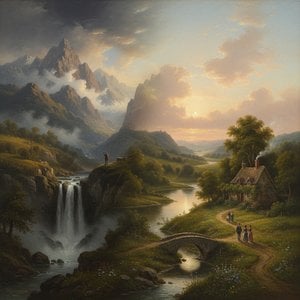
The oeuvre of Zimmermann is primarily celebrated for its ability to capture both the grandeur and the quiet tranquility of the German landscape, with a particular focus on the breathtaking scenery of Bavaria. His canvases are not merely static images but pulsating environments where vibrant colors and masterful brushwork converge to tell a story of nature's power. He was a master of chiaroscuro, utilizing the dramatic interplay between light and shadow to heighten atmospheric depth and evoke feelings of awe, contemplation, and even a touch of melancholy. Through his eyes, a simple mountain vista could become a monumental confrontation with the infinite.
Recurring motifs within his work serve as windows into the Romantic preoccupation with the sublime. A viewer might find themselves lost in:
- Snow-covered peaks that evoke the silent, chilling majesty of the high Alps;
- Rushing rivers and waterfalls that capture the untamed energy of the wilderness;
- Expansive vistas bathed in twilight, where the soft glow of the setting sun creates a sense of fleeting beauty and nostalgia;
- Intimate naturalist studies, such as his detailed depictions of birds like the Golden-Fronted Woodpecker, which showcase his keen observational skills.
This duality—the ability to move between the epic scale of a mountain massif and the delicate detail of a single branch—is what defines his technical legacy. Whether painting the distant silhouette of Mount Etna or the quiet stillness of a winter scene featuring faggot gatherers, Zimmermann maintained an unwavering commitment to atmospheric truth.
Legacy and Historical Significance
As the nineteenth century progressed, Zimmermann’s work became a cornerstone of the Romantic landscape tradition. His influence extended through his role as a teacher—notably serving as a mentor to his brother Max—and through his ability to capture the changing face of Europe, from the rugged terrains of Germany to the pastoral rhythms of rural life. His paintings do more than document geography; they document an era of profound philosophical inquiry into the relationship between humanity and the natural world.
Today, the works of August Albert Zimmermann continue to resonate with collectors and art historians alike. His ability to evoke the sublime—that specific mixture of beauty and terror found in the greatness of nature—ensures his place in the canon of great German masters. Through his mastery of light, his emotional depth, and his unwavering devotion to the landscape, Zimmermann left behind a visual legacy that continues to invite us to pause, breathe, and contemplate the magnificent, often overwhelming, beauty of the world around us.
Pitanja i odgovori
Koje je boje August Albert Zimmermann najčešće koristio/la?
Upotrebu boje u djelima umjetnika August Albert Zimmermann koja su navedena na ovaj web-mjesto moguće je proučiti na umjetnikovoj stranici Genom palete.
Kako mogu pratiti radove umjetnika August Albert Zimmermann godinu po godinu?
Stranica Kronologija umjetnina prikazuje djela umjetnika August Albert Zimmermann poredana prema datumu, godinu po godinu.
Gdje su djela umjetnika August Albert Zimmermann grupirana prema tehnici?
Stranica Svi mediji grupirana je prema tehnici izrade djela umjetnika August Albert Zimmermann.