


 Pregledaj u stvarnoj veličini
 Podijeli
 Podijeli
 Detalji
 Vodič
Vodič

 Preuzmi datoteku
 Slični predmeti
 Rentgenska snimka
 Slide show
 Statistika
Taking tea


 Pročitajte više
Ručno rađena uljana reprodukcija
Ručno oslikano uljanim bojama na platnu u dimenzijama i okviru po vašem izboru, izrađeno po narudžbi od strane naših umjetnika. ( Prebacite na prodaju printova Prebacite na digitalnu prodaju slika)




P118B $10

P118H $10

P118W $10

P438Z $10

P508JH $12

P508YH $12

P805H $10

P805Z $10

P919BZ $10

P919G $10

P919XJ $10

P959ZH $10

P968JZ $12

W106C $8

W218G $10

W218JH $8

W218Y $10

W307PJ $10

W316G $10

W316PJ $8

W316Y $10

W398PJ $8

W4111J $10

W500HY $15

W500JH $15

W692G $12

W849H $8

W940BG $15

W953PJ $8




Odaberite jednu od naših unaprijed definiranih veličina koje odgovaraju izvornim proporcijama umjetničkog djela.

Možete unijeti vlastite dimenzije kako bi odgovarale određenom okviru ili prostoru. Ako odabrana veličina ne odgovara proporcijama izvorne slike, izrezat ćemo umjetničko djelo ili proširiti sliku dodatnim ručno oslikanim elementima. Digitalni nacrt bit će vam poslan na odobrenje prije početka proizvodnje.
Imajte na umu da pregled na ekranu ne prikazuje stvarno izrezivanje ili proširivanje. Samo će nacrt točno prikazati konačni sastav.
Iako su dostupne prilagođene veličine, preporučujemo odabir dimenzije s preddefiniranog popisa kako bismo očuvali izvorne proporcije.
Nakon narudžbe, tim ArtsDot.com kontaktirat će klijenta putem e-pošte radi dobivanja uputa te dostaviti probni prikaz (mockup)
Isporuka širom svijeta () u roku od 3-4 tjedna umjesto standardnih 5 tjedana. (23 Rujan). Bez kompromisa u kvaliteti.

Besplatna ekspresna dostava širom svijeta

Visokokvalitetno laneno platno

Potpuno osiguranje transporta

Jamstvo povrata carine i uvoznih poreza

Jamstvo vjernosti boja

Politika povrata u roku od 100 dana (samo u slučaju nedostataka)

Jamstvo povrata 100% novca

Popust na više proizvoda
 Opcija stakla dostupna je samo za dimenzije manje od 110 cm

Taking tea
Tehnika izrade
Veličina reprodukcije
-


Ukupna cijena
$ 263
A Moment Captured in Valencia’s Golden Light
Joaquín Sorolla's "Taking Tea" isn’t merely a depiction of two women enjoying afternoon refreshments; it’s an exquisite distillation of Valencian life and artistic sensibility at the cusp of the roaring twenties. Painted in 1918, this portrait transcends its subject matter to become a testament to Sorolla’s masterful command of light – a hallmark that defines his entire oeuvre and cemented his reputation as one of Spain's foremost Impressionists.The Painter’s Technique: Embracing Luminosity
Sorolla’s technique is instantly recognizable. He eschewed the meticulous detail favored by many of his contemporaries, opting instead for loose brushstrokes that capture the ephemeral quality of sunlight filtering through a Valencian window. Layers upon layers of thin washes of pigment create an illusion of depth and vibrancy, mimicking the way light dances across surfaces. Notice how he skillfully renders the translucence of the vase’s glass – not with hard edges but with soft gradations that convey its luminous interior. This deliberate disregard for precise representation prioritizes feeling over factual accuracy, aligning perfectly with Sorolla's artistic philosophy.Historical Context: Valencia and Modernity
Valencia in 1918 was experiencing a period of significant cultural renewal. The city’s burgeoning bourgeoisie embraced the ideals of modernity, fostering an environment conducive to artistic experimentation. Sorolla himself benefited from patronage – notably from wealthy Valencian families – allowing him to dedicate himself fully to his craft. “Taking Tea” reflects this spirit of optimism and engagement with contemporary life, portraying women engaged in conversation amidst a scene of domestic comfort. It’s a snapshot of a society striving for beauty and refinement, mirroring Sorolla's own belief that art should illuminate the human experience.Symbolism Within Light
The pervasive use of light isn’t accidental; it carries profound symbolic weight. Sorolla was deeply influenced by Japanese Impressionism, particularly Hiroshige’s landscapes, which emphasized atmospheric perspective and a focus on capturing fleeting moments. Just as Hiroshige sought to convey the essence of Japan's natural beauty, Sorolla aimed to encapsulate the warmth and vitality of Valencian culture. The light itself symbolizes joy, serenity, and connection – qualities that permeate the painting’s composition and contribute to its emotional resonance.Emotional Impact: A Gentle Radiance
Ultimately, “Taking Tea” succeeds in conveying a palpable sense of tranquility and intimacy. The figures are rendered with understated grace, their expressions subtly hinting at shared companionship. Sorolla's masterful manipulation of light imbues the scene with an ethereal glow, transporting the viewer to a sunlit Valencian terrace. It’s a painting that invites contemplation – prompting us to savor the simple pleasures of life and appreciate the beauty found in everyday moments. This reproduction captures not just an image but an atmosphere—a feeling of warmth, connection, and timeless elegance.Srodna umjetnička djela


Biografija umjetnika
Joaquín Sorolla y Bastida – A Life Bathed in Light
Joaquín Sorolla y Bastida, a name synonymous with the radiant light and vibrant energy of Spain, was more than just a painter; he was a chronicler of his nation’s soul. Born in Valencia in 1863, Sorolla's early life was marked by tragedy. Orphaned at the tender age of two following a cholera epidemic that claimed both parents, young Joaquín and his sister were raised by their maternal aunt and uncle. This early experience with loss perhaps instilled within him a profound appreciation for the fleeting beauty of life – a sentiment that would permeate his art. Though hardship shadowed his beginnings, it did not dim the spark of artistic talent that quickly became apparent. He received initial instruction in Valencia, demonstrating an aptitude that led to studies under established artists like Cayetano Capuz and José Benlliure, eventually culminating in a four-year grant to study in Rome. It was there, amidst the classical grandeur of Italy, that Sorolla began to forge his unique artistic path, absorbing influences while simultaneously developing a style distinctly his own.Early Life and Influences
Joaquín Sorolla’s formative years were shaped by profound loss and familial resilience. Born into a modest Valencian family, he endured the devastating impact of cholera when both his parents succumbed to illness at just two years old. Raised by his maternal aunt and uncle—a locksmith—he experienced firsthand the hardships faced by ordinary Spaniards during that era. This early exposure to adversity undoubtedly instilled within him an empathy for human suffering and a deep fascination with capturing emotion in his art. His artistic education commenced at Valencia’s School of Artisans, where he honed his skills under instructors like Cayetano Capuz and José Benlliure—artists who championed realism and celebrated the beauty of everyday life. Recognizing Sorolla's exceptional talent, he secured a prestigious scholarship to study painting in Rome in 1884, immersing himself in the artistic milieu of Italy and encountering luminaries such as Francisco Pradilla Ortiz, the director of the Spanish Academy in Rome—a pivotal encounter that would profoundly influence his artistic vision.Rome and Impressionistic Explorations
Sorolla’s time in Rome proved transformative, propelling him toward a distinctly Impressionistic style. He diligently studied masterpieces by artists like Jules Bastien-Lepage and Adolf von Menzel, absorbing their techniques for capturing light and color—a stylistic approach that would become central to his oeuvre. The Academy of Fine Arts welcomed him with open arms, fostering an environment conducive to experimentation and artistic growth. Sorolla’s keen observation of the Roman landscape—particularly its sunlit vistas—inspired countless canvases brimming with vibrant hues and dynamic brushstrokes. He embraced plein air painting wholeheartedly, striving to faithfully reproduce the ephemeral effects of natural light—a commitment that distinguished him from many of his contemporaries who favored studio-based methods. This dedication to capturing the immediacy of experience would become a hallmark of Sorolla’s artistic practice throughout his career.The Valencian Coast and Luminism
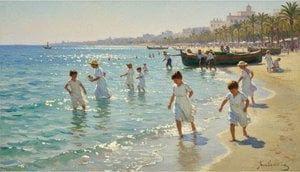
Sorolla's artistic sensibilities found their most compelling expression in depictions of the Valencian coast—a region he cherished deeply and revisited repeatedly during his lifetime. He became captivated by the intense Mediterranean sunlight, the shimmering sea, and the lively rhythms of coastal life—subjects that would dominate his output for decades to come. Sorolla’s technique evolved into what is now recognized as Luminism—a style characterized by bold, impastoed brushstrokes designed to convey maximum luminosity and atmospheric depth. He meticulously studied how light interacted with surfaces, capturing its subtle nuances and transforming ordinary scenes into canvases of breathtaking beauty. Paintings like *Children on the Seashore* exemplify this masterful approach—figures bathed in golden light, rendered with an unparalleled sense of spontaneity and vitality. Sorolla’s ability to evoke emotion through color and texture cemented his reputation as one of Spain's foremost artists.Legacy and Recognition
Joaquín Sorolla y Bastida achieved international acclaim during his lifetime, exhibiting extensively throughout Europe and the United States—receiving numerous honors and commissions that affirmed his stature as a leading figure in the artistic landscape of his era. His monumental mural cycle commissioned by the Hispanic Society of America—titled *Vision of Spain*—stands as an enduring testament to his artistic ambition and technical prowess—a project completed posthumously and showcasing his unparalleled command of color and composition. Sorolla’s influence extended far beyond his own lifetime, inspiring generations of artists who sought to emulate his distinctive Luminist style. Today, his paintings reside in prominent museums globally—including the Museo Sorolla in Madrid—where they continue to captivate audiences with their radiant beauty and evocative portrayal of Spanish life—a legacy that secures Sorolla’s place as a cornerstone of Spanish art history.
Joaquin Sorolla
1863 - 1923 , Španjolska
Brzi pregled
- Artistic Movement Or Style: Realizam, Luminizm, Impresionizam
- Artists Or Movements Influenced By This Artist: ['Impressionisti']
- Artists Who Influenced This Artist:
- Francisco Pradilla
- Jules Bastien-Lepage
- Adolph von Menzel
- Date Of Birth: 27. veljače 1863.
- Date Of Death: 10. kolovoza 1923.
- Full Name: Joaquín Sorolla y Bastida
- Nationality: Španjolski
- Notable Artworks:
- Marguerite
- Povratak iz ribolova
- Žalosna naslednica
- Place Of Birth: Valencia, Španjolska
Povezani članci

Rafael de Penagos: A Study in Spanish Portraiture & Artistic Identity
Explore the life & art of Rafael de Penagos, a leading Spanish Art Deco illustrator. Discover his iconic 'Penagos Woman', commercial work, and lasting legacy. Learn about this pivotal figure in 20th-century Spanish art history.

Impressionism's Masterpieces: 10 Paintings That Defined a Movement | ArtsDot
Journey through Impressionism's heart with 10 iconic paintings by Monet, Renoir & Degas. Explore light, color & the stories behind these masterpieces. Find museum-quality art reproductions and elevate your home decor on ArtsDot.com.
Joaquín Sorolla: Capturing Spanish Light & Life – A Legacy of Impressionism
Explore the luminous world of Joaquín Sorolla, Spanish master of Impressionism. Discover his life, techniques & legacy – a guide for art collectors and enthusiasts. Invest in timeless beauty.

Manuel Benedito Vives: A Study of Light, Color & Emotional Resonance in Contemporary Spanish Painting
Explore the captivating world of Manuel Benedito Vives, a celebrated Spanish painter influenced by Sorolla. Discover his masterful portraits, luminous landscapes & enduring legacy – a favorite of the Spanish Royal Family. Art collectors will appreciate this in-depth study.

Portrayals of Power & Perception: A Historical Survey of Women in Art
Explore the rich history of women in art – from iconic muses to groundbreaking artists. Discover feminist movements & reclaim female narratives with ArtsDot. Expert insights for discerning collectors.


