

 Pregledaj u realnoj veličini
 Pošalji
 Podijeli
 Detalji o umjetničkom djelu
 Vodič
Vodič

 Preuzmi umjetničko djelo
 Slični predmeti
 Rentgenska snimka
 Slide show
 Pitanja i odgovori
 Statistika
untitled (7539)

 Prikaži više
Djelo prikazano na ovoj stranici zaštićeno je autorskim pravima, što znači da zakonski ne možemo izraditi niti prodati identičnu reprodukciju. Ova se zaštita provodi u skladu s međunarodnim sporazumima kao što su Bernska konvencija i nacionalnim zakonima, uključujući i one koji su utvrđeni u Američki zakon o autorskom pravu – Title 17.
Ova metoda u potpunosti je usklađena s autorskim pravima jer ne uključuje kopiranje ili dupliciranje zaštićenih umjetničkih djela. Umjesto toga, riječ je o kreativnoj reinterpretaciji – novoj slici koja je dobila utjecaj na izvornik, ali nije identična njemu.
Giclée / Umjetnički otisak
Giclée tisak muzejske kvalitete ili otisak na platnu uz brzu izradu i raznolike opcije završne obrade. ( Kupi ručno oslikano djelo Prebacite na digitalnu sliku)




P118B €10

P118H €10

P118W €10

P438Z €10

P508JH €12

P508YH €12

P805H €10

P805Z €10

P919BZ €10

P919G €10

P919XJ €10

P959ZH €10

P968JZ €12

W106C €8

W218G €10

W218JH €8

W218Y €10

W307PJ €10

W316G €10

W316PJ €8

W316Y €10

W398PJ €8

W4111J €10

W500HY €15

W500JH €15

W692G €12

W849H €8

W940BG €15

W953PJ €8




Odaberite jednu od naših unaprijed definiranih veličina koje odgovaraju izvornim proporcijama umjetničkog djela.

Unesite potrebnu širinu i visinu kako bi odgovarali vašem okviru ili zidu. Print se može samo izrezati, nikada ne može biti veći od slike, stoga format s drugačijim omjerom stranica uzrokuje gubitak dijela slike. Prije bilo kakve štampe šaljemo vam digitalni prikaz (mockup) na odobrenje. Slika prikazana na ovoj stranici ne prikazuje stvarni rez — to prikazuje isključivo digitalni prikaz.
Dostava širom svijeta () u roku od 2 tjedna umjesto standardnih 4/5 tjedana. (5 Studeni)

Besplatna ekspresna dostava širom svijeta

Visokokvalitetno laneno platno

Potpuno osiguranje dostave

Jamstvo povrata carine i uvoznih poreza

Jamstvo vjernosti boja

Politika povrata u roku od 100 dana (samo u slučaju nedostataka)

Jamstvo povrata 100% novca

Popust na više proizvoda
 Opcija stakla dostupna je samo za dimenzije manje od 110 cm

untitled (7539)
Giclée / Umjetnički otisak
Veličina reprodukcije
-


Ukupna cijena
€ 56
A Silent Echo of Dreams: Decoding Giorgio de Chirico’s “Untitled (7539)”
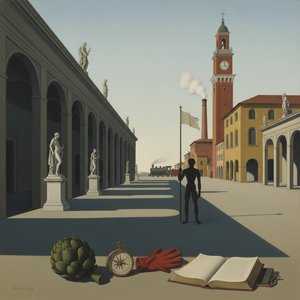
The painting "Untitled (7539)" by Giorgio de Chirico, a cornerstone of Metaphysical Art, transcends mere visual representation; it invites contemplation and whispers secrets of the subconscious mind. Captured in an image that showcases a solitary statue perched atop a pedestal against a backdrop of an arched building—a scene reminiscent of classical Roman ruins—the artwork immediately establishes a mood of stillness and melancholic beauty. This isn’t simply a depiction of space; it's a meticulously crafted illusion designed to unsettle the viewer, prompting questions about perception and reality itself.The Surreal Landscape: Influences Beyond Sight
De Chirico’s artistic vision was profoundly shaped by intellectual currents circulating in Europe during his formative years. Like many artists of his time, he wrestled with existential anxieties fueled by thinkers such as Nietzsche and Schopenhauer—ideas that questioned the foundations of Western philosophy and championed the primacy of subjective experience. These philosophical explorations found their visual expression in landscapes imbued with a dreamlike quality, mirroring the unsettling logic of irrational thought. The architectural setting – echoing Roman grandeur yet rendered strangely desolate – deliberately disrupts conventional spatial conventions, creating an atmosphere of disorientation and hinting at hidden narratives beneath the surface. Böcklin’s evocative depictions of Alpine landscapes served as inspiration, fostering a fascination for symbolic imagery and conveying profound emotional resonance.Technique and Composition: Precision Within Illusion
De Chirico's masterful technique contributes significantly to the artwork’s hypnotic effect. Employing oil paints on canvas with painstaking detail, he achieved remarkable realism within an unreal context. The statue itself is rendered with meticulous accuracy—a deliberate choice that underscores its presence as a tangible element amidst the ethereal surroundings. Notice the subtle gradations of color and light; these aren't intended to create a comforting visual experience but rather to heighten the sense of unease and mystery. Furthermore, the positioning of the figures – one standing rigidly beside the pedestal and another closer to the right—creates a dynamic tension that draws the eye across the canvas, reinforcing the feeling of observation and prompting viewers to consider their own role within this enigmatic tableau.Symbolism: Absence Speaks Volumes
“Untitled (7539)” is laden with symbolic significance. The statue represents not just an inanimate object but also embodies stillness, contemplation, and perhaps even decay—themes central to de Chirico’s preoccupation with mortality and the passage of time. Its posture suggests repose, yet it simultaneously conveys a sense of vulnerability and abandonment. The arched building symbolizes permanence and grandeur, juxtaposed against the desolate emptiness of the surrounding space. This deliberate contrast underscores the artwork's exploration of themes like isolation and the confrontation with the unknown—concepts that resonate powerfully within the framework of existential philosophy. The absence of human interaction amplifies these feelings, inviting viewers to project their own anxieties onto the scene.Emotional Resonance: A Portrait of Disquiet
Ultimately, “Untitled (7539)” succeeds in capturing a profound emotional state – one characterized by quiet melancholy and unsettling curiosity. It’s not an artwork that offers easy answers or comforting resolutions; instead, it compels us to confront uncomfortable truths about our own perceptions and beliefs. Like many Surrealist masterpieces, it operates on multiple levels of interpretation, stimulating intellectual engagement alongside visceral sensation. Reproductions of this iconic piece offer a chance to bring home a fragment of de Chirico’s visionary aesthetic—a reminder that art can illuminate the hidden landscapes of the human psyche and provoke enduring contemplation.Pitanja i odgovori
Gdje mogu pronaći statistiku o djelu "untitled (7539)" autora Giorgio De Chirico?
Stranica Statistika pregleda djela "untitled (7539)" autora Giorgio De Chirico prikazuje statistiku javnih posjeta: mjesečni broj posjeta ovom umjetničkom djelu, usporedbu s najgledanijim djelima tog umjetnika te informacije o porijeklu posjetitelja.
Mogu li naručiti uljanu reprodukciju djela "untitled (7539)"?
Ručno oslikane kopije djela "untitled (7539)" autora Giorgio De Chirico dostupne su na stranici ovaj web-mjesto: ručno oslikana uljana reprodukcija na lanenom platnu, a mogu se naručiti putem njihove stranice Ručno oslikana reprodukcija.
Je li "untitled (7539)" autora Giorgio De Chirico slika, crtež ili grafika?
"untitled (7539)" autora Giorgio De Chirico klasificirano je kao WallArt. Ova kategorija opisuje vrstu umjetničkog djela kojem original pripada.
Srodna umjetnička djela


Biografija umjetnika
Giorgio de Chirico (1888–1978): The Architect of Dreamlike Landscapes
Giorgio de Chirico, born in Volos, Greece, on July 10th, 1888, to Italian parents—a Genoese mother and a Sicilian father—was an artist whose life was inextricably linked with the intellectual currents of his time. From a young age, he demonstrated an exceptional talent for drawing and painting, nurtured by a formal education at Athens Polytechnic where he honed his skills in classical techniques. However, it was his relocation to Munich in 1906 that truly propelled him onto the artistic stage, immersing him in the vibrant atmosphere of German Symbolism and fostering connections with artists like Arnold Böcklin and Max Klinger—figures whose haunting landscapes and symbolic imagery profoundly shaped his aesthetic sensibilities. These encounters instilled within him a fascination for mythology and a preoccupation with exploring the hidden realities beneath the surface of perception.The Genesis of Metaphysical Art
Around 1909, de Chirico embarked on an unprecedented artistic endeavor: the creation of “Metaphysical” art—a style that defied conventional categorization and sought to capture the unsettling poetry residing within familiar spaces. Inspired by the philosophical writings of Friedrich Nietzsche, Arthur Schopenhauer, and Otto Weininger—who wrestled with questions of existentialism and the irrationality of human desire—he began to depict scenes populated by enigmatic figures and architectural elements rendered in jarring juxtapositions. His most iconic works, such as *The Vexations of the Thinker* and *The Enigma of an Autumn Afternoon*, exemplify this distinctive aesthetic: desolate cityscapes bathed in melancholic shadows, inhabited by mannequins and statues imbued with a palpable sense of loneliness—a visual language that resonated deeply with the anxieties of the era. This groundbreaking style quickly gained recognition within the artistic community, establishing him as a pioneer of Surrealism and influencing artists like René Magritte and Salvador Dalí.A Collaborative Spirit & Early Recognition
In 1919, de Chirico moved to Paris alongside his brother Alberto Savinio—a partnership that proved pivotal in shaping their artistic trajectory. Together, they founded the Scuola Metafisica, a collective dedicated to exploring the metaphysical principles of art and challenging established conventions. Their initial exhibitions at the Salon d’Autoumne and Salon des Indépendants garnered critical acclaim and cemented their connections with influential figures like Guillaume Apollinaire—who penned one of his earliest biographical texts—and Paul Guillaume—who secured him his first commercial contract. Notably, he befriended Mario Tozzi, Massimo Campigli, Alberto Magnelli and Gino Severini, all Italian artists who were operating in Paris during this period.Expanding Horizons & Embracing Surrealism
The Second World War interrupted de Chirico’s artistic pursuits but did not diminish his influence on the burgeoning Surrealist movement. He continued to paint prolifically, experimenting with diverse styles and subjects—from monumental sculptures inspired by classical mythology to intimate portraits reflecting a profound engagement with human psychology. His exploration of architectural spaces and enigmatic figures—recurring motifs in his oeuvre—became emblematic of Surrealism’s quest for dreamlike imagery and subconscious expression. Despite facing criticism from some quarters regarding the perceived decline in quality of his later works, de Chirico remained steadfast in his artistic convictions, revisiting themes from his formative years while maintaining a meticulous attention to craftsmanship and technical skill.Legacy & Enduring Influence
Giorgio de Chirico’s contribution to art history transcends stylistic innovation; it represents a fundamental rethinking of perception and representation—a challenge to the accepted norms of Western painting that continues to inspire artists today. His pioneering exploration of metaphysical principles paved the way for Surrealism, influencing generations of creatives who sought to capture the elusive realm of dreams and unconsciousness. Beyond his artistic achievements, de Chirico’s intellectual engagement with Nietzsche and Schopenhauer—and his unwavering commitment to humanist values—solidified his place as a visionary artist whose work embodies the spirit of an era marked by profound philosophical questioning and aesthetic experimentation. His paintings remain treasured artifacts of 20th-century art, inviting viewers to contemplate the mysteries of existence and the transformative power of imagination.
Giorgio De Chirico
1888 - 1978 , Грчка
Osnovne informacije
- Artistic Movement Or Style: Metafizička umjetnost
- Artists Who Influenced This Artist:
- Arnold Böcklin
- Max Klinger
- Friedrich Nietzsche
- Date Of Birth: 10 srpnja 1888.
- Date Of Death: 20. studenoga 1978.
- Full Name: Giorgio de Chirico
- Nationality: Talijan
- Notable Artworks:
- The Vexations of the Thinker
- The Enigma of an Autumn Afternoon
- Place Of Birth: Volos, Grčka
Srodni članci

Bronze Sculptures That Defined Art History | ArtsDot
Journey through art history with our Top 10 bronze sculptures! Explore masterpieces by Rodin, Michelangelo & more. Discover stories behind iconic statues and find museum-quality reproductions for your home decor at ArtsDot.com.

The Enduring Form: Exploring Themes & Techniques in Sculpture Across Historical Periods
Explore the rich history of sculpture from ancient masterpieces to contemporary innovations. Discover key techniques, influential artists & investment potential for discerning art collectors.
Giorgio de Chirico: Metaphysical Realities & the Poetics of Absence
Explore the captivating world of Giorgio de Chirico and his groundbreaking Metaphysical painting movement. Discover the philosophical depths & surreal imagery that influenced generations of artists. Learn more at ArtsDot.

Francisco Goya: 25 Remek-djela Španjolskog Majstora za Vaš Dom | ArtsDot
Uronite u svijet Francisca Goye! Otkrijte 25 remek-djela španjolskog majstora – od portreta do crnih slika. Povijest umjetnosti, tehnike i inspiracija za vaš dom. Kupite reprodukcije na ArtsDot.com!

Beyond Reality's Veil: Exploring the Enigmatic World of Metaphysical Art
Explore the captivating world of Metaphysical art with ArtsDot. Discover Giorgio de Chirico's iconic paintings, philosophical influences & lasting impact on Surrealism. Expert insights for collectors.


