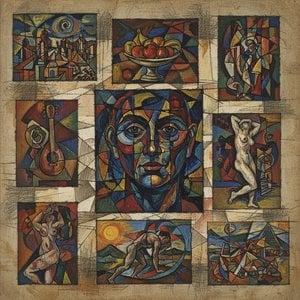
The Visionary Pulse of Chicana Expressionism
Born in the vibrant yet turbulent landscape of Los Angeles in 1951, Patricia Valdez—often known by her evocative moniker Patssi Valdez—emerged as a transformative force in the American avant-garde. Her artistic consciousness was forged in the crucible of East Los and the systemic struggles of the mid-twentieth century, where the realities of racial inequity and social upheaval served as both a challenge and a profound inspiration. Rather than retreating from these harsh truths, Valdez embraced them, weaving the complexities of Chicana identity into a visual language that is as much about resistance as it is about beauty. Her early life, marked by the shadows of police brutality and the disproportionate impact of the Vietnam draft on Mexican-American communities, instilled in her a lifelong commitment to using art as a tool for social justice and cultural reclamation.
The trajectory of Valdez’s career is inextricably linked to the legendary Asco art collective. Operating between 1972 and 1987, Asco functioned not merely as a group of collaborators but as a radical movement designed to confront cultural erasure and institutional silence. Within this experimental ecosystem, Valdez pushed the boundaries of what constituted "art," moving fluidly between performance, fashion, and cinematic-inspired imagery. Her work during this era often utilized the aesthetics of goth film stills and street-level interventions to stage protests against violence and oppression. By bringing art into the scarred landscapes of gang conflict and urban neglect, she transformed the streets of Los Angeles into a living gallery, forcing the viewer to confront the visceral realities of marginalized existence through a lens of surrealist defiance.
A Tapestry of Surrealism and Glamour
The aesthetic signature of Valdez is a mesmerizing alchemy of seemingly disparate worlds. Her mature work achieves a breathtaking synthesis of Art Deco glamour, psychedelic imagery, and magical realism. There is a rhythmic, almost hypnotic quality to her compositions, where the sharp, structured elegance of Art Deco meets the fluid, dreamlike distortions of surrealism. This stylistic duality allows her to navigate the tension between the harshness of social reality and the limitless potential of the imagination. In her paintings, one might find figures that possess an otherworldly grace, draped in fashion that feels both futuristic and deeply rooted in a reimagined Chicano heritage.
Beyond the canvas, Valdez’s influence extends into the realm of visual identity and performance. Her ability to manipulate texture and light creates a sense of depth that invites the spectator into a psychological landscape where the boundaries between the self and the collective blur. The significance of her contribution lies in this very ability to reclaim the narrative; through her use of avant-garde expressionism, she provides a voice for the silenced, turning the struggle for visibility into a triumphant display of artistic mastery. Her legacy remains a cornerstone of Chicana visual culture, reminding us that art is most powerful when it serves as both a mirror to society's wounds and a window into its most profound dreams.
प्रश्न और उत्तर
क्या मैं रंगों के स्पेक्ट्रम के आधार पर Patricia Valdez की कलाकृतियों को देख सकता हूँ?
Patricia Valdez की कलाकृतियों को रंग के आधार पर कलाकार के स्पेक्ट्रल इंडेक्स पेज पर देखा जा सकता है।
क्या Patricia Valdez की सभी कलाकृतियों की कोई पूरी सूची उपलब्ध है?
यह वेबसाइट पर Patricia Valdez की प्रत्येक कृति को कलाकार के सभी कलाकृतियाँ पेज से देखा जा सकता है।
Patricia Valdez अन्य किन नामों से जाने जाते हैं?
Patricia Valdez को Patssi Valdez के नाम से भी जाना जाता है।