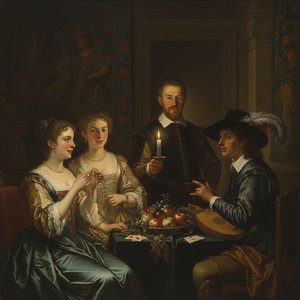
Willem van Mieris (1662 - 1747) : Le Maître du Détail Élégant
Willem van Mieris (1662-1747) s'impose comme une figure charnière du mouvement des fijnschilders de Leyde, incarnant l'aboutissement des idéaux artistiques du Baroque néerlandais. Né à Leyde le 3 juin 1662, il est issu d'une lignée profondément ancrée dans la tradition artistique ; son père, Frans van Mierables l'Ancien (1635-1681), était lui-même un peintre de genre célèbre, réputé pour sa capacité à capturer les nuances de la haute société. Cet héritage familial a profondément façonné les années de formation de Willem et a instillé en lui un dévouement inébranlable pour maintenir la position prestigieuse de son père en tant que premier fijnschilder de Leyde — un engagement qui allait définir l'ensemble de sa carrière artistique.- Formation initiale et influences :
- L'impact profond de Frans van Mieris l'Ancien sur la technique et la sensibilité esthétique de Willem est immense. Sous la tutelle de son père, Willem a perfectionné ses compétences sous l'œil attentif de Gerrit Dou (1613-1675), maître du clair-obscur et de l'observation méticuleuse — une approche stylistique qui allait devenir indissociable des fijnschilders de Leyde.
La Tradition de Leyde et la Vision de Pieter Post
La trajectoire artistique de Willem van Mieris était inextricablement liée aux courants intellectuels plus larges de son époque. L'influence de Pieter Post (1659-1734), théoricien de l'art et humaniste néerlandais, s'est révélée particulièrement transformatrice. Post défendait l'idée que les peintres de genre devaient transcender la simple représentation pour élever leurs sujets à travers les idéaux classiques de beauté et de proportion. Cette conviction a poussé Willem à analyser méticuleusement les chefs-d'œuvre sculpturaux de l'Antiquité, intégrant leurs principes compositionnels au cœur même de ses peintures.Une Carrière Définie par le Mécénat et l'Innovation Artistique
La vie professionnelle de Willem s'est déployée au sein d'un paysage de mécénat artistique considérable ; il a obtenu des commandes de figures éminentes telles que Madame Oortmans et Pieter de la Court van der Voort, consolidant ainsi sa réputation d'un des artistes les plus convoités de Leyde. Notablement, il occupa la fonction de doyen de la Guilde de Saint-Luc en 1693, démontrant non seulement ses prouesses artistiques, mais aussi son implication dans le tissu intellectuel et social de Leyde.Style et Technique : La Quête de la Perfection
Le style distinctif de Willem van Mieris — caractérisé par une attention inégalée au détail et une maîtrise magistrale du clair-obscur — représentait l'apogée de l'ambition artistique des fijnschilders de Leyde. À l'instar de son père, Willem a étudié méticuleusement les œuvres de Gerrit Dou, adoptant sa technique et son approche stylistique. Il rendait avec une précision remarquable les textures et les surfaces, capturant des nuances subtiles qui insufflaient la vie à ses sujets. De plus, il employait fréquemment des poses classiques empruntées aux sculptures de Francis van Bossuit — un geste délibéré visant à élever la peinture de genre au niveau de l'art monumental.Héritage et Importance Historique
L'œuvre de Willem van Mieris comprend une vaste collection de scènes de genre et de portraits, reflétant les goûts et les sensibilités de son époque. Ses peintures offrent des perspectives inestimables sur la société néerlandaise durant la période baroque, dépeignant des intérieurs opulents, des costumes raffinés et des portraits psychologiquement perspicaces du caractère humain. L'influence durable de Willem s'étend au-delà de ses accomplissements artistiques ; il a fondé l'Académie de Dessin de Leyde aux côtés de Jacob Toorenvliet et Carel de Moor, favorisant ainsi une nouvelle génération d'artistes déterminés à perpétuer la tradition de Leyde — un héritage qui continue de résonner aujourd'hui dans l'histoire de l'art néerlandais.Questions et réponses
Dans quels mouvements Willem Van Mieris a-t-il travaillé ?
Retrouvez les œuvres de Willem Van Mieris classées par mouvement sur la page Tous les mouvements artistiques de l'artiste.
Puis-je parcourir les œuvres de Willem Van Mieris par technique ?
La page Par technique regroupe les œuvres de Willem Van Mieris par technique.
Où puis-je voir les œuvres de Willem Van Mieris par ordre chronologique ?
Retrouvez les œuvres de Willem Van Mieris par ordre chronologique sur la page Chronologie des œuvres de l'artiste.