Jeunesse et formation
Pierre Étienne Théodore Rousseau, peintre français, est né à Paris le 15 avril 1812. Sa famille, bien que n'étant pas elle-même composée d'artistes, encouragea son intérêt précoce pour l'art. S'il reçut initialement une formation de base, il manifesta rapidement une aptitude remarquable pour la peinture. Son père, qui avait d'abord regretté sa décision de délaisser le commerce, finit par se réconcilier avec ce choix et soutint la carrière de Théodore.Carrière artistique
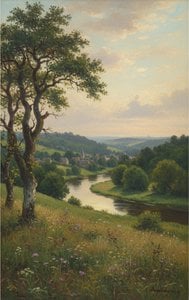
Théodore Rousseau fut une figure de proue du développement de la peinture de paysage et un pilier de l'École de Barbizon. Il était reconnu pour son observation méticuleuse de la nature, qu'il étudiait souvent durant de longues heures afin de la graver dans sa mémoire. Cette approche lui permit de créer des peintures d'un réalisme et d'une précision saisissants.Œuvres notables et style
L'art de Théodore Rousseau se caractérise par un mélange complexe de réalisme et de romantisme. Parmi ses œuvres les plus marquantes, on peut citer :- Les Chênes d'Apremont, véritable témoignage de son souci du détail.
- Le Printemps, illustrant sa capacité à capturer l'essence même de la nature.
- La Gorge aux loups, reflétant son lien profond avec le monde naturel.
Héritage et influence
L'héritage de Théodore Rousseau dépasse largement le cadre de ses propres créations. Il a influencé toute une génération d'artistes par son approche unique du paysage. Son insistance sur l'observation de la nature a inspiré de nombreux peintres, faisant de lui une figure incontournable de l'histoire de l'art. Découvrez les œuvres de Théodore Rousseau sur ArtsDot : [https://ArtsDot.com/@/pierre étienne théodore rousseau](https://ArtsDot.com/@/pierre%20étienne%20théodore%20rousseau) Explorez l'École de Barbizon et son influence sur Wikipédia : [https://en.wikipedia.org/wiki/barbizon_school](https://en.wikipedia.org/wiki/barbizon_school)Conclusion
La vie et l'œuvre de Théodore Rousseau nous rappellent la puissance du dévouement et de l'observation dans la création de chefs-d'œuvre intemporels. Son héritage continue d'inspirer les artistes et les passionnés d'art, faisant de lui un membre indispensable de l'histoire de l'art. En savoir plus sur Théodore Rousseau sur ArtsDot : /en/art/show/art-d3av5h-en/Questions et réponses
Comment puis-je suivre l'évolution de l'œuvre de Théodore Rousseau année après année ?
Les œuvres de Théodore Rousseau peuvent être consultées par ordre chronologique sur la page Chronologie des œuvres de l'artiste.
Comment trouver des œuvres de Théodore Rousseau sur un thème spécifique ?
Les œuvres de Théodore Rousseau peuvent être explorées par mot-clé sur la page Par mots-clés de l'artiste. Chaque mot-clé regroupe les œuvres associées.
Puis-je parcourir les œuvres de Théodore Rousseau par technique ?
Pour trouver toutes les œuvres de Théodore Rousseau dans une technique donnée, consultez la page Tous les médiums de l'artiste.