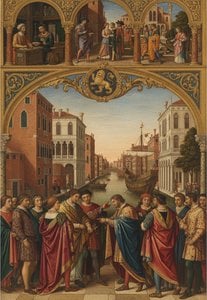
L'Architecte du Baroque Bolognais
Au cœur vibrant et intellectuel de Bologne, une ville où la tradition de la Renaissance rencontrait l'esprit bourgeonnant d'une ère nouvelle, Ludovico Carracci s'est imposé comme une force transformatrice de l'art européen. Né en 1555, sa vie fut inextricablement liée aux fondements mêmes de l'École bolognaise. Membre de l'illustre famille Carracci, aux côtés de ses cousins Annibale et Agostino, Ludovico ne s'est pas contenté de participer à un mouvement artistique ; il a aidé à concevoir la transition entre l'élégance stylisée et souvent artificielle du Maniérisme et le naturalisme profond et émotif du Baroque. Ses premières années furent façonnées par l'atelier de son père, Prospero Carracci, un cadre qui servit de creuset à l'expérimentation et de sanctuaire pour l'étude du disegno—cette observation méticuleuse de la forme et de l'anatomie qui deviendrait la marque de fabrique de son héritage.
Alors que ses cousins cherchaient souvent la gloire dans les grandes cours de Rome, Ludovico resta profondément enraciné dans sa Bologne natale. Ce lien indéfectible lui permit de cultiver un sanctuaire artistique unique, dirigeant une académie qui devint un phare pour la génération suivante de maîtres, notamment Guido Reni et Domenichino. Son œuvre représente une synthèse magistrale d'influences historiques ; il s'est nourri de la grâce divine de Raphaël, de la douce luminosité de Corrège et du riche colorisme de Titien, tout en insufflant à ces éléments classiques une vitalité nouvelle et dramatique. En rejetant les poses étirées et souvent contraintes des peintres maniéristes tardifs comme Parmigianino, Ludovico embrassa une réalité plus viscérale, utilisant des gestes audacieux et une lumière atmosphérique vacillante pour émouvoir l'âme de ses spectateurs.
Lumière, Ombre et Intensité Spirituelle
Le véritable génie de Ludovico Carracci réside dans sa capacité à manipuler le clair-obscur—ce jeu dramatique entre l'ombre et la lumière—pour en faire un vecteur de contemplation spirituelle. Ses toiles sont rarement de simples représentations d'événements bibliques ; ce sont des expériences immersives conçues pour évoquer la ferveur religieuse. Dans des œuvres telles que Un ange libère les âmes du purgatoire, on peut témoigner de la manière dont son usage de la lumière ne se contente pas d'éclairer une scène, mais participe activement à son récit, sculptant les figures hors de l'obscurité pour mettre en lumière des instants de compassion et de grâce divines. Cette technique, rappelant le naturalisme naissant de Caravage, lui permit d'insuffler aux sujets les plus sacrés une émotion humaine palpable.
Sa maîtrise s'étendait à divers médiums, de l'échelle monumentale des fresques à la précision délicate des eaux-fortes et des estampes. Qu'il capturât la sérénité sacrée de la Présentation au Temple ou la tension musculaire et héroïque de son Nu masculin (Hercule ?), un fil conducteur de profondeur émotionnelle traverse toute son œuvre. Ses peintures religieuses, comme la Madone Bargellini, démontrent une capacité à organiser des groupes complexes de saints et d'anges en compositions harmonieuses mais dynamiques, où chaque pli de draperie et chaque inclinaison de tête contribue à un sentiment plus vaste de mouvement céleste.
Un Héritage Durable dans le Canon Italien
L'importance historique de Ludovico Carracci ne peut être surestimée. Il fut une figure pivot qui a aidé à réenchanter l'art italien à une époque où celui-ci risquait de stagner sous le poids de ses propres traditions formalistes. En défendant un style privilégiant la vérité émotionnelle et l'observation naturaliste, il a fourni le modèle des accomplissements les plus célèbres de l'ère baroque. Son influence rayonna bien au-delà de Bologne, façonnant le langage esthétique d'une grande partie de l'Europe et posant les bases du naturalisme classique qui allait dominer le XVIIe siècle.
En réfléchissant à sa vie et à son œuvre, nous voyons un artiste qui a réussi à jeter un pont entre deux mondes : la perfection structurée de la Renaissance et l'énergie dramatique et théâtrale du Baroque. Sa capacité à marier la rigueur intellectuelle du disegno avec un sens profond du colore et une résonance émotionnelle assure sa place parmi les peintres les plus vitaux de son époque. Par sa dévotion à son art et son engagement envers la puissance spirituelle de la peinture, Ludovico Carracci a laissé une marque indélébile dans l'histoire de la peinture occidentale, nous rappelant que la véritable beauté réside à l'intersection de la maîtrise technique et du cœur humain.
Questions et réponses
Dans quel pays Lodovico Carracci est-il né ?
Lodovico Carracci est né(e) en Italie.
Puis-je parcourir les œuvres de Lodovico Carracci par palette de couleurs ?
La page Par palette de couleurs regroupe les œuvres de Lodovico Carracci par palette de couleurs.
Où puis-je trouver des statistiques sur les œuvres de Lodovico Carracci ?
La page Statistiques de Lodovico Carracci présente des statistiques calculées à partir des œuvres de l'artiste répertoriées sur ce site.